
GEO vs SEO - What Actually Changes
GEO is a layer within SEO, not a replacement. This guide compares geo vs seo across objectives, metrics, and priorities so you know what actually changes and wh

GEO vs SEO: what actually changes
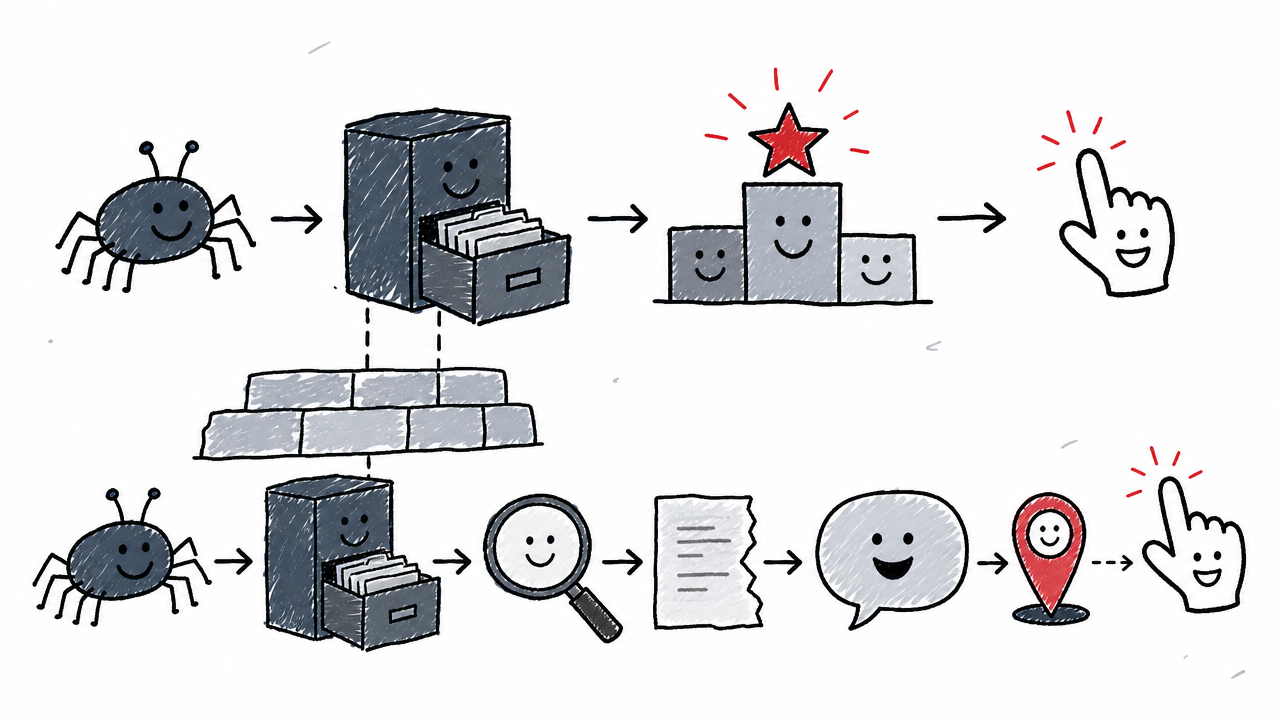
Generative engine optimization (GEO) does not replace search engine optimization (SEO). It changes the visibility event. SEO makes pages discoverable, crawlable, indexable, and competitive in ranked results. GEO adds a second question: can an AI system retrieve the page, extract a useful passage, and cite it in a generated answer? Google's own documentation confirms that its generative Search features remain rooted in core ranking and quality systems. For the full GEO definition and background, see our generative engine optimization explained guide.
Our verdict is direct: GEO is a layer within modern SEO, not a successor that makes SEO obsolete. Build the foundation first, then add the GEO layer.
Side-by-side comparison: SEO vs generative engine optimization (GEO)
The table below compares SEO and GEO across the dimensions that matter for practitioners making resource decisions. Each cell is kept short so you can scan it fast, and so AI answer surfaces can quote it cleanly.
The last row is the core argument. Everything GEO adds depends on the foundation SEO provides.

What SEO still controls
Before discussing what changes, practitioners need to absorb what does not. These basics carry equal or greater weight than any GEO tactic.
Crawlability, indexing, and technical access
A page must be crawlable and indexed before any visibility is possible, in ranked results or AI answers. Google states that a page must be indexed and eligible to appear in Search with a snippet to be considered for its AI features. No shortcut exists.
Practical results:
- A
robots.txtrule that blocks Googlebot prevents indexing and kills AI-feature eligibility. - A
noindexdirective removes the page from the index entirely. - A
nosnippettag blocks Google from showing a text snippet, so the page cannot serve as a supporting link in AI Overviews or AI Mode. - Broken internal links, redirect chains, slow server responses, and render-blocking issues reduce crawl efficiency for both conventional and generative search.
No amount of GEO effort makes up for pages a search engine cannot reach.
Search intent and useful original content
Intent match is foundational in both models. When someone types a query or writes a conversational prompt, they have a question, need, or goal. Conversational prompts make the underlying intent more explicit, not irrelevant. A page that misses the intent will not rank well, and it will not be retrieved as a useful source for a generated answer either.
Commodity summaries lose in both arenas. First-hand experience, original analysis, unique data, and primary-source citations remain competitive advantages. Google's AI optimization guide stresses valuable, non-commodity content as the editorial standard for its generative features.
Authority, trust, and site structure
Backlinks, topical depth, E-E-A-T signals, internal linking, and coherent topic coverage still determine whether a page is a credible candidate for any form of search visibility. A site with thin, disconnected pages on loosely related topics does not become authoritative just because it formatted content for AI extraction.
Keyword research remains the starting point for understanding demand and intent. Before creating content around any topic, confirm that people are searching for it and understand what they expect to find. The Keyword Research tool provides estimated volume, CPC, competition, trends, and related keywords from a seed query, helping you anchor content planning in real search demand.
What generative engine optimization adds
GEO introduces shifts in emphasis within SEO, not a separate discipline. The foundation stays the same. The visibility event, its economics, and its measurement are what differ.
From ranking a page to being used in an answer
SEO asks "Where does this page rank?" GEO asks "Is this source retrieved, understood, cited, or mentioned in a generated answer?"
Google documents retrieval-augmented generation (RAG) as its method for generating AI responses: the system retrieves relevant, up-to-date pages from its Search index and uses them to generate responses with supporting links. It also describes query fan-out, where the system issues related searches across subtopics and data sources to assemble a broader answer.
The pipeline is: retrieval → extraction → synthesis → citation. Ranking helps at the retrieval stage, but being retrieved does not guarantee being cited.
From page-level results to passage-level visibility
A conventional search result displays a page title, URL, and snippet. A generated answer may extract and synthesize a single paragraph, or even a single claim, from within a page. Self-contained, attributed passages improve extractability but do not guarantee selection.
This is the practical editorial shift: every key claim, fact, or conclusion on a page should make sense on its own if pulled out of context. The surrounding page still needs coherent structure and depth, but individual passages should be useful in isolation.
From click economics to mixed visibility economics
The user may read the AI-generated answer without visiting the source site. This is the "zero-click" concern. But the picture is more varied than "AI kills traffic."
Three distinct outcomes need separate tracking:
- Citation: A source reference (often with a clickable link) in the generated answer.
- Mention: A brand or entity is named without a link to a page.
- AI referral traffic: An actual visit from an AI platform to the source site.
Google has observed higher-quality clicks from search result pages containing AI Overviews, but this should not be generalized to all AI platforms. ChatGPT, Perplexity, Gemini, and Claude each handle source linking differently, and their behavior is less publicly documented.
From one result set to answer variability
Conventional search results fluctuate, but you can track a position for a given query on a given day. AI answers vary far more. A Search Engine Land tracking project that sampled 2,500 prompts across Google AI Mode and ChatGPT reported that 40% to 60% of cited sources changed from month to month.
This variability means a single observation proves nothing. GEO measurement requires a defined prompt set, repeated sampling at regular intervals, and records of platform, date, region, answer wording, citations, and mentions.
What people wrongly believe is new
Several myths circulate about GEO. Each one wastes time or budget when treated as fact.
Myth: GEO replaces SEO. Verdict: No. Google says its generative Search features are rooted in core Search ranking and quality systems. The foundation has not changed.
Myth: A universal GEO markup or tag exists. Verdict: Google documents no special schema for AI Overviews or AI Mode. No other platform has published a universal citation markup standard either.
Myth: llms.txt is required for AI answers. Verdict: It is a proposal with uneven adoption, not a ratified web standard or a citation guarantee. Google states that its generative features do not require special AI files or Markdown.
Myth: Ranking first guarantees an AI citation. Verdict: Ranking may help at the retrieval stage, but ranking and citation are separate events. The Aggarwal et al. GEO research (ACM SIGKDD 2024) found that content optimization methods improved visibility by up to 40% in their experimental setting, independent of conventional rank position.
Myth: A citation equals a visit. Verdict: A citation is a source reference. Referral traffic is a separate metric that must be tracked on its own. Many citations produce zero direct visits.
Myth: Structured data guarantees AI inclusion. Verdict: Standard Schema.org markup remains useful for rich results in conventional search, but no schema guarantees AI-feature selection.
How to measure SEO and GEO results
Before using any metric as a success indicator, define it. The terms below are not synonyms.
SEO metrics (established, standardized):
- Rankings: Position for a query in conventional search results.
- Impressions: How often a page appeared in search results.
- Clicks / CTR: Visits from search results and their rate against impressions.
- Organic sessions and conversions: Tracked via analytics and Search Console.
GEO metrics (emerging, less standardized):
- Citation rate: Share of tracked prompts where your page is cited (source reference, usually with a link) in the generated answer.
- Mention rate: Share of tracked prompts where your brand or entity is named, with or without a link.
- AI share of voice: Share of a controlled prompt set in which your source appears. Not yet a standardized industry metric; define your own prompt set and approach.
- AI referral traffic: Visits from AI platforms to your site. Measure separately from citations and mentions.
- Answer accuracy: Whether the generated answer correctly represents your information.
- Assisted conversions: Conversions where AI-sourced visits played a role in the journey.
How to run a GEO measurement program: Track a fixed prompt set on a repeating schedule (weekly or monthly), recording platform, date, region, answer wording, citations, and mentions. Google AI-feature traffic appears within Search Console's Web search type. Cross-platform GEO measurement is less standardized and typically requires manual sampling or specialized tools.
Where to start: priority order for practitioners
Here is a clear sequence matched to your current situation.
1. If technical SEO is broken, fix crawlability, indexing, and page experience first. No GEO effort makes up for pages a search engine cannot reach. Resolve robots.txt blocks, noindex directives, broken links, slow response times, and render issues before anything else.
2. If content is thin or generic, invest in useful, original, well-sourced content. This lifts both SEO and GEO readiness at once. Cover topics with genuine depth, original analysis, primary-source citations, and first-hand experience. Replace summaries with content that would still be worth reading even if it never appeared in an AI answer.
3. If SEO fundamentals are solid, add extractable structure and explicit attribution. This is the GEO layer. Make key facts self-contained. Identify entities, relationships, dates, and qualifications. Add source attribution within the content itself, not just in a footnote. Structure passages so they can be understood when pulled from the surrounding page.
4. If you need AI visibility data, begin sampling AI answers. Define a prompt set relevant to your topics and brand. Sample answers weekly or monthly, recording platform, date, region, answer wording, citations, mentions, and referral traffic. Add this as a reporting layer alongside existing Search Console and analytics data.
Growth Calendar can help with the shared SEO foundation across these stages: researching markets and keywords, planning content clusters, writing articles with direct-answer structures and source citations, and managing internal linking. It does not track AI citations, so pair it with a separate GEO measurement workflow when you reach stage four.
For the full strategic framework that connects these stages, see the AI search engine optimization complete guide.

How GEO relates to AEO (answer engine optimization)
Answer engine optimization (AEO) is a related but distinct term. AEO typically focuses on earning featured snippets, voice-search answers, and direct-answer placements in conventional search. GEO broadens this scope to full generative answer experiences, including AI Overviews, AI Mode, ChatGPT, Perplexity, and other AI assistants where the answer is synthesized rather than extracted from a single snippet.
The two overlap: both stress clear, concise, self-contained answers. But the measurement, platforms, and visibility economics differ. For the detailed breakdown, see our dedicated AEO vs SEO comparison.
FAQ
Is generative engine optimization (GEO) a subset of SEO or a separate discipline?
GEO is best understood as a layer within SEO. It shares SEO's foundation of crawlability, indexing, relevance, authority, and useful content, then adds attention to retrieval, extraction, citation, and AI-surface measurement. You do not need a separate team or strategy; you need a second lens on the same work.
Does SEO help with GEO?
Yes. Google documents that its AI features are rooted in core Search ranking and quality systems. A page that cannot be indexed and shown in Search with a snippet is ineligible for Google's generative features. Strong SEO is the prerequisite, not the alternative.
Does Google require special markup for AI Overviews?
No. Google states there are no technical requirements beyond standard SEO best practices. No special schema, Markdown file, or AI-specific tag is needed for its generative Search features.
Should a business invest in GEO before fixing technical SEO?
No. Crawlability, indexing, and content quality are prerequisites. Working on AI answers without a sound technical and content foundation wastes effort. Fix the foundation first, then add the GEO measurement and optimization layer.
What is the difference between a citation, a mention, and AI referral traffic?
A citation is a source reference (often with a clickable link) in a generated answer. A mention names a brand or entity without linking to a page. AI referral traffic is an actual visit from an AI platform to your site. All three are distinct outcomes and must be tracked separately.