
Generative Engine Optimization Explained - How Solopreneurs Get Cited by ChatGPT and AI Overviews
Learn what generative engine optimization is and how solopreneurs can get cited by ChatGPT, AI Overviews, and Perplexity with a practical 7-step GEO playbook.

Generative engine optimization (GEO) is the practice of making your content more likely to be retrieved, quoted, and cited inside AI-generated answers from systems like ChatGPT Search, Google AI Overviews, Perplexity, and Gemini. GEO builds on traditional SEO rather than replacing it. The core promise for solopreneurs: you can earn visibility inside synthesized AI answers without a marketing team or enterprise budget by publishing clear, evidence-backed content that these systems can trust and extract.
What is generative engine optimization (GEO)?
GEO means shaping your web content so that AI-powered search systems retrieve it, include it in generated responses, and attribute it with a visible citation or link. Traditional SEO aims for a high-ranking blue link. GEO targets inclusion inside a synthesized answer that a large language model assembles from several sources.
A useful analogy: traditional SEO is like getting your book shelved in the library where browsers can find it. GEO is like getting the librarian to read a passage from your book aloud when a visitor asks a question.
The term was formalized by Aggarwal et al. in their paper GEO: Generative Engine Optimization, published in the Proceedings of the 30th ACM SIGKDD Conference on Knowledge Discovery and Data Mining (arxiv.org/html/2311.09735v2; DOI 10.1145/3637528.3671900). The researchers introduced GEO-bench, a benchmark of 10,000 queries across diverse domains, and tested nine content optimization methods. In their experiments, adding citations, statistics, and relevant quotations to content produced visibility improvements of up to 40%. That figure represents a benchmark result under specific experimental conditions, not a universal guarantee for every website or AI platform.
The paper describes generative engines as systems that retrieve information from several sources and synthesize responses using large language models. That definition captures today's landscape: ChatGPT Search, Google AI Overviews, Google AI Mode, Perplexity, Gemini, Claude, and Microsoft Copilot all fit the description, though each uses different retrieval methods, indexes, and citation behaviors.
What does GEO stand for?
In this context, GEO stands for Generative Engine Optimization. It does not refer to geographic or location-based SEO, even though the same acronym is occasionally used for that purpose. When you see "GEO" discussed alongside ChatGPT, AI Overviews, or Perplexity, it refers to visibility inside AI-generated answers, not local search.
How is GEO different from traditional SEO?
Traditional SEO targets rankings, impressions, and clicks in a list of links. GEO targets inclusion, quotation, and attribution inside a synthesized answer that an AI system generates in response to a user's query. The two are complementary, not competing.
GEO is an umbrella covering several AI platforms, each with its own retrieval pipeline and citation logic. An approach that earns a citation in ChatGPT Search does not automatically produce a citation in Google AI Overviews or Perplexity.
Google's own documentation makes the relationship clear: there are no extra technical requirements for appearing in AI Overviews or AI Mode beyond standard SEO best practices (Google Search Central, AI Features and Your Website). Traditional SEO remains foundational. GEO layers on attention to answer extraction, source attribution, entity authority, and prompt-level measurement.
The "GEO replaces SEO" narrative is wrong. If your pages are not crawlable, not indexed, and not relevant to any query, no amount of GEO-specific tactics will get them cited.
Is GEO the same as answer engine optimization (AEO)?
Not quite. Answer engine optimization (AEO) predates the current generation of LLM-powered search. AEO traditionally focused on earning featured snippets, knowledge panels, and direct answers in conventional search engines. GEO extends that concept to AI systems that synthesize multi-source answers using large language models, where the response is generated rather than extracted from a single snippet. The two overlap in their emphasis on clear, direct answers, but GEO also accounts for citation behavior, multi-platform retrieval, and the unique challenges of attribution inside generated text.
How AI search engines choose which websites to cite
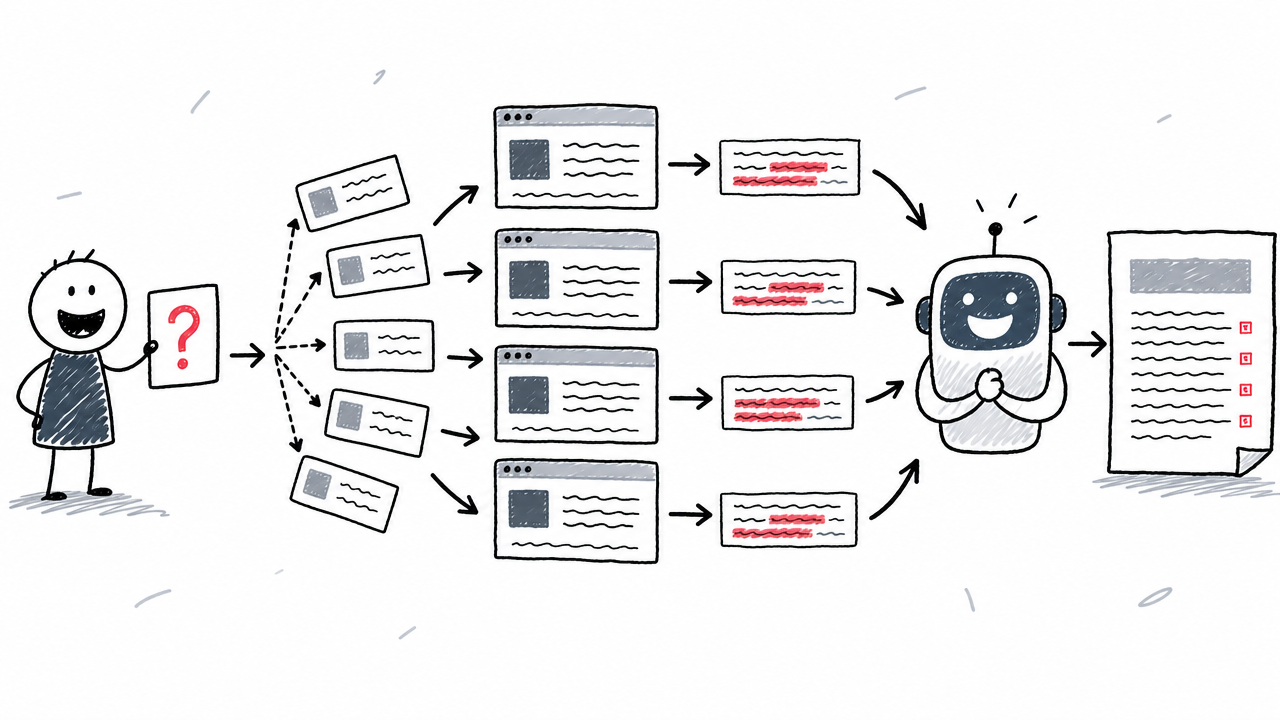
AI search systems use a process called retrieval-augmented generation (RAG), sometimes referred to as grounding. The AI retrieves web pages to improve the accuracy and freshness of its generated response, rather than relying solely on what it learned during training. Google describes this process in its optimization guide: retrieved web pages help improve the accuracy and freshness of generated responses (Google Search Central, AI Optimization Guide).
A key detail: AI features often use query fan-out. Instead of running one search, the system may run several related searches across subtopics and data sources to assemble a thorough answer (Google Search Central, AI Features). This means your page might be retrieved for a sub-question you did not target on purpose.
The retrieval-to-citation framework (7 steps)
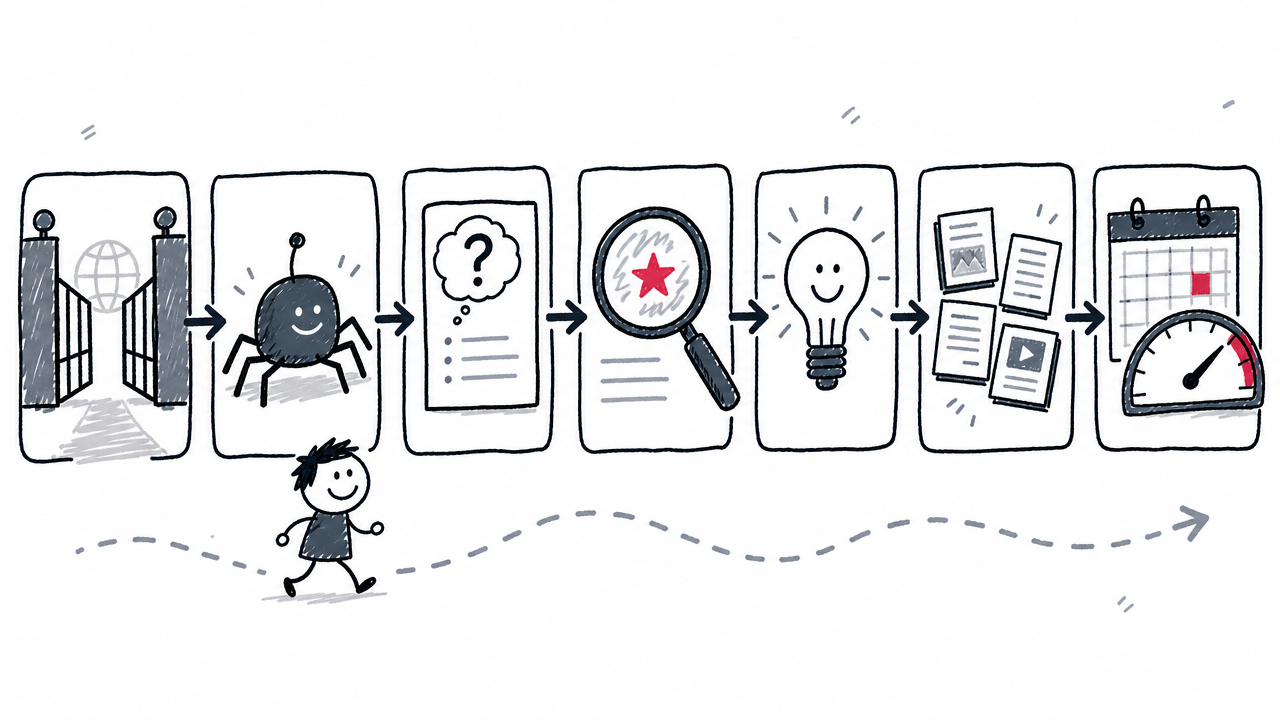
This framework breaks the AI citation process into stages a solopreneur can use as both a mental model and a diagnostic checklist.
- Access: Can the AI platform's crawler reach your page? If your
robots.txtblocks OAI-SearchBot or Googlebot, the system cannot retrieve your content. - Eligibility: Is the page indexed, accessible, and permitted to appear with a snippet? For Google AI features, a page must be indexed and eligible to appear in Search with a snippet.
- Relevance: Does the page answer the user's question? The AI system judges topical match, just as traditional search does.
- Extractability: Is there a clear, self-contained passage the system can quote? Vague, rambling text is harder for an AI to pull a useful answer from.
- Trust: Are the claims backed by credible evidence and consistent external signals? Verifiable data, named sources, and entity authority matter.
- Attribution: Does the final generated answer link to or cite your page? This is the outcome you want, but it depends on the model's behavior, not just your work.
- Measurement: Can you observe whether your visibility changed? Without monitoring, you are working blind.
You cannot control every stage directly. Attribution is an outcome of the system's behavior. But stages 1 through 5 are where your effort pays off, and stage 7 is how you know whether it works.
A solopreneur's step-by-step GEO playbook
This is the practical core. Seven actionable steps, organized around the retrieval-to-citation framework above, scoped for a one-person business with limited budget and time.
Step 1: Keep your pages eligible and crawlable
A page that is not indexed cannot be cited. Start here.
Confirm indexability in Google Search Console. Check the URL Inspection tool for any page you want AI systems to find. Look for noindex tags you may have set by accident.
Make important content available in server-rendered HTML text, not locked inside JavaScript widgets, images, or iframes that crawlers cannot parse. Google's AI features page states that a page must be indexed and eligible to appear with a snippet to qualify as a supporting link (Google Search Central, AI Features).
Do not block Googlebot via robots.txt by accident. Check your hosting provider's default settings, especially if you use a CDN or firewall that might challenge bot traffic. Use internal links to help crawlers discover your most important pages.
Step 2: Understand and manage AI crawler access
Different AI platforms use different crawlers, and you can control access to each one on its own.
OpenAI documents three distinct bots (OpenAI Crawler Overview):
- OAI-SearchBot: Powers ChatGPT Search. Allowing it lets your site appear in ChatGPT Search answers.
- GPTBot: Crawls content that may be used to train OpenAI's foundation models.
- ChatGPT-User: A user-initiated fetcher, distinct from automatic crawling.
You can allow OAI-SearchBot while disallowing GPTBot. The settings are independent. This lets your site appear in search results without contributing to model training, if that is your preference.
OpenAI states that robots.txt changes can take about 24 hours to propagate (OpenAI Crawler Overview). And a critical reminder: allowing a crawler does not guarantee a citation. OpenAI states there is no way to guarantee top placement (OpenAI Help Center, ChatGPT Search).
For Google AI features, standard Googlebot access is enough. If you want finer control over how Google uses your content in AI features, you can use nosnippet, data-nosnippet, or max-snippet directives (Google Search Central, AI Features). Be aware that more restrictive settings reduce your visibility.
Step 3: Answer one real question clearly
Match each page to a specific audience problem. What is the one question this page answers better than any other source?
Put the direct answer near the top of the page. Do not bury it under three paragraphs of context. An AI system looking for an extractable passage needs to find a clear, self-contained statement it can use.
Use descriptive headings and logically organized sections. Each section should make sense on its own, because AI retrieval may pull a single passage rather than reading your entire page.
Avoid creating dozens of thin pages for minor query variations. Google warns that this approach can trigger scaled content abuse policies (Google Search Central, AI Optimization Guide). One thorough page that covers a topic well beats ten shallow pages that each add nothing new.
Step 4: Make every claim verifiable
Vague statements like "many experts agree" or "studies show" give an AI system nothing to anchor on. Specific claims are more extractable and more trustworthy.
Use specific figures, dates, and named sources. Instead of "SEO traffic increased a lot," write "organic sessions grew 34% between March and June 2026, measured in Google Analytics."
Cite original studies, official documentation, or primary sources. Include publication dates for time-sensitive claims so both readers and AI systems can assess currency.
The Aggarwal et al. GEO study found that adding citations, statistics, and quotations to content produced over 40% visibility gains in their benchmark experiments (Aggarwal et al.). That is an experimental signal from a specific benchmark, yet the direction is consistent: verifiable, evidence-backed content gets cited more often.
Step 5: Add what competitors cannot easily copy
This is the solopreneur's genuine advantage.
Google's optimization guide specifically distinguishes first-hand reviews and original expertise from summaries that merely repeat existing information (Google Search Central, AI Optimization Guide). AI systems have no shortage of generic summaries to retrieve. What they need are credible, specific sources that add something new.
Where you can contribute original value:
- First-hand experience with a product, workflow, or industry
- Original data from your own business or experiments
- Real product tests with a transparent process
- Unique customer stories or case studies
- Niche expertise that large publications do not cover
A solopreneur who publishes an honest, detailed comparison of two tools they used is more citable than a listicle that paraphrases vendor marketing pages.
Step 6: Build external corroboration
Entity authority and brand mentions strengthen the trust signals that AI systems weigh when deciding which sources to cite.
Earn mentions from credible publications, communities, and industry sources. This could mean contributing guest posts to reputable blogs, being quoted in relevant podcasts, taking part in community forums where your expertise is visible, or getting covered by niche industry outlets.
Do not manipulate Wikipedia, review platforms, or social media. The goal is genuine reputation-building over time. When credible external sources mention your brand or cite your work, AI systems have stronger signals that you are a trustworthy source on your topic.
This is a long game. But for solopreneurs in a specific niche, becoming the go-to expert on a narrow topic is achievable and compounds over time.
Step 7: Measure a fixed prompt set monthly
You cannot improve what you do not measure, and AI citation visibility is not tracked by any standard analytics tool by default.
Choose 10 to 20 questions your ideal customer would ask an AI assistant. These should be questions where your content is a credible answer.
Test monthly across at least three platforms: ChatGPT Search, Google AI Overviews or AI Mode, and one more system (Perplexity, Gemini, or Copilot).
For each test, record:
- Date
- Platform
- Exact prompt used
- Sources cited in the response
- Whether your brand or URL was mentioned
- Which competitors appeared instead
- Sentiment of any brand mention
- Any notable changes from the previous month
A simple spreadsheet is enough. Compare which pages are cited instead of yours and find the content gap. If a competitor's page is getting cited for a question you should own, read that page and ask what it provides that yours does not.
Does structured data help you appear in AI answers?
Structured data helps search systems understand your page content, but it is not a magic lever for AI citations. Use it where it genuinely reflects your visible content; do not treat it as a guaranteed shortcut.
Google's guidance on AI-assisted content states that structured data should match visible content and follow feature-specific policies (Google Search Central, AI-Assisted Content Guidance). Marking up an FAQ in JSON-LD when there is no visible FAQ section on the page violates that principle.
No source found in this research supports a guaranteed benefit from FAQPage schema for earning AI citations. The claim that "FAQ schema gets you cited by ChatGPT" circulates in marketing communities, but it lacks verifiable evidence.
Practical recommendation: use structured data where it genuinely fits (Article, HowTo, FAQPage if you have a visible FAQ section, Product schema if you sell products). Add it accurately using Schema.org vocabulary in JSON-LD format. Then focus your effort on the steps with stronger evidence behind them: clear answers, verifiable claims, original expertise, and consistent measurement.
Should solopreneurs use AI-generated content for GEO?
AI is a useful writing assistant, but it cannot replace original expertise. Here is how to use it well.
AI can help with research, outlining, drafting, and editing. It speeds up the writing process. But Google warns against producing many pages without adding value, noting this may violate scaled content abuse policies (Google Search Central, AI-Assisted Content Guidance).
The defensible approach:
- Use AI to research topics and structure outlines.
- Draft with AI help.
- Add your own original experience, evidence, examples, and editorial judgment.
- Review for accuracy, especially any statistics or claims the AI generated.
- Publish content that a reader could not get by prompting the same AI themselves.
Google also notes that publishers may provide context about how content was created when automation is used (Google Search Central, AI-Assisted Content Guidance). Transparency does not hurt.
For a deeper look at tools that can support this workflow, see AI SEO Tools for Solopreneurs: The Complete Buyer's Guide.
Measuring the business value of AI citations
Citation visibility matters only if it leads to real business results. A citation that generates no traffic, no signups, and no revenue is a vanity metric.
Track referral traffic from ChatGPT where your analytics supports it. ChatGPT Search provides clickable source links, so referral visits are measurable.
For Google AI features, traffic is included in the Search Console Performance report under the Web search type (Google Search Central, AI Features). Google has observed that clicks from search results pages with AI Overviews tend to be higher quality, with users spending more time on the site (Google Search Central Blog).
What to track beyond citations:
- Referral traffic from AI search platforms
- Signups, leads, or sales tied to AI-referred sessions
- Engagement metrics such as time on site and pages per session
- Assisted conversions where an AI citation was part of the user's path to buying
Treat citation share as a leading indicator. Revenue and conversions are the trailing indicators that tell you whether GEO effort is paying off.
Keeping up with GEO as a one-person operation
The operational burden is real. A solopreneur handling GEO needs to research customer questions, plan topic clusters, draft and edit content, publish on a steady schedule, track AI citations, and improve underperforming pages, all while running the rest of the business.
This is where an integrated workflow becomes valuable. Growth Calendar, for example, combines topic research, cluster design, content creation, and publishing calendar management in a single platform, reducing the need to juggle separate keyword research tools, writing apps, and scheduling systems. For a solopreneur, that consolidation can save hours each week. (Verify current capabilities on the product page before relying on any specific feature.)
No tool can guarantee AI citations. But a consistent publishing workflow increases the surface area of content eligible for citation. The more high-quality, specific, evidence-backed pages you have addressing real customer questions, the more chances AI systems have to retrieve and cite you.
For a broader comparison of tools that support this workflow, see AI SEO Tools for Solopreneurs: The Complete Buyer's Guide.
What GEO cannot guarantee
Honest limitations matter. Here is what no one can promise you.
AI-generated answers change by platform, prompt, location, date, model version, and user context. The same prompt tested five minutes apart can produce different citations. OpenAI states that there is no way to guarantee top placement in ChatGPT Search (OpenAI Help Center).
Vendor claims about exact citation rates, required word counts, fixed benefits from specific schema types, or guaranteed timeframes deserve skepticism unless the sample size, process, and platform coverage are transparent and independently verifiable.
A citation is an outcome of the system's behavior, not a controllable ranking position. You can shape the inputs (crawlability, content quality, verifiability, authority), but you cannot control the output with certainty.
The Aggarwal et al. results are domain- and query-dependent. The researchers themselves emphasize that effectiveness varies. A 40% visibility improvement on a GEO-bench query set does not mean your specific page will see a 40% lift on any specific AI platform.
The best GEO strategy is also the best content strategy: publish genuinely useful, well-sourced content that serves real people. The citations follow the quality, not the other way around.
FAQ
Can a page be cited by AI search engines without ranking first in Google?
Yes. For Google AI Overviews, the page must be indexed and eligible to appear with a snippet, but it does not need a #1 blue-link ranking. Google AI features use query fan-out across subtopics, so a page ranking for a related query can be retrieved. ChatGPT Search uses its own retrieval system entirely. General findability and authority still help across all platforms, but a top-10 Google ranking is not a strict prerequisite.
Do I need to allow AI crawlers in robots.txt?
For ChatGPT Search, allowing OAI-SearchBot is recommended. Blocking it can prevent your site from appearing in ChatGPT Search answers (OpenAI Crawler Overview). For Google AI features, standard Googlebot access is enough. You can allow search crawlers (OAI-SearchBot, Googlebot) while blocking training crawlers (GPTBot) since the settings are independent.
Does appearing in an AI answer generate website traffic?
It can, but volume varies by platform and query. Google has noted that clicks from AI Overview results tend to show higher engagement, with users spending more time on site (Google Search Central Blog). ChatGPT Search provides clickable source links. Track referral traffic and conversions rather than assuming every citation equals a visit.
How often should I check whether my pages are being cited?
Monthly is a practical cadence for most solopreneurs. Use a fixed set of 10 to 20 prompts tested across at least two AI search platforms. Record results in a simple spreadsheet and look for trends over time rather than reacting to single-session swings. AI answers are inherently variable, so a pattern over three to six months is more meaningful than any one test.
Does Google require a special GEO markup or an llms.txt file?
No. Google states there are no extra technical needs beyond standard SEO practices for appearing in AI Overviews or AI Mode (Google Search Central, AI Features). The llms.txt convention is a community proposal, not a Google rule or an industry standard. Focus on indexability, accurate structured data that matches visible content, and high-quality, people-first content.