
AEO vs SEO - Answer Engine Optimization Compared
AEO vs SEO compared side by side: what each label means, where they overlap, how GEO fits in, and which to prioritize based on your business situation.

Answer Engine Optimization (AEO) is not a replacement for Search Engine Optimization (SEO). SEO makes a page discoverable, indexable, and rankable. AEO adds a layer focused on whether a specific answer can be extracted, presented, and attributed in AI-generated responses, featured snippets, and voice results. The underlying work overlaps, but the visibility unit and the measurement lens differ. Here is how the two compare, when each label is useful, and where Generative Engine Optimization (GEO) fits in.
AEO vs SEO at a glance
The table below captures practical emphasis, not wholly separate ranking systems. Google's own AI optimization guide states that its generative Search features remain rooted in core Search ranking and quality systems. That means the SEO column is not "old" and the AEO column is not "new." They describe different lenses on overlapping work.
How to read this table: Each dimension reflects a real choice marketers face: what are you trying to achieve, what does success look like, and how do you report it? The dimensions are not mutually exclusive. A single page can serve both columns well.

What does AEO stand for?
Answer Engine Optimization is the full form. It describes the practice of making content eligible to appear as a direct answer, cited source, or attributed passage in answer-oriented surfaces: Google AI Overviews, Google AI Mode, featured snippets, People Also Ask boxes, voice assistants, and third-party AI products such as ChatGPT, Perplexity, Gemini, Claude, and Copilot.
The market also uses GEO (Generative Engine Optimization), LLM SEO, LLMO, and AI SEO as overlapping labels. None of these is a formally standardized discipline. They describe different emphases within the same shifting landscape. For the full terminology map and how these labels relate to one another, see the AI Search Engine Optimization: The Complete Guide hub.
A note on search data: The bare term "AEO" is dominated by unrelated retail brand searches (American Eagle Outfitters). This article targets the explicit phrase "answer engine optimization" and the comparison query "aeo vs seo" (1,900 monthly searches, DataForSEO, en-US, August 6, 2026).
What SEO still controls
SEO provides the entire foundation that AEO depends on. Without it, there is no page for an answer engine to extract from. Google's SEO Starter Guide defines SEO as helping search engines understand content and helping users find and decide whether to visit a site. That definition has not been replaced; it has expanded to cover more surfaces.
Here is what SEO governs and AEO does not:
- Crawlability and indexability. If Googlebot or another crawler cannot reach and parse a page, no answer system will use it. Sitemaps, internal linking, canonical tags, and server accessibility remain prerequisites.
- Relevance and intent satisfaction. Matching user intent with useful, original content is still how a page earns visibility. Google's helpful content guidance rewards first-hand expertise, depth, and people-first quality.
- Authority and E-E-A-T. Experience, expertise, authoritativeness, and trustworthiness are qualities Google's systems seek to identify. These apply to conventional rankings and to source selection for AI features alike.
- Technical accessibility. Structured HTML, mobile usability, page speed, clean JavaScript rendering, and proper HTTP status codes are SEO concerns. They do not change because of AEO.
Google's AI features documentation states that a page must be indexed and eligible to appear with a Search snippet. There are no added technical requirements for appearing as a supporting link in AI Overviews or AI Mode. Standard SEO eligibility is the entry ticket.
How answer engine optimization differs from SEO in practice
The practical gaps between SEO and AEO center on three areas: what counts as visibility, how content is evaluated for extraction, and how you report success.
The visibility unit changes
In conventional SEO, the primary unit of success is a page appearing in a ranked position and earning a click. In AEO, the unit shifts to whether an answer system selects, presents, or attributes a passage from your content. These are distinct outcomes, and the terms deserve precision:
- Citation: The answer links to or attributes information to your page as a source.
- Mention: Your brand or entity appears in the answer without a source link back to your page.
- Visibility: Your brand or page appears in an answer experience, whether cited, mentioned, or summarized.
- Referral traffic: A measurable visit arriving from an AI or search interface to your site.
These categories matter because "appearing in an AI answer" can mean a linked citation (which may drive traffic), an unlinked mention (which builds awareness but not visits), or paraphrased information with no attribution at all. Measuring AEO requires knowing which of these you are tracking.
Content emphasis shifts toward extractability
AEO places extra weight on whether a passage can be cleanly extracted and presented. This means:
- Directness: Leading sections with a self-contained answer rather than burying the conclusion.
- Answer clarity: Stating claims, definitions, and comparisons in plain language that can be quoted without surrounding context.
- Entity clarity: Identifying who, what, and where without ambiguity so that a retrieval system can match your content to the right query.
- Source attribution: Citing your own sources so that an AI system can assess the reliability chain.
Google's AI optimization guide warns against breaking content into tiny chunks or adding unnecessary AI-specific files. The goal is not mechanical formatting. Write content that answers the question well enough for both a human reader and an extraction system to find the answer quickly.
Measurement requires new reporting
Traditional SEO reporting relies on rankings, impressions, clicks, click-through rate, organic sessions, and conversions. AEO adds answer-level metrics:
Google Search Console introduced generative AI performance reports in June 2026, providing impressions, pages, countries, devices, and dates for generative AI surfaces. At the time of the announcement, these reports were rolling out to a subset of websites. Check your own Search Console account for current availability.

Is AEO replacing SEO?
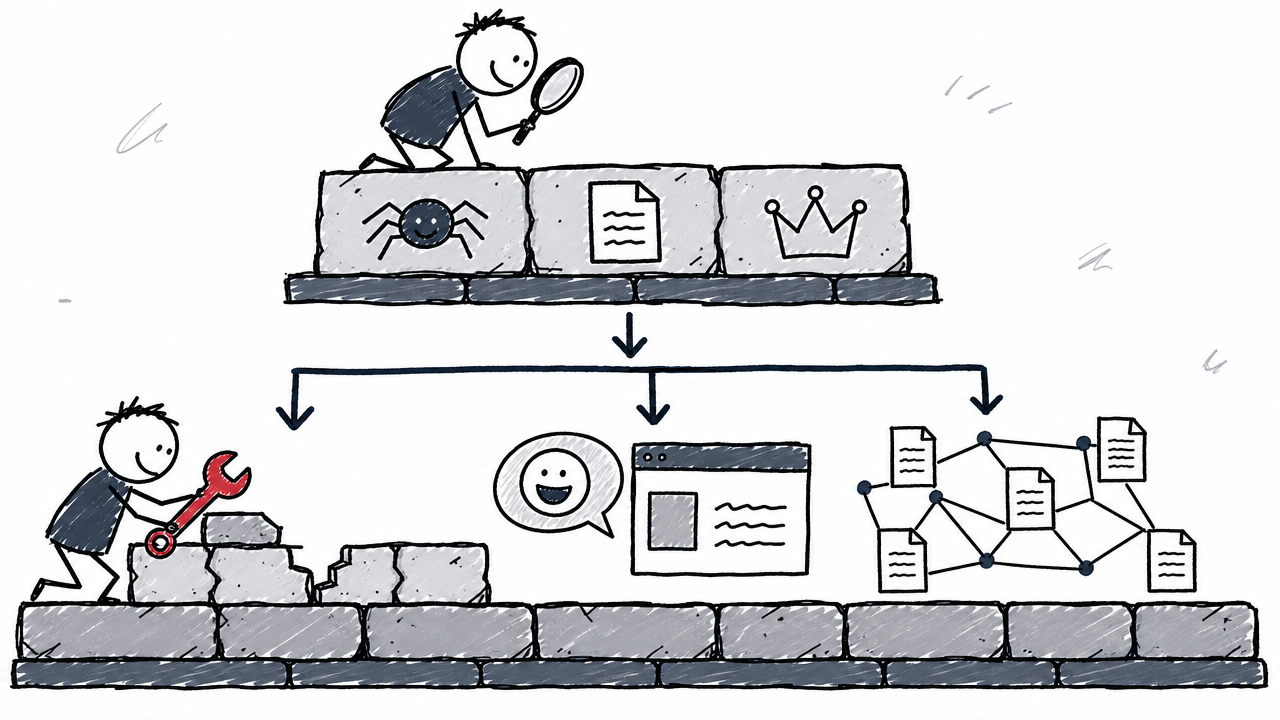
No. SEO remains the foundation. Without indexability, relevance, authority, and useful content, there is no reliable path to answer visibility. Every answer system needs a source, and sources are discovered, evaluated, and maintained through SEO work.
Google's AI optimization guide says that generative AI features are rooted in core Search ranking and quality systems. Its helpful content guidance still rewards original information, first-hand expertise, and people-first content. None of this has been superseded.
AEO is a lens, not a system. It asks one more question of your content: "Is this answer easy for a machine to find, extract, present, and attribute?" That question sits on top of SEO, not beside it.
Be cautious if a vendor pitches "AEO" as a mysterious second campaign with its own budget, separate from your SEO program. Ask what concrete work is being done, what measurement is in place, and whether the deliverables are transferable. If the answer is vague, you are likely paying twice for the same discipline under a new label.
SEO vs GEO vs AEO: the three-way comparison
The query "seo vs geo vs aeo" (320 monthly searches, DataForSEO, en-US, August 6, 2026) reflects real confusion about where one label ends and another begins. These are overlapping market terms that emphasize different goals, not formally standardized disciplines with fixed boundaries.
How to distinguish the three labels
Is GEO the same as AEO?
They overlap, but they are not identical. AEO is the narrower frame: it asks whether your content is selected as the answer to a specific question. GEO is the broader frame: it asks how your brand, expertise, and narrative appear across the full range of generative AI outputs, even when no single question triggers your content.
Neither term is formally standardized. In practice, a content team may do AEO work (writing clear, extractable answers) and GEO work (building entity authority across sources that LLMs consume) on the same page. The label matters less than the work and the measurement.
For a deeper comparison of GEO and traditional SEO, see the Generative Engine Optimization vs SEO comparison.
Which should you prioritize?
The right emphasis depends on your business situation. Here is a verdict per scenario rather than a single winner:
1. Most businesses: start with SEO fundamentals, then layer AEO. If your site has crawlability issues, thin content, poor internal linking, or weak authority, fix those first. No amount of "answer optimization" compensates for pages that search engines cannot find or trust. Once the foundation is solid, apply AEO thinking to your highest-value question-driven content.
2. Brands competing for direct answers, voice results, or featured snippets: AEO emphasis pays off. If your audience asks specific questions ("What is the difference between…," "How much does…," "Which is better…"), AEO directly addresses whether you win those answer slots. Focus on clear, extractable answers on pages that already rank or are building authority.
3. Brands concerned with reputation and narrative in AI outputs: GEO is the better frame. If your concern is how ChatGPT, Gemini, or Perplexity describes your brand, your category, or your competitive positioning, GEO covers the broader territory. This involves entity authority, source diversity, and narrative consistency across the web, applied across many queries and surfaces.
4. All cases: do not treat the labels as separate silos. A strong page can support conventional rankings, featured snippets, Google AI features, and third-party AI answers at the same time. The distinction is about the target surface, the unit of visibility, and the reporting, not a wholly separate content or technical discipline.
For step-by-step implementation of answer engine optimization, see the Answer Engine Optimization practical guide.
What AEO is not
Several misconceptions circulate in the market. Clearing them up saves time and budget:
AEO does not always mean zero clicks. AI answers frequently include source links. Google AI Overviews and AI Mode surface supporting links, and users do click through. "Zero-click" is a possible outcome, not the defining feature of AEO.
FAQ schema does not guarantee AI Overview inclusion. Structured data such as FAQPage markup serves ordinary rich-result eligibility. No evidence supports the claim that it raises the likelihood of appearing in AI-generated answers.
Fixed 30–60 word answer blocks are not a documented rule. Google's AI optimization guide warns against breaking content into tiny chunks. Write with clarity and lead with answers because it helps readers, not because a specific word count triggers extraction.
llms.txtis a proposal, not a ratified standard. The format, described at llmstxt.org, proposes a root-level Markdown file for AI agents. Adoption is uneven, and publishing the file does not establish crawler support, inclusion, or citation. Do not treat it as an AEO requirement.AEO is not a separate technical system. It does not have its own crawling, indexing, or ranking infrastructure independent of search engines. It is a set of priorities applied to content that is already discoverable through SEO.
FAQ
Do I need both AEO and SEO?
Yes. SEO provides the foundation: crawlability, indexing, relevance, and authority. AEO adds answer-level visibility on top of that foundation. They are not competing strategies. Treat AEO as a specialized lens within your SEO program, not a parallel campaign.
Does SEO help AEO?
Directly. Indexed, authoritative, well-structured pages are the primary pool from which answer engines extract responses. Google's AI features documentation states that a page must be indexed and snippet-eligible to appear as a supporting link. Strong SEO is the prerequisite, not the competitor.
Can a page rank well for SEO but fail to appear as an answer?
Yes. Ranking signals and answer-extraction suitability overlap but are not identical. A page may earn a top-five position for a query without having a passage that is direct and extractable enough for a featured snippet or AI Overview. The reverse also happens: a page that answers a question exceptionally well may appear in an AI answer even from a lower ranking position.
Does AEO require special schema markup?
Google states there are no added technical requirements for AI Overviews or AI Mode beyond being indexed and snippet-eligible. Use structured data (Article, FAQPage, HowTo) where it serves ordinary SEO and rich-result eligibility, not as an AEO-specific tactic.
How do you measure AEO success?
Track answer visibility, citations, AI referrals, and assisted conversions alongside traditional SEO metrics. Google Search Console's generative AI performance reports, announced in June 2026, are an emerging measurement surface for Google. For third-party AI platforms, measurement currently relies on manual monitoring or specialized tracking tools, as standardized reporting does not yet exist across platforms.