
Best GEO Tools 2026
This guide separates GEO tools into production and monitoring categories, covering Frase, OtterlyAI, AirOps, Profound, and more with pricing, limitations, and t

Best generative engine optimization (GEO) tools 2026
Generative engine optimization tools split into two categories: production tools that help create content AI systems are more likely to cite, and monitoring tools that track whether AI answers mention or cite your brand. For page-level production, Frase is the strongest choice. For practical AI citation monitoring, OtterlyAI offers the best entry point for most teams. No tool in either category can guarantee citation: results vary by platform, prompt, model, and session.
Why this list separates production tools from monitoring tools
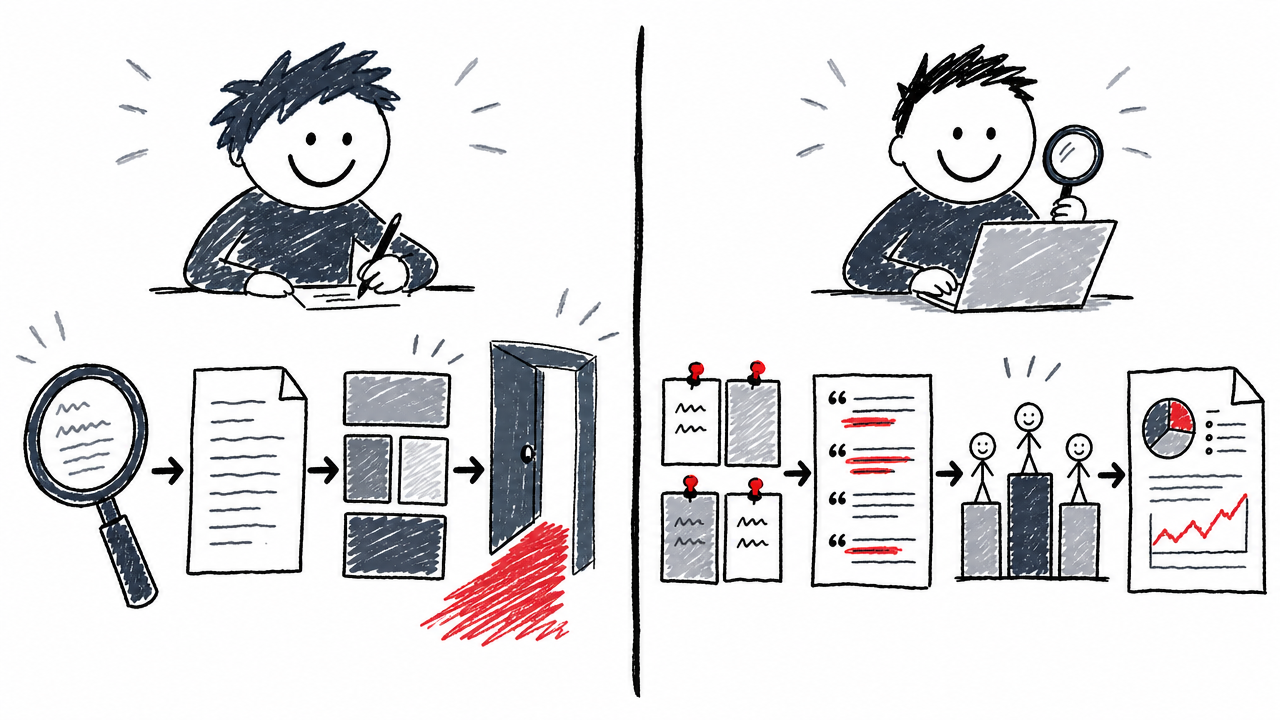
These two jobs are different, and buying the wrong tool wastes budget. Production tools help you research, plan, structure, and publish content that is easier for AI systems to retrieve and cite. Monitoring tools measure whether AI answers mention your brand, cite your pages, or favor competitors for tracked prompts.
Most competing roundups blend these jobs into a single list. A content editor that scores "GEO readiness" does not tell you whether ChatGPT cited your page last Tuesday. A citation tracker that shows you lost share of voice on a prompt cluster does not write better content for you. Each entry below is labeled Production or Monitoring so you can match the tool to the job you need.
For a deeper look at how generative engine optimization, answer engine optimization (AEO), and traditional SEO relate to each other, see AI Search Engine Optimization: The Complete Guide.
What GEO tools measure: key terms defined
Before comparing tools, pin down these terms. Vendors use them loosely; this article does not.
Monitoring data is not ground truth. Results vary by prompt set, model, platform, country, date, session context, and sampling method. Peec AI's metrics documentation provides the clearest definitions among the tools reviewed. And as Google's AI optimization guide confirms, Google's generative features remain rooted in core Search ranking and quality systems, so SEO fundamentals still apply.
Comparison table: every tool at a glance
Scan the table to find your category, then read the detailed section below.
Best production-side GEO tools
These tools help create, structure, and publish content so AI systems are more likely to retrieve and cite it.
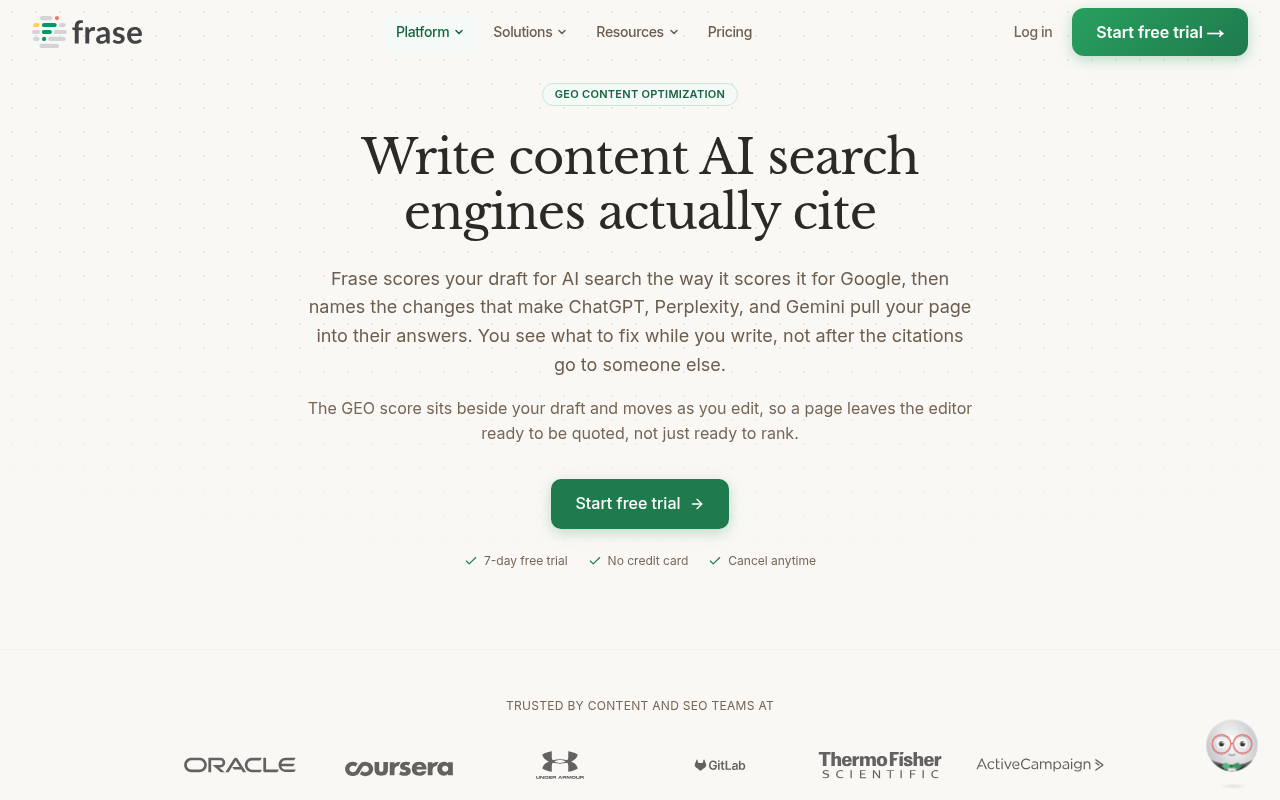
1. Frase, best for page-level GEO optimization
Frase is the strongest production-side GEO tool for teams that want actionable, item-level guidance while writing or editing individual pages. It provides a GEO score alongside a traditional SEO score, with specific recommendations for direct-answer formatting, entity coverage, evidence inclusion, and definition structure.
You can import a live page, see exactly where it falls short on GEO readiness, and fix issues inside the same editor. That tight loop between analysis and action is what sets Frase apart from tools that only report numbers.
Best for: Content and SEO teams that improve individual pages for generative-search citability.
Standout trait: Actionable, item-level GEO guidance embedded in the writing workflow, not separated into a dashboard you visit after publishing.
Limitation: The GEO score estimates readiness. It does not prove that ChatGPT, Perplexity, or Google AI Overviews will cite the page. Teams that only need monitoring should skip to the monitoring section.
Pricing: Plans start at $39/month billed yearly, with a seven-day trial.
Who should not buy it: Teams that already have a content production workflow and only need citation tracking. Buyers wanting a free, full-scale monitoring platform. Organizations needing enterprise-wide content operations rather than page-level guidance.
2. Growth Calendar, best for building a complete content program
Growth Calendar wins for solo creators and small teams that need to build a full content program from research through publishing, with structures designed for AI retrieval. It covers market research, competitor analysis, keyword research, strategic article-cluster planning, scheduled writing, review workflows, internal linking, direct-answer structures, and authoritative source citations. It publishes to WordPress, Ghost, Shopify, and Notion.
Best for: Solo creators and small teams building a content program from scratch, designed for both search engines and AI retrieval.
Standout trait: Covers the entire production lifecycle in one calendar, with built-in direct-answer structures and source citations that support citability.
Limitation: Growth Calendar does not monitor AI-answer citations. If your primary need is measuring whether ChatGPT or Perplexity cited you, you need a monitoring tool.
Pricing: Starter plan at $29/month.
Who should not buy it: Teams whose sole need is citation monitoring. Enterprises requiring scaled workflow governance with agent execution.
3. AirOps, best for enterprise content operations
AirOps is the right choice for large teams running scaled content programs that need workflow automation, governance, and agent execution. It provides research, creation, and refresh workflows, a Brand Kit for voice consistency, human review gates, and the Quill agent that executes approved strategies. AirOps Insights connects visibility signals to content actions at scale.
Best for: Enterprise content teams needing end-to-end workflow automation with brand governance.
Standout trait: Connects AI visibility data to content production actions across creation, refresh, and offsite workflows.
Limitation: Operationally complex and overkill for a small team. Pricing is not publicly listed in current sources. Customer outcome claims on the AirOps platform page are vendor-reported; treat them as such.
Who should not buy it: Solo marketers, small teams, or anyone who just needs a page-level GEO editor.
4. Writesonic, best for an integrated content and GEO action center
Writesonic offers GEO analysis for existing articles, landing pages, and documentation, with issue categories mapped to fixable content elements. Categories include schema gaps, title-content alignment, missing FAQs, comparison tables, freshness signals, and author credentials. It also includes citation tracking within the same workflow, making it the closest to a single-interface production-plus-monitoring tool.
Best for: Teams wanting production work and basic monitoring in one interface.
Standout trait: Issue-level GEO audit categories that translate directly to editorial action items, organized by GEO projects scoped by site, market, topics, and competitors.
Limitation: Verify current pricing on the Writesonic documentation before purchasing. The vendor's cited 60–70% citation-rate improvement has not been independently established for all users.
Who should not buy it: Teams needing only deep enterprise monitoring without a content editor. Users satisfied with a simpler, cheaper page-level tool like Frase.
Supporting production utilities
These are not full GEO platforms but serve specific production tasks well.
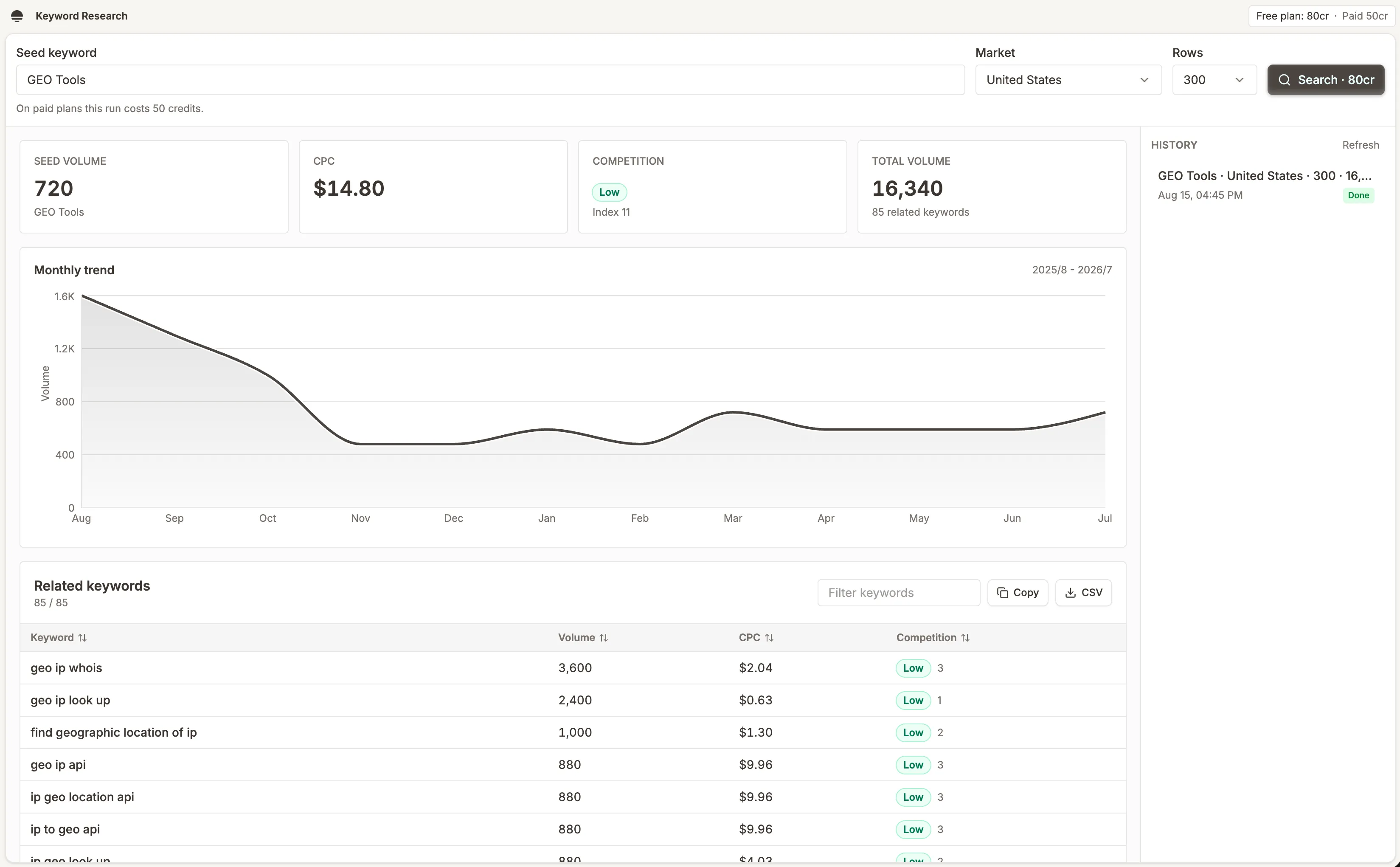
Timothe Keyword Research, keyword and SERP research
A keyword research tool that provides estimated volume, CPC, competition scores, trend data, related keywords, and organic Google results for any seed keyword, with country-market selection and CSV export. Use it to build prompt-aware keyword lists and content briefs before moving into a production platform like Frase or Growth Calendar.
Limitation: This is a keyword research tool. It does not monitor AI-answer citations.
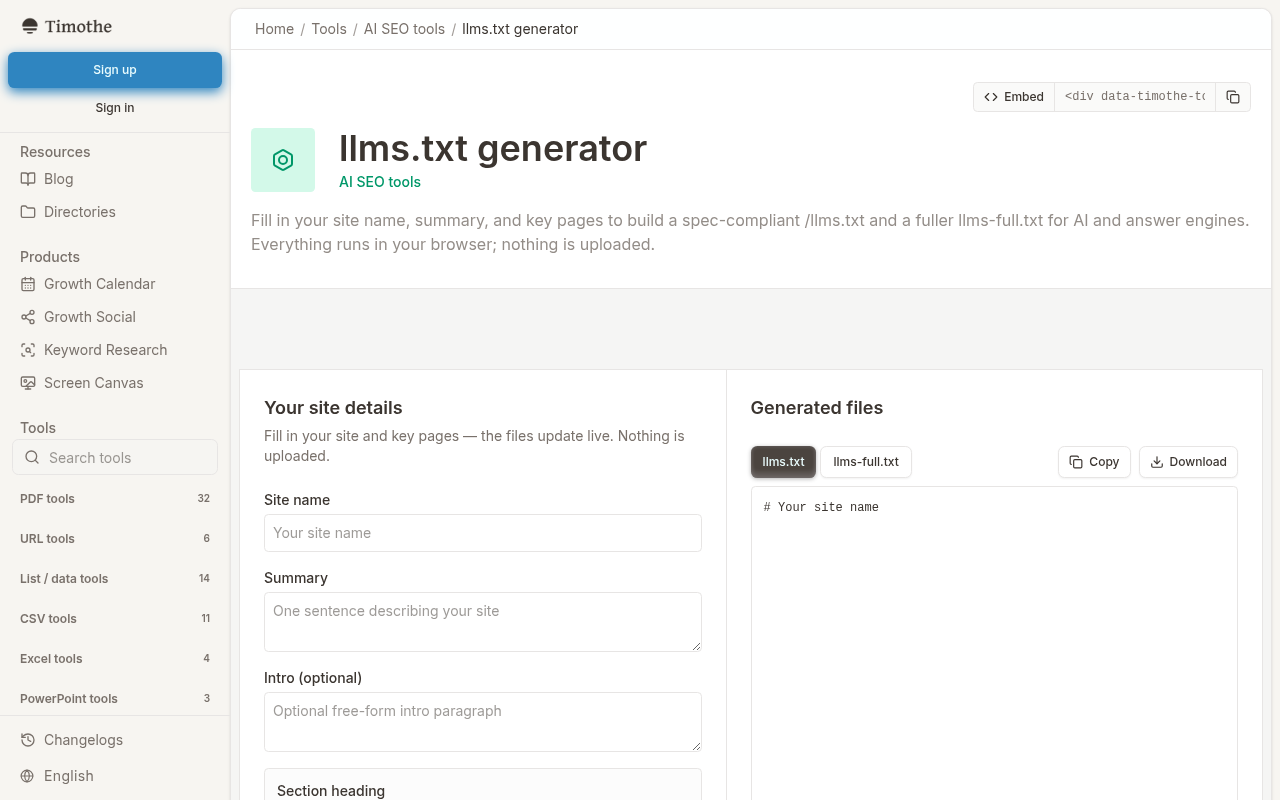
Timothe llms.txt Generator, free llms.txt file builder
A browser-based tool that generates llms.txt and llms-full.txt from your site details and key-page links. Inputs remain in the browser and are not uploaded.
Use it when you want to publish an llms.txt file quickly as part of your site's information architecture. Do not treat it as a required GEO tactic. The llms.txt proposal is just that: a proposal with uneven adoption, not a ratified standard, crawler directive, or citation guarantee.
Best monitoring-side GEO tools
These tools track whether AI answers mention, cite, or link to your brand and your competitors.
1. OtterlyAI, best overall monitoring tool for most teams
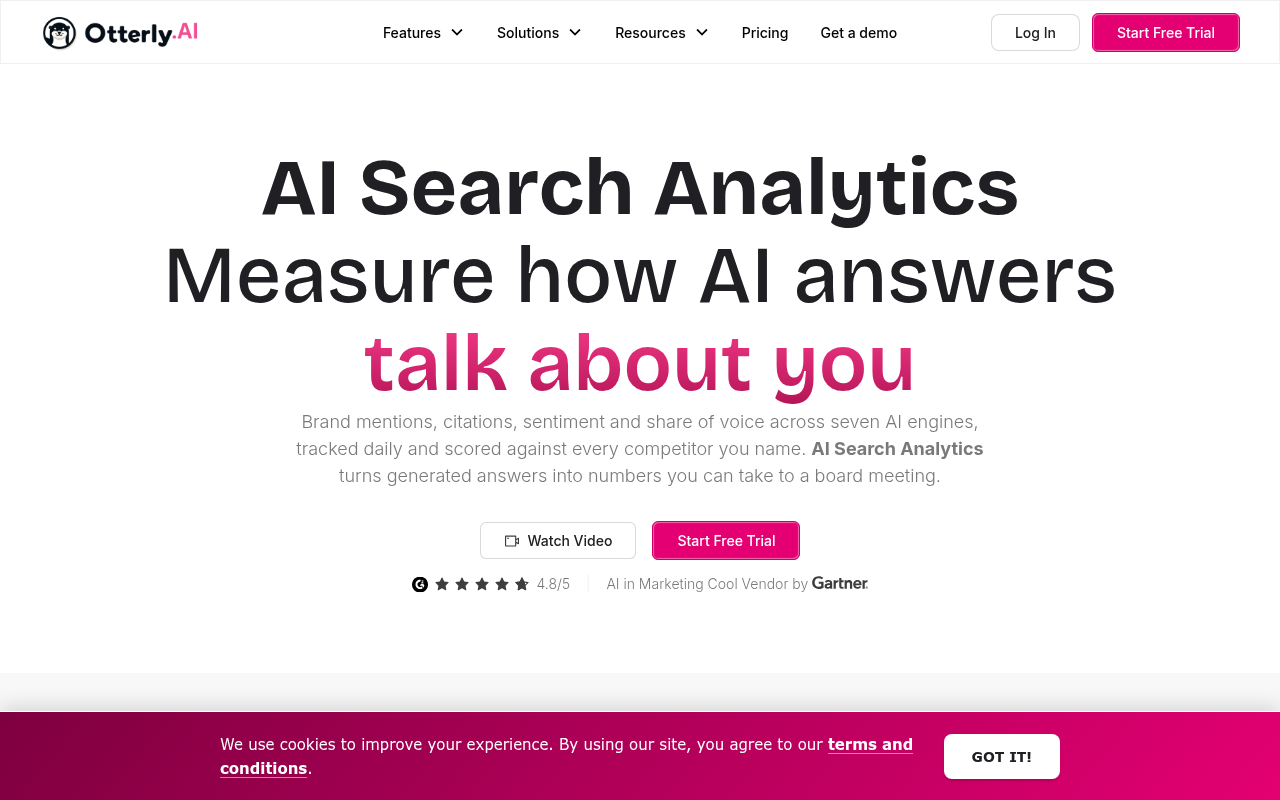
OtterlyAI is the best entry point for small and mid-sized marketing teams starting daily AI citation monitoring. The Lite plan costs $29/month, includes 15 tracked prompts, daily tracking, and covers ChatGPT, Google AI Overviews, Perplexity, and Microsoft Copilot.
It provides brand visibility scores, prompt research, domain ranking, link-citation analysis, competitor comparison, and exportable reports. Higher tiers add more prompts, API/MCP access, and Looker Studio integration.
Best for: Small and mid-sized marketing teams that need a transparent, affordable starting point for AI visibility monitoring.
Standout trait: Transparent pricing, daily cadence, and four engines included on the entry plan.
Limitation: Claude, Gemini, and Google AI Mode are add-ons, not included on the base plan. Prompt volume is limited at lower tiers. Not suitable for large-scale enterprise sampling.
Pricing: Lite $29/month, Standard $189/month, Premium $489/month, Enterprise from $1,000/month. Recheck before purchasing.
Who should not buy it: Enterprise teams needing deep source categorization and earned-media analysis (consider Profound). Teams needing content production, not monitoring.
2. Profound, best for enterprise citation intelligence
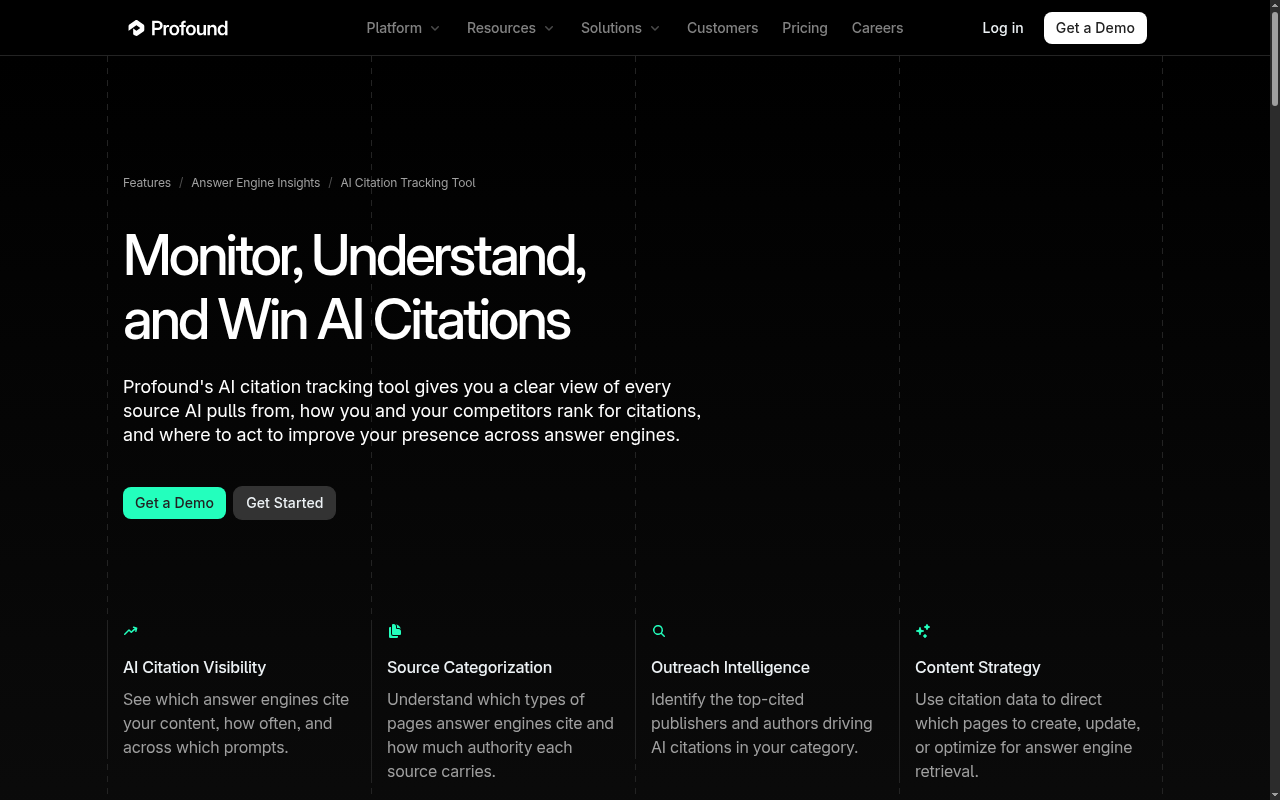
Profound is the strongest option for enterprise teams that need deep citation intelligence, source categorization, and earned-media analysis. It tracks citation share by platform, topic, and prompt, and categorizes sources as owned, competitor, earned media, PR wire, social, or institutional. It identifies frequently cited publishers and authors, supporting PR and link-building strategy.
Best for: Enterprise teams needing granular citation intelligence and source-type analysis.
Standout trait: Source categorization and publisher/author discovery that connects monitoring to actionable outreach.
Limitation: More depth than most small teams need. Current pricing on the Profound pricing page displayed malformed values during research; verify manually before committing.
Who should not buy it: Solo marketers testing GEO for the first time. Small teams needing a simple prompt tracker.
3. Peec AI, best for clear source-versus-mention analysis
Peec AI offers the cleanest analytical framework among monitoring tools, with precise distinctions between brand visibility, source visibility, citation, and retrieval. It provides share of voice, sentiment, position tracking, prompt tracking, competitor tracking, and gap analysis.
Best for: Teams that need precise analytical distinctions for reporting and internal alignment.
Standout trait: Clear metrics documentation that separates being mentioned from being sourced from being cited. This matters when you report to stakeholders who conflate these terms.
Limitation: Recheck exact platform coverage and pricing on the Peec AI product page before purchasing.
Who should not buy it: Teams looking for a content production tool. Buyers who just want a simple "are we cited, yes or no" answer.
4. Ahrefs Brand Radar, best for search-backed prompt scale and SEO integration
Ahrefs Brand Radar draws its prompt corpus from Google's People Also Ask data and Ahrefs' keyword database, rather than relying solely on synthetic prompts. It covers several AI platforms, tracks brand and competitor mentions, provides citation analysis, supports custom prompts, and includes YouTube, TikTok, Reddit, and web visibility features.
Best for: SEO-led teams that want search-backed prompt data and tight integration with an existing Ahrefs workflow.
Standout trait: Prompt corpus derived from real search behavior, with monthly question-set updates and a 90-day reporting window.
Limitation: Estimated impressions are modeled from search volume, not measured AI audience reach. Pricing (€358/month for selected platforms, €654/month for all platforms) makes it unsuitable for many small teams. Recheck before purchasing.
Who should not buy it: Budget-conscious small teams. Users who do not already use Ahrefs for SEO.
How to choose by team size and goal
For readers who use the broader "answer engine optimization" terminology, the AEO tools round-up covers the same landscape through that lens.
What GEO tools cannot prove
No tool can guarantee that ChatGPT, Perplexity, Gemini, Claude, or Google AI Overviews will cite your page. A GEO score estimates readiness, not outcome. A monitoring tool samples a prompt set; it does not observe every query on every platform.
Results shift with model updates, prompt phrasing, personalization, and session context. A citation that appeared yesterday may not appear tomorrow.
That context matters for understanding why this work still matters. A Pew Research Center study (March 2025) analyzed 68,879 Google searches from 900 U.S. adults and found that traditional-result clicks dropped from 15% to 8% when an AI summary appeared. Only 1% of visits with a summary led to clicks on links inside the AI summary. Visibility in the answer itself is becoming the primary real estate.
The foundational ACM SIGKDD GEO paper reported visibility improvements of up to 40% in its experimental setting. That is a research result in a controlled environment, not a universal guarantee for commercial websites.
For Google-specific measurement, Google Search Console's generative AI performance report covers AI Overviews and AI Mode impressions. It does not cover ChatGPT, Claude, or Perplexity. For those platforms, you need a dedicated monitoring tool.
Selection criteria
Every tool in this article was evaluated against six criteria:
- Primary category clarity: Does the tool serve production or monitoring, rather than hiding its main function behind "all-in-one" positioning?
- Actionability: Does it tell you what to change or just report numbers?
- Entry accessibility: What does it cost, is there a trial, and can a small team use it?
- Platform coverage: Which AI engines are included, and which require add-ons?
- Measurement transparency: Does the tool explain its sampling approach and limitations?
- First-party verification: Capabilities and pricing confirmed on official product pages. Tools with unverifiable claims were flagged.
FAQ
Can a GEO tool guarantee that ChatGPT or Perplexity will cite my website?
No. Production tools improve content structure and citability signals. Monitoring tools track whether citations happen. Neither controls an AI platform's retrieval or generation decisions. Results vary by model, prompt, session, and update cycle. Treat any tool that promises guaranteed citations as a red flag.
Do GEO tools replace traditional SEO tools?
No. Crawlability, indexing, relevance, authority, and site structure remain foundational. As Google's AI optimization guide confirms, generative features are rooted in core Search ranking systems. GEO tools add a layer for AI citability and AI-answer presence on top of conventional SEO work.
What is the difference between a brand mention and a citation?
A mention means the brand name appears in the AI answer text. A citation means the answer explicitly links to or attributes a source URL. A page can also be retrieved as a source without being visibly mentioned or cited, which is why tools like Peec AI distinguish these three states.
Does Google Search Console measure ChatGPT, Claude, or Perplexity citations?
No. Google's generative AI performance report covers AI Overviews and AI Mode only. For ChatGPT, Claude, Perplexity, and other platforms, you need a dedicated monitoring tool such as OtterlyAI, Profound, Peec AI, or Ahrefs Brand Radar.
Do I need an llms.txt file to appear in AI answers?
No. The llms.txt proposal has uneven adoption. It is not a ratified standard or crawler directive. Publishing one does not guarantee retrieval or citation. It can serve your site's information architecture, but it is optional, not a prerequisite for AI visibility.