
AI Search Engine Optimization - The Complete Guide
AI search engine optimization extends traditional SEO to generative answer surfaces.

AI search engine optimization is the practice of making a website, brand, and supporting evidence easier for AI-powered search systems to discover, understand, trust, cite, and recommend in generated answers. The focus here is AI-powered answer experiences, not using AI tools to automate ordinary SEO tasks. AI search changes retrieval, extraction, synthesis, citation, and measurement, but it does not replace the SEO foundation: crawlability, indexing, relevance, authoritative sourcing, and useful original content.
What AI search engine optimization means
AI search engine optimization (AI SEO) extends traditional SEO to cover generative answer surfaces where an AI system retrieves, synthesizes, and presents information rather than listing ranked links. Traditional SEO earns a seat at the table. AI SEO earns a voice in the conversation.
The distinction matters because "AI SEO" carries two meanings in practice. One meaning, and the subject of this guide, is shaping your content so AI-powered search systems find it, trust it, cite it, and send users to it. The other is using AI tools to perform ordinary SEO tasks (keyword research, content drafting, technical audits). Both are legitimate uses of the phrase, so clarity is essential: this guide covers the first meaning throughout.
Google Search Central's AI optimization guide is the primary authority for Google-specific guidance. Google states plainly that its generative AI features are rooted in core Search ranking and quality systems. That single sentence is the most useful thing a practitioner can internalize: the foundation is SEO. What changes is the output layer, where an AI system generates, composes, and presents an answer rather than listing ten blue links, and the measurement layer, where impressions, citations, and referrals replace position tracking alone.
If your pages are not crawlable, indexable, relevant, and authoritative, they will not be retrieved for a generative answer on any platform. Fix SEO first. Then address the answer layer.
How generated answers differ from ranked results
The shift is from ranking to synthesis. Instead of ten blue links, the user sees a composed answer that may cite, quote, paraphrase, or ignore any given source. Understanding the pipeline behind that answer is the starting point for any work on it.
The generative answer pipeline
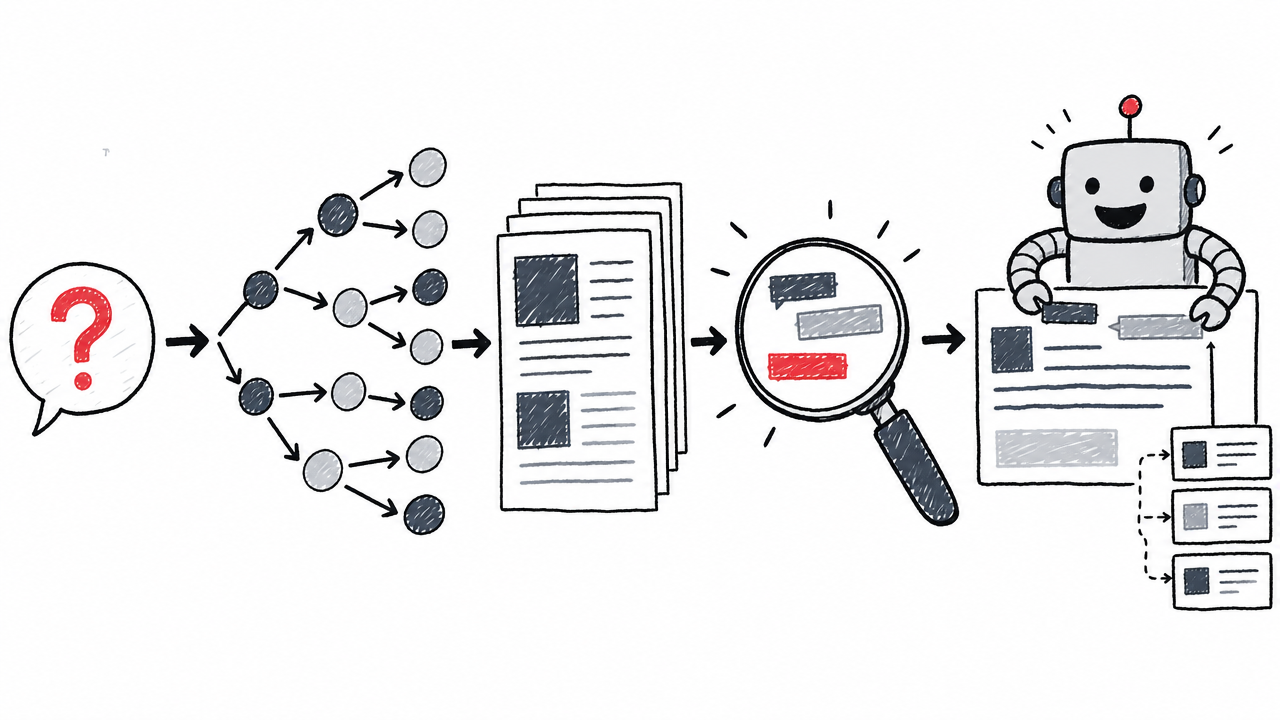
Most AI search systems follow a variation of retrieval-augmented generation (RAG). Google describes this as using Search systems to retrieve relevant, current pages before generating a response (Google Search Central). The pipeline works roughly as follows:
- Query interpretation. The system parses the user's question and may rewrite it into one or more targeted sub-queries.
- Retrieval. The system searches an index (or the live web) to find candidate pages. Google calls its version of multi-query retrieval "query fan-out," where it generates related searches to address different subtopics (Google AI Features documentation).
- Extraction. The system reads retrieved pages, identifying passages, facts, entities, and evidence relevant to the query.
- Synthesis. A large language model composes a response by combining extracted information, its own parametric knowledge, and structural reasoning.
- Grounding and citation. The system decides which sources to attribute, link, or display alongside the answer.
- Presentation. The user sees the generated answer, which may include inline citations, a source panel, follow-up suggestions, or a combination.
Citation selection is not citation absorption
A page can be retrieved and never cited. It can be cited and barely absorbed. Or it can shape the answer's structure, facts, and wording.
A cross-platform preprint studying 602 controlled prompts and over 21,000 valid search-layer citations across ChatGPT, Google AI Overview/Gemini, and Perplexity illustrates this gap. Mean citations per prompt varied sharply: ChatGPT averaged 6.88, Google 12.06, and Perplexity 16.35. But mean fetched-page influence (a measure of how much the cited page contributed to the answer) diverged even more: ChatGPT scored 0.2713, Google 0.0584, and Perplexity 0.0646 (arXiv preprint).
The practical lesson: being selected as a source and materially shaping the answer are different outcomes. Working only toward citation count misses the deeper goal of influencing what users read.
Is AI search engine optimization the same as SEO?
AI SEO is an extension of SEO, not a replacement. Google's AI features rely on core Search ranking and quality systems (Google Search Central). A page must be indexed and eligible to appear with a Search snippet to serve as a supporting link in AI Overviews or AI Mode (Google AI Features).
The same principle applies across platforms: ChatGPT Search, Perplexity, and Gemini all retrieve pages from the web. If a page is invisible to search infrastructure, it is invisible to AI answer generation.
This guide's position is direct: fix SEO first, then address the answer layer. The two are not in competition; one is built on the other.
The terminology map: SEO, GEO, AEO, LLM SEO, and AI SEO
The field has five overlapping labels, and practitioners use them inconsistently. That inconsistency wastes time in meetings, confuses hiring decisions, and muddies strategy documents. Here is a concise map of how each term is used in practice and how this guide recommends using them.
This hub uses "AI search engine optimization" and "AI SEO" as the umbrella term. When referencing generative engine optimization (GEO) specifically, the guide links to the existing GEO explainer rather than recreating that definition here.
The terminology overlap has practical consequences beyond semantics: it shapes which searches find your content. If you write about "AEO" without expanding it, you compete with a clothing retailer. If you write about "GEO" without context, you attract geographic and geospatial queries. Precision matters for your readers and for the AI systems parsing your content.
The major AI search surfaces and how they work
The surfaces that matter for AI search visibility are Google AI Overviews and AI Mode, ChatGPT Search, Perplexity, and Gemini. Each retrieves web content, but they differ in how they search, synthesize, cite, and present sources. Below is what each platform documents about its own behavior. Undocumented behavior is labeled as such.
Google AI Overviews and AI Mode
Google AI Overviews help users understand complex topics and provide links for further exploration. AI Mode supports detailed questions, reasoning, and comparisons. Both may use query fan-out to address subtopics (Google AI Features).
A page must be indexed and eligible to appear with a Search snippet to qualify as a supporting link. Google states there are no technical requirements beyond its normal Search requirements (Google AI Optimization Guide). No special AI-specific markup, AI files, or Markdown files are needed.
Key fundamentals include crawlability, internal links, page experience, textual content, high-quality media, and accurate structured data. Controls for Search visibility (robots.txt, nosnippet, data-nosnippet, max-snippet, noindex) apply to AI features as well.
ChatGPT Search
ChatGPT Search provides timely answers with links to web sources. ChatGPT can rewrite a user's prompt into one or more targeted queries and may use third-party search providers. Search responses may include inline citations, and users can open a Sources panel when citations are not shown inline (OpenAI Help Center).
ChatGPT may search automatically when a question would benefit from web information. OpenAI does not publicly document a universal ChatGPT ranking formula, so treat any third-party claims about one as unverified.
Perplexity
Perplexity searches the internet in real time, gathers information from articles, websites, and journals, and summarizes its findings. Each answer includes numbered citations linking to original sources. Pro Search can conduct deeper, multi-step research across several sources (Perplexity Help Center).
Claims about Perplexity preferring specific page lengths, freshness windows, or source types are not documented by the platform and should be treated as unverified.
Does Gemini cite web sources?
Gemini Apps may show sources and related content in or below a response. Sources can include public websites and, where connected, user-provided files or Google Workspace content. They may appear through a Sources button, inline links, or a side panel. Not every response includes sources. Directly quoted web content may link back to the source page (Gemini Apps Help).
Be cautious: not every Gemini response is web-grounded. Some responses draw entirely from the model's parametric knowledge and include no citations at all.
Should you work on each platform separately?
Not primarily. The foundation (technical accessibility, useful original content, entity clarity, genuine authority) is shared across every platform that retrieves web content. Platform-specific differences exist in citation display, prompt handling, and source presentation, but the core work overlaps heavily.
Track each platform separately to understand where your content appears and how it is represented. But focus on the shared foundation first: the work that helps on Google also helps on ChatGPT, Perplexity, and Gemini because each of them starts by retrieving and reading web pages.
What moves AI search visibility (priority order)
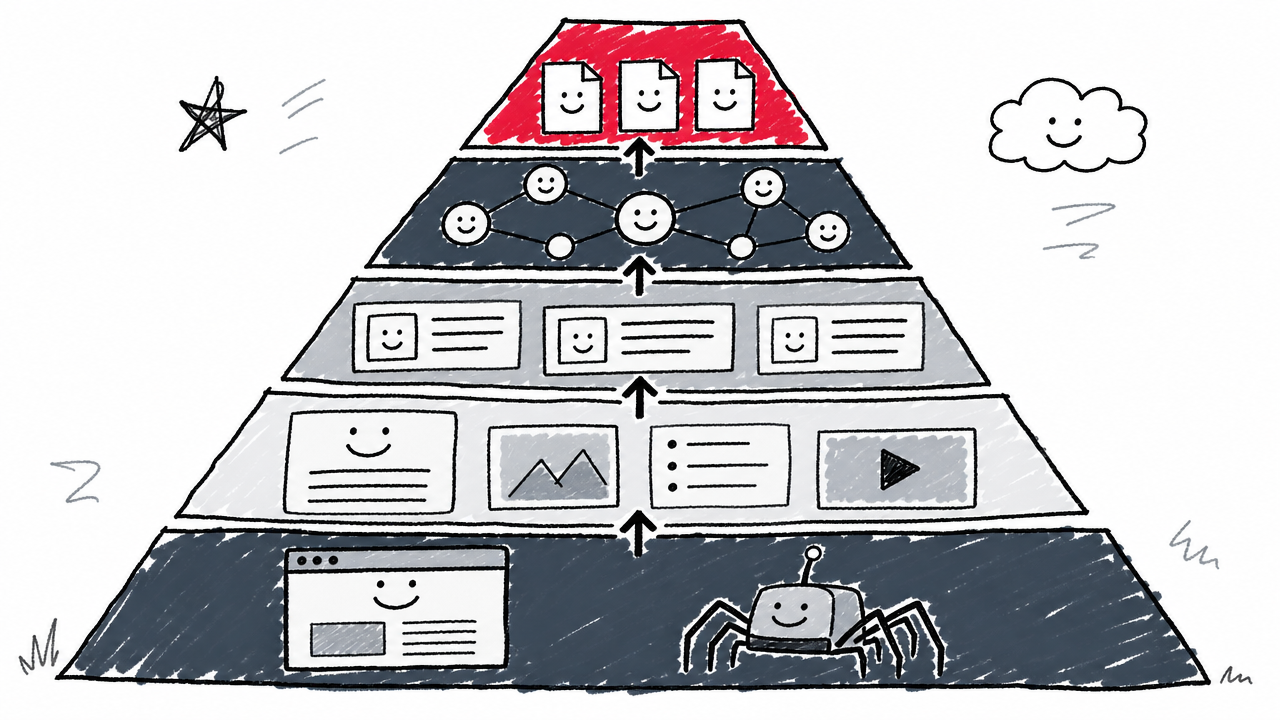
This is the core of the guide. The work is ranked from highest confidence to lowest. Priority 1 has the greatest impact because Google explicitly ties AI features to core Search systems, and other platforms also depend on indexable, crawlable, authoritative web content.
Priority 1: Fix conventional SEO foundations
No amount of answer-layer work compensates for broken SEO fundamentals. Before doing anything else:
- Allow appropriate crawling. Review robots.txt to ensure Googlebot and other legitimate crawlers can reach important content.
- Ensure important pages are indexable. Remove unintended
noindextags. Check that canonical tags point to the correct URLs. - Make key content available as text. Content rendered only in JavaScript, images, or video without text alternatives is harder for every retrieval system to process.
- Use crawlable internal links. Standard anchor elements (
<a href="...">) remain the most reliable way to help crawlers discover and connect pages. - Resolve JavaScript rendering problems. If critical content depends on JavaScript, verify that search engines can render it.
- Maintain page experience. Fast load times, mobile usability, and HTTPS remain quality signals.
- Keep structured data accurate and consistent with visible content. Schema.org markup helps search systems understand entities, products, and relationships, but structured data must match what users see on the page.
Google says no special AI files, AI-specific markup, or Markdown files are needed for its AI features (Google AI Optimization Guide). These are the same fundamentals that have driven SEO for years.
Growth Calendar can help plan and publish technically structured content clusters with internal links and direct-answer formatting, keeping the publishing pipeline on schedule while the team focuses on content quality.
Priority 2: Publish information that deserves to be cited
AI systems synthesize answers from retrieved sources. If your content adds nothing original, it has no reason to be cited. Focus on:
- Original research and proprietary data. If you measured something, surveyed someone, or built a dataset, publish the findings.
- Firsthand experience. Hands-on reviews, implementation walkthroughs, and real-world case descriptions carry weight that summaries cannot replicate.
- Clear comparisons with conclusions. A comparison that reaches a verdict is more useful (and more citable) than a side-by-side table with no recommendation.
- Specific examples and verifiable statistics. Concrete details are easier for AI systems to extract and attribute.
- Expert explanations with visible credentials. Author pages, professional affiliations, and demonstrated expertise build trust for both human readers and quality-evaluation systems.
Generic AI-written summaries that repeat existing pages add no unique value. Google warns that mass-generated pages without added value may violate its scaled content abuse policy (Google guidance on AI-generated content). AI-assisted content is acceptable when reviewed, corrected, sourced, and improved with original value. The goal is content that deserves to be cited, not content that merely exists.
Priority 3: Make answers easy to identify and reuse
Structure your content so AI systems can find, extract, and attribute specific answers:
- Descriptive headings that state the topic, not clever wordplay.
- Direct answers near the start of each section, so the system does not need to read five paragraphs of context before reaching the point.
- Self-contained paragraphs where each passage makes sense on its own and can be quoted without surrounding text.
- Declarative sentences that state facts clearly.
- Clear definitions when introducing terms.
- Lists and tables where they improve comprehension and comparisons.
- Enough context around facts so they are not misleading when extracted.
Reject rigid word-count formulas. Google says there is no ideal page length and no need to break content into tiny pieces (Google AI Optimization Guide). The cross-platform preprint also found that Q&A formatting alone did not improve citation absorption: Q&A pages had a mean influence score of 0.0947 compared with 0.1005 for non-Q&A pages (arXiv preprint). Write for human usefulness and machine legibility, not for an arbitrary template.
Priority 4: Build entity clarity and topical authority
AI systems need to understand what your business is, what it does, and how its products and content relate to each other. Strengthen:
- Consistent brand and product names across your site and external profiles.
- Clear descriptions of what the business does, written as factual statements rather than marketing fog.
- Internal links between related pages, forming a coherent topic cluster rather than isolated articles.
- Author pages with relevant credentials and links to published work.
- Consistent product, pricing, and business details across Google Business Profile, Merchant Center, and owned profiles.
Entity clarity means removing ambiguity so that when an AI system encounters your brand across contexts, it connects the dots correctly. Use the same names, the same descriptions, and the same relationships everywhere.
Priority 5: Earn genuine third-party evidence
AI systems may use sources beyond your own website. Publications, reviews, communities, expert references, and citations in other research all contribute to how AI systems understand and trust a brand. Focus on:
- Genuine editorial coverage
- Customer reviews on credible platforms
- Expert references and citations
- Industry associations and directories
- Useful community participation (not seeding)
Reject paid "AI mentions," fake testimonials, coordinated community posts, inauthentic listicle placements, and manufactured citations. Google explicitly warns that seeking inauthentic mentions is not a sound strategy (Google AI Optimization Guide). Platforms evolve their detection, and the reputational cost of getting caught outweighs any temporary visibility gain.
What not to waste time on
Some widely repeated advice is low-value or misleading. Here is a firm position on each:
- Exact answer-length formulas (40–60 words, etc.). No platform documents a preferred answer length. Write the length the answer requires, with the key point up front.
- FAQ schema for AI answers. Google says there is no special schema.org markup required for generative AI Search (Google AI Optimization Guide). FAQPage schema can still earn rich results in traditional search, but it is not an AI-answer lever.
- Buying "AI mentions." Inauthentic mentions are explicitly called out by Google. The risk is real, not hypothetical.
- Treating
llms.txtas mandatory infrastructure. It is a proposal with uneven adoption (see the next section). - Blocking all AI crawlers reflexively. Blocking crawlers prevents your content from being retrieved. If your goal is AI visibility, blocking works against you. Block only when you have a deliberate reason (licensing, content protection).
- Publishing thin AI-generated content at scale. Volume without value is the fastest path to violating Google's scaled content abuse policy and earning zero citations.
Time is finite. Spend it on the priority order above. Skip tactics with no documented impact.
Does llms.txt improve AI citations?
llms.txt is a proposal, not a ratified web standard. It defines a root-level Markdown file (/llms.txt) that curates a site overview and links to key resources, along with an optional llms-full.txt for expanded content. The proposal is designed to help language models and AI agents quickly understand what a site offers.
Adoption is uneven. The proposal itself does not specify how platforms must process the file, and publishing one does not guarantee crawler support, inclusion, or citations. Google explicitly says no special files or Markdown files are needed for its AI features (Google AI Optimization Guide).
Verdict: Publish llms.txt if it improves your documentation, content curation, or agent access to important resources. Do not publish it expecting rankings or citations. It is a low-cost, low-priority addition, not a strategic lever.
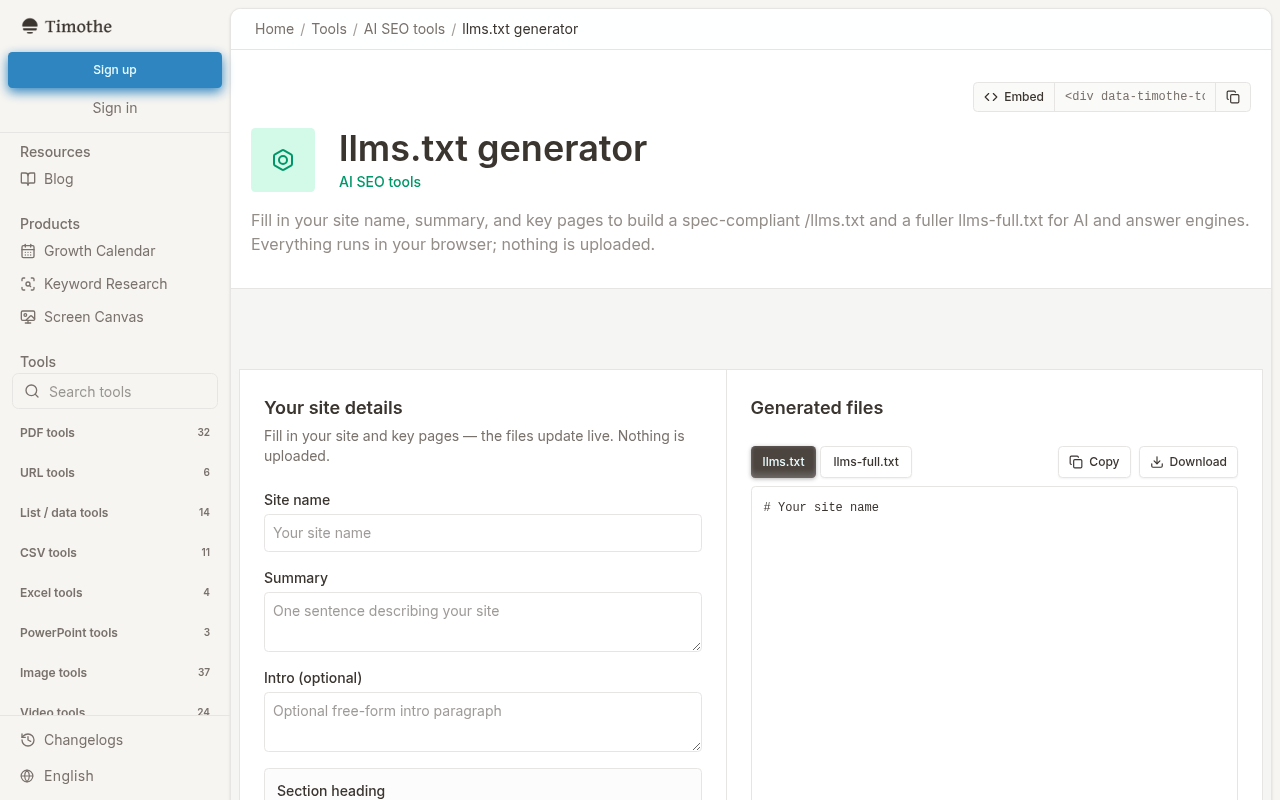
The fastest creation path is the llms.txt generator, a free browser-based tool that builds both files from your site details and key-page links without uploading your inputs. A manual method using any text editor also works; the format is straightforward Markdown.
How to measure AI search visibility
A citation is not a visit. A mention is not necessarily positive. A visit is not necessarily a conversion. Define your terms before building a measurement framework.
The measurement stack
Google Search Console. Google announced dedicated generative AI performance reports in June 2026, exposing impressions, pages, countries, devices, and dates with hourly through monthly granularity (Google Search Blog). Important qualification: the reports are rolling out to a subset of sites, so not every Search Console property has access.
Google Analytics and server-side referral data. Track referral sessions from AI platforms (chatgpt.com, perplexity.ai, gemini.google.com, and related referrers). Tie referral visits to on-site conversions. Referrals and conversions are where business value lives.
Controlled prompt testing. Build a stable prompt set from real customer questions: definition prompts, comparison prompts, "best" and recommendation prompts, brand-category prompts, and competitor prompts. Record the platform, date, region, exact prompt, whether your brand appears, how it is represented, and which competitors show up. Do not treat a single response as a durable ranking; AI answers vary across sessions, regions, and model versions.
Dedicated monitoring tools. Third-party AI visibility monitoring products exist and are evolving rapidly. Before relying on one, verify its method, coverage (which platforms and query types), and refresh cadence.
The keyword research tool can help identify the queries and demand behind your prompt testing, providing estimated volume, competition, and related keywords for each seed term.
Control for platform growth
A longitudinal field study of a single high-traffic domain found that total ChatGPT referrals grew 5.7× over the study window, while untreated pages on the same domain grew 3.5×. The intervention-aligned estimate was 1.82× (95% CI: 1.31–2.54), but a conservative placebo-in-time test produced p = 0.16, leading the authors to describe the effect as suggestive rather than conclusive (arXiv preprint).
The lesson: do not attribute all growth in AI referrals to your work. Control for platform growth, seasonality, prompt mix, and broader demand. Measure the delta between treated and untreated pages on your own domain wherever possible.
A prioritized implementation plan
Work this list top-down. Each step builds on the one before it.
- Audit technical SEO foundations. Crawlability, indexing, JavaScript rendering, page experience, structured data accuracy. Fix problems before adding content.
- Identify high-value pages and ensure they contain original, citable information. Start with pages that already rank for relevant queries, then expand to gaps.
- Restructure key content for answer readability. Direct answers near headings, self-contained paragraphs, declarative sentences, tables and lists where they improve comprehension.
- Strengthen entity clarity and internal linking. Consistent names, clear business descriptions, author pages, and a coherent topic cluster. Growth Calendar supports research, cluster planning, writing, internal linking, direct-answer formatting, and publishing on a schedule, making steps 1 through 4 easier to run systematically.
- Develop genuine off-site evidence. Earn editorial coverage, encourage authentic reviews, take part in relevant communities.
- Build a prompt test set from real customer questions. Cover definition, comparison, recommendation, brand-category, and competitor prompts across Google AI Overviews, ChatGPT, Perplexity, and Gemini.
- Set up measurement. Google Search Console generative AI reports (where available), analytics referrals from AI platforms, and a prompt log.
- Optionally publish
llms.txt. Use the llms.txt generator for speed. - Track, iterate, and control for platform-level changes. AI answers are not static. Re-run prompt tests monthly, compare treated vs. untreated pages, and adjust based on what the data shows rather than what a blog post promised.
Frequently asked questions
Can a page appear in Google AI Overviews without special AI markup?
Yes. Google explicitly states there is no special schema.org markup, AI-specific files, or Markdown files required to appear in Google Search AI features. A page must be indexed and eligible to appear with a Search snippet (Google AI Optimization Guide). The standard fundamentals (crawlability, content quality, structured data accuracy) apply.
How do AI search engines choose which sources to cite?
Each platform retrieves pages using search or index systems, then selects sources based on relevance, authority, content quality, and query context. Exact selection criteria are not fully public for any platform. The strongest documented signal aligns with traditional search: be the most useful, authoritative, and accessible answer to the query. Being retrieved is necessary but not enough on its own; citation selection and citation absorption are separate outcomes.
Does AI-generated website content help with AI search?
AI-assisted content is acceptable if reviewed, corrected, sourced, and improved with original value. Mass-generated pages without added value may violate Google's scaled content abuse policy (Google guidance on AI-generated content). The standard is not whether AI was involved in production, but whether the final content deserves to be cited.
What is the difference between an AI citation and a referral visit?
A citation means the answer attributes information to or links to a page. A referral means a user clicks through to the site. In practice, many citations produce minimal click-through because the user's question was answered in the generated response. Measure both, but tie business value to referrals and conversions, not citation counts alone.
Can AI search visibility be guaranteed?
No. AI answers vary by platform, query, region, session, model version, and product release. No practitioner, agency, or tool can guarantee a specific citation, mention, or ranking in a generated answer. Anyone making that promise should be treated with skepticism. The achievable goal is increasing the probability and consistency of visibility through disciplined, evidence-backed work.