Best AI Content Optimization Tools (2026)
Compare six leading AI content optimization tools — Surfer, Clearscope, Frase, MarketMuse, NEURONwriter, and Semrush — with pricing, features, and workflow guidance.

The best AI content optimization tool depends on the workflow bottleneck you need to solve, not on a single "best overall" pick. This guide compares six leading platforms: Surfer (page-level optimization), Clearscope (premium editorial teams), Frase (research-to-publish with GEO scoring), MarketMuse (site-wide topical authority), NEURONwriter (budget-friendly), and Semrush Content Toolkit (full SEO-suite integration). No tool guarantees rankings or AI-search citations; human editing, fact-checking, and original expertise remain essential.
What is an AI content optimization tool (and what it is not)
An AI content optimization tool analyzes draft or published content against SERP data, semantic keywords, entities, topic coverage, and competitor pages. It then assigns a content score and recommends improvements. Think of it as a diagnostic instrument, not a ranking guarantee.
This category is distinct from several adjacent ones:
- AI writers (ChatGPT, Jasper) generate text but do not perform real-time SERP analysis or NLP-based topic modeling.
- Keyword research suites (Ahrefs, Semrush core) find search terms but do not score page-level content.
- Grammar checkers (Grammarly, Hemingway) polish prose but ignore semantic SEO signals.
- SEO plugins (Yoast, Rank Math) enforce on-page checklists but lack deep competitor and entity analysis.
A newer adjacent capability is GEO/AEO tracking: monitoring whether your content appears as a citation in Google AI Overviews, ChatGPT, Perplexity, Gemini, or Claude. Some optimization tools now bundle this; others treat it as a separate product.
Core concepts these tools rely on include semantic SEO, NLP, SERP analysis, topic coverage, search intent, content scoring, and E-E-A-T signals. Google's own guidance on creating helpful, reliable, people-first content is the standard every piece should meet, regardless of which tool scores it.
One important caveat: a content score reflects how well your page covers topics that ranking competitors cover. It does not measure factual accuracy, originality, or the likelihood of ranking first.
How we selected and evaluated these tools
Every tool on this list was evaluated against seven criteria, the same criteria you should apply when shortlisting any content optimization platform:
- Primary function: The tool must center on content optimization, not just AI writing or keyword research.
- SERP-informed recommendations: Real-time scoring driven by competitor analysis and NLP, not generic checklists.
- Workflow coverage: Evaluated across research, briefing, drafting, optimization, publishing, refreshing, and monitoring.
- Pricing transparency: Official pricing verifiable on vendor pages at the time of publication.
- Integration ecosystem: Compatibility with WordPress, Google Docs, CMS platforms, and broader SEO tools.
- AI-search capabilities: Whether the tool addresses GEO/AEO tracking, AI citations, or AI Overviews.
- Independent stance: Vendor-reported results are labeled as such. No tool is assumed to outperform others without independent evidence.
No independent controlled study was found proving one tool consistently improves rankings more than all others.
Quick comparison table
Prices reflect annual billing as found on official vendor pages during research. Recheck before purchasing, as SaaS pricing changes frequently.

Best AI content optimization tools reviewed
Surfer: best for page-level optimization and mature SEO workflow
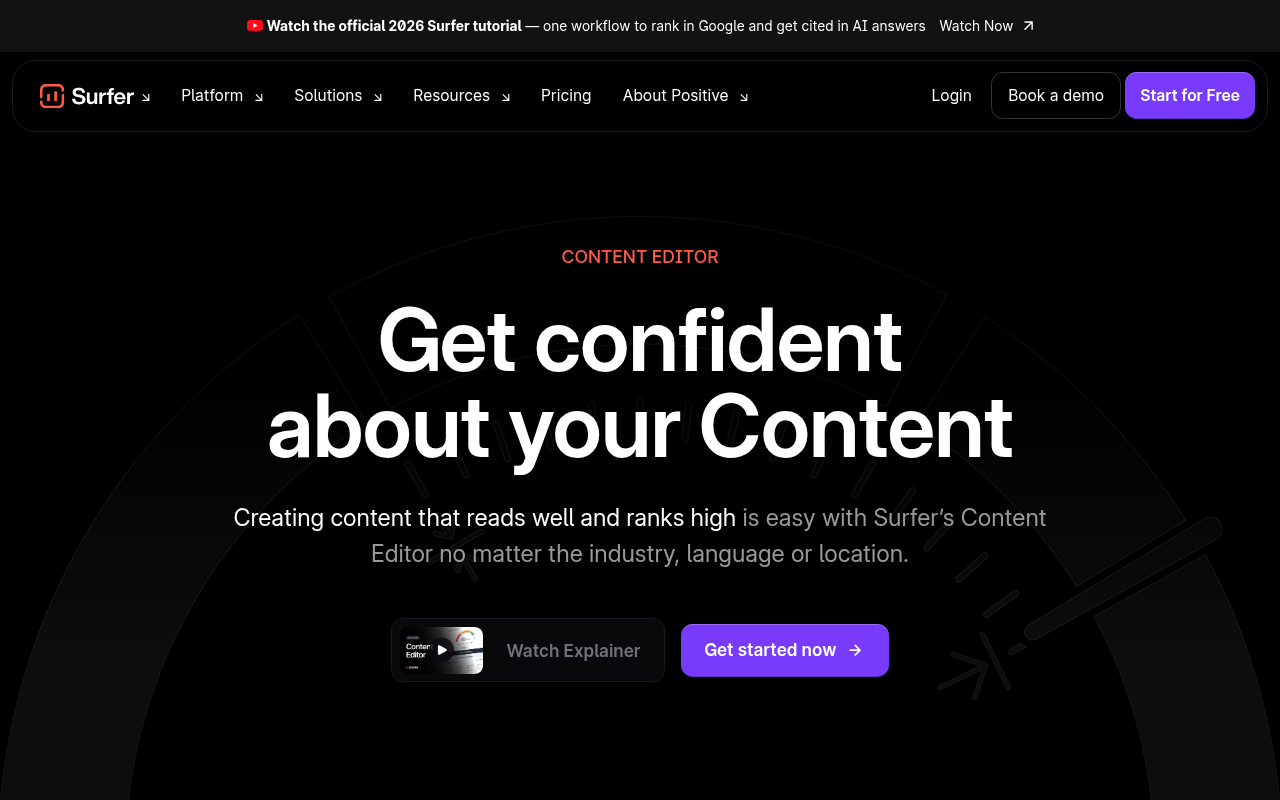
Surfer is the strongest choice for SEO teams and agencies that want a data-rich, real-time page-level editor with broad integrations and topical-authority mapping built in.
The Surfer Content Editor provides a real-time Content Score based on keyword optimization, entity extraction, topic coverage, and link equity. Beyond the editor, Surfer includes an Outline Builder, Auto-Optimize (one-click improvement suggestions), automatic internal linking, and a Topical Map for cluster planning. Integrations span Google Docs, WordPress, ChatGPT, and Contentful.
This combination of page-level scoring and a topical-authority layer sets Surfer apart. The Topical Map helps plan entire clusters, not just single pages, and AI-visibility tracking lets you see how content performs in AI-search contexts. The tool suits teams managing dozens to hundreds of pages per month.
The Standard plan starts at $99/month on annual billing, which is mid-range. Smaller freelancers may find the per-document economics costly at scale, particularly if they need fewer than the plan's included documents each month.
Clearscope: best for premium editorial teams
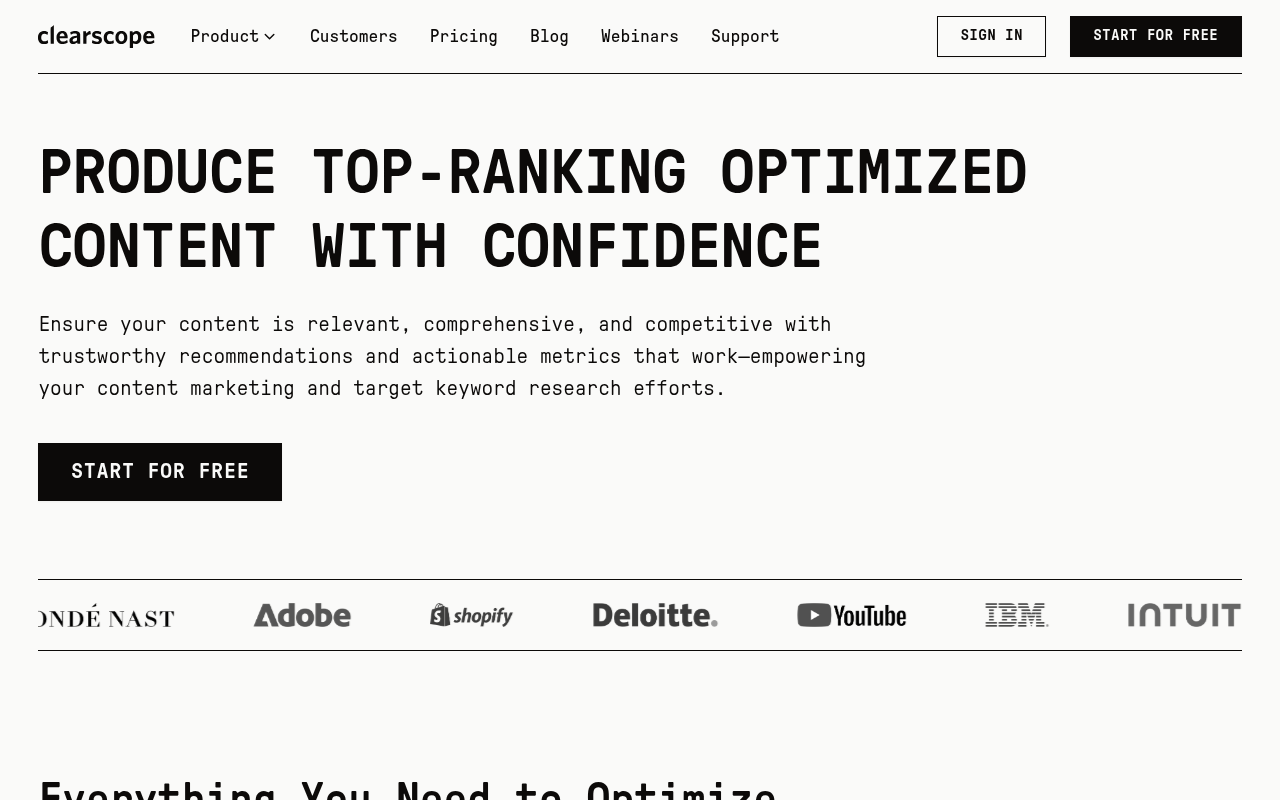
Clearscope is the right pick for in-house editorial teams and publishers that value a clean grading workflow and unlimited collaboration over an extensive AI-drafting engine.
Clearscope Optimize is a content grading platform offering real-time topic-coverage scoring, keyword recommendations, citation suggestions, popular questions, and internal-linking functionality. Its NLP stack draws from Google Cloud, OpenAI, and IBM Watson. The grading interface is deliberately streamlined: writers see a real-time content grade, a list of recommended terms, and suggested questions. Integrations with Google Docs, Microsoft Word, and WordPress mean writers rarely leave their preferred tool.
The Essentials tier includes unlimited users and unlimited projects, so there is no per-seat cost escalation. That makes Clearscope especially attractive for teams where editors, writers, and stakeholders all need access.
The catch is price: the Essentials tier starts at $129/month with 50 pages and 50 tracked prompts, the highest entry price on this list. AI writing features are more limited than Surfer's or Frase's, so teams that need heavy AI drafting alongside optimization may want to pair Clearscope with a separate writing tool.
Frase: best research-to-publish workflow with SEO and GEO scoring
Frase covers the widest workflow arc of any tool here, stretching from SERP-based research through AI drafting, optimization, multi-CMS publishing, and ongoing content monitoring, all with dual SEO and GEO scores.
The platform starts with SERP analysis and content brief generation, moves through AI drafting with brand-voice controls and live SEO and GEO optimization scores, and ends with direct publishing to WordPress, Webflow, Sanity, Wix, or FraseCMS. It supports 70+ languages. Frase Answers provides question-focused content blocks, and Content Guard watches published pages for performance changes.
The dual SEO + GEO scoring system is the standout feature. While no tool can guarantee inclusion in AI Overviews or ChatGPT, Frase's GEO score gives directional feedback on citation-readiness. Broad CMS publishing and URL-import content refresh capabilities round out a complete workflow. Content teams that want a single tool from research through publishing will find the most coverage here.
The Starter plan ($39/month annual) limits you to 10 articles and 50 audit pages per month with a single seat. Most teams will need the Professional tier ($103/month annual) for three seats, five sites, and 40 articles. Scaling costs climb quickly.
MarketMuse: best for site-wide topical authority and content planning
MarketMuse is the most strategic tool on this list. Rather than scoring a single page, it analyzes entire content inventories, identifies topical gaps and content decay, and helps teams decide what to create or refresh first.
MarketMuse is a content intelligence platform. It performs site-wide content inventory analysis, identifies topic gaps and content decay, assigns Personalized Difficulty scores that factor in your existing site coverage, builds content briefs, and evaluates E-E-A-T signals across the top 20 ranking competitors.
The Personalized Difficulty metric is the key differentiator. Unlike generic keyword difficulty, it considers your site's existing topical coverage and tells you where you have the best chance of competing. The content inventory and decay detection features let teams focus on updates over new creation. If your bottleneck is knowing what to write or refresh rather than how to score a single article, MarketMuse solves a different problem than page-level editors.
Pricing is demo-gated for paid tiers; the Free plan is limited to one user and 10 queries per month. MarketMuse is more strategic than operational, so it does not replace a page-level editor for writing-time optimization. Teams often pair it with Surfer or Clearscope for the actual drafting phase.
NEURONwriter: best budget option for freelancers and small teams
NEURONwriter delivers solid SERP-driven NLP optimization at the lowest price point on this list, making it the clear choice for cost-conscious freelancers and small agencies.
The platform is built around SERP analysis and NLP-based topic recommendations. Its Content Designer provides a writing interface with real-time optimization guidance. Plans include AI writing credits, plagiarism checks, Google Search Console integration, and WordPress/Shopify publishing.
The Bronze plan starts at $19/month on annual billing, the lowest entry point in this round-up. The Gold plan at $57/month adds Google Search Console and WordPress/Shopify integrations, API access, and 45,000 AI credits, still well below Surfer or Clearscope. For freelancers, solo SEOs, and small agencies producing a moderate volume of content, NEURONwriter delivers meaningful guidance without requiring a $100+/month commitment.
Feature depth and UX are more basic than Surfer or Clearscope, however. The platform had no built-in GEO/AEO tracking at the time of research. The Bronze plan's 25 analyses and two projects per month may also feel restrictive for freelancers with growing client lists.
Semrush Content Toolkit: best for broader SEO-suite integration
Semrush Content Toolkit is the strongest option for marketers who already use (or plan to use) Semrush's keyword, competitor, and reporting tools and want content optimization in the same ecosystem.
The Semrush Content Toolkit is a content marketing module within the Semrush platform. It includes data-driven content ideas, article generation from briefs, SEO Content Boosts for existing pages, AI-visibility recommendations, brand-voice drafting, and content repurposing into email and social formats. It connects directly to Semrush's keyword, backlink, and competitor databases.
That direct access to Semrush's data layer is the key advantage. Content Boosts can analyze and improve existing articles using competitor data, and AI-visibility recommendations address how content might appear in AI-search contexts. Marketers and in-house teams that value having content optimization, keyword research, competitor analysis, rank tracking, and reporting in a single login will find the most value here.
The Base plan at $60/month (annual billing) covers content features only; the full Semrush SEO suite requires a separate subscription. The five SEO Content Boosts per month included in the Base plan may feel restrictive for high-volume teams.
How to choose the right tool for your workflow
Start with your bottleneck, not a feature checklist. The table below maps common workflow problems to the tool most suited for each:
Most teams gain from trialing two or three tools on their actual content before committing to annual billing. Use a real article you have already published to compare scoring accuracy, recommendation quality, and how well the tool fits your editing process. Annual billing saves 15–25% on most platforms, but lock-in is real: verify the tool meets your needs on a monthly plan first.
Do AI content optimization tools work for AI search visibility?
Some tools now offer AI-visibility scoring or tracking, but no tool can guarantee your content will appear in Google AI Overviews, AI Mode, ChatGPT, Perplexity, Gemini, or Claude.
GEO (generative engine optimization) refers to structuring content so that generative AI systems cite or reference it. AEO (answer engine optimization) is the broader practice of making content answer-ready for any system that surfaces direct answers. Frase offers a dedicated GEO score alongside its SEO score. Surfer provides AI-visibility tracking. Semrush Content Toolkit includes AI-visibility recommendations.
Google's documentation on AI features and your website states that there are no extra technical requirements for AI features beyond standard SEO. A page must be indexed and eligible to appear in Google Search to serve as a supporting link in AI Overviews. Standard fundamentals still apply: indexability, structured data, topical depth, internal links, and page experience.
Relevant concepts in this space include query fan-out (AI systems searching across related queries), AI citations and share of voice (how often your domain is referenced), and AI crawler monitoring (tracking bots like GPTBot and ClaudeBot in your server logs). These are emerging metrics, not established standards.
What AI content tools cannot replace
AI content optimization tools are diagnostic instruments, not autonomous publishers. The following still require human involvement:
- Fact-checking and accuracy verification. No content optimizer verifies whether your claims are factually correct.
- Original experience and first-hand expertise. E-E-A-T's "Experience" signal cannot be synthesized from competitor pages.
- Editorial judgment on search intent. Tools infer intent from SERP patterns, but a human must decide whether a page should educate, compare, or convert.
- Brand voice and tone consistency. Scoring engines look at topic coverage, not your brand's personality.
- YMYL claims. Legal, medical, financial, and other high-risk content demands professional review that no NLP model provides.
- Interpretation of content scores. A score is a diagnostic, not a target. Chasing 100% can produce keyword-stuffed, unnatural copy.
Google's guidance on using generative AI content warns that generating many pages without adding genuine value may violate the scaled-content-abuse spam policy. The best workflow is AI-assisted research and drafting followed by human editing, fact-checking, and original insight.
FAQ
What is the difference between an AI content writer and a content optimization tool?
An AI writer generates text from a prompt. A content optimization tool analyzes existing or draft text against SERP data, semantic keywords, topic coverage, and competitor content, then recommends improvements. Many platforms now combine both: Frase and Surfer include AI drafting alongside their optimization engines, while Clearscope focuses on grading and recommendations.
Can ChatGPT replace an SEO content optimization tool?
ChatGPT can draft and edit text, but it does not perform real-time SERP analysis, NLP-based topic modeling, content scoring against competitors, or site-wide content auditing. It has no access to your Google Search Console data or live ranking pages. The two serve different functions and work best together: use ChatGPT for drafting and ideation, then run the output through a SERP-informed tool.
Should writers always aim for the highest possible content score?
No. A content score shows alignment with a tool's data model, reflecting how thoroughly you cover topics that top-ranking competitors cover. Chasing 100% often leads to keyword stuffing, forced subtopics, or unnatural phrasing. Use the score as a directional guide (typically aiming for the range the tool flags as competitive), then focus on search-intent alignment, originality, and editorial quality.
Are free AI content optimization tools available?
MarketMuse offers a free tier with 10 queries per month and one user. Frase provides a seven-day free trial with no credit card required. NEURONwriter offers a seven-day trial under Gold-plan terms. Most serious tools require a paid plan for regular use; free options are useful for evaluation but too limited in volume for ongoing content production.
Is AI-generated content allowed by Google?
Google does not ban AI-generated content. It evaluates content on helpfulness, originality, and quality regardless of production method. Publishing AI content at scale without adding genuine value may trigger the scaled-content-abuse policy. Google recommends focusing on accuracy, quality, relevance, metadata, and context about how content was created.
What is the difference between SEO, AEO, and GEO?
SEO (search engine optimization) targets traditional organic rankings in search engines like Google and Bing. AEO (answer engine optimization) focuses on structuring content so answer engines (voice assistants, featured snippets, People Also Ask) surface it directly. GEO (generative engine optimization) goes further, aiming for citations inside AI-generated responses from systems like ChatGPT, Perplexity, Gemini, and Google AI Overviews. The three overlap but address different surfaces; most content optimization tools focus on SEO, with GEO and AEO features still emerging.
Which is better: Surfer or Clearscope?
The answer depends on your workflow. Surfer offers deeper on-page scoring, a topical-authority map, Auto-Optimize, and AI-visibility tracking at $99/month (annual). Clearscope offers a cleaner editorial grading experience with unlimited users at $129/month. Teams that need AI drafting and cluster planning lean toward Surfer; teams that value simplicity, collaboration, and a focused grading workflow lean toward Clearscope. Both are strong page-level editors.
How much do AI content optimization tools cost?
Entry prices on annual billing range from $19/month (NEURONwriter Bronze) to $129/month (Clearscope Essentials), with MarketMuse requiring a demo for paid-tier pricing. Beyond the headline price, compare document limits, audit pages, AI credits, seats, and add-ons. The total cost per article matters more than the sticker price.