
Best AI SEO Content Generators - Which Ones Actually Rank?
We compared 8 AI SEO content generators across 10 ranking criteria, from Surfer AI to Clearscope, plus what the data says about which drafts actually rank.

AI SEO content generators: which ones rank?
No AI content generator guarantees rankings. The tools most likely to produce ranking-ready drafts combine live SERP research, search-intent analysis, topical coverage, citation grounding, and a human editorial layer. This comparison evaluates eight tools (Surfer AI, Frase, Jasper, Writesonic, KoalaWriter, Scalenut, NEURONwriter, and Clearscope) across ten criteria that matter for organic performance. The comparison table below gives you the full picture at a glance. For broader coverage beyond content generators, see our guide to the best AI SEO tools compared.
Comparison table: 8 tools at a glance
Scalenut's $24/mo annual price is promotional (60% off); monthly price is $59/mo. Prices, plan limits, and features are time-sensitive. Verify on each tool's official pricing page before purchasing.
What an AI SEO content generator is (and is not)
An AI SEO content generator uses large language models alongside search data to produce or improve content designed for organic rankings. The category is broader than most listicles suggest, and lumping every tool together misleads buyers.
Four distinct subcategories exist:
- Generator-first tools (e.g., KoalaWriter) focus on one-click draft creation from a keyword.
- SERP research and optimization tools (e.g., Clearscope, NEURONwriter) score and improve existing content against competitor analysis.
- Brand-governed marketing platforms (e.g., Jasper) focus on tone, style, and enterprise workflows rather than SERP-level optimization.
- Hybrid SEO/GEO platforms (e.g., Surfer AI, Frase, Writesonic, Scalenut) combine generation, SERP research, and emerging AI-search visibility features.
Knowing which subcategory a tool belongs to prevents comparing an optimizer's depth against a generator's speed. For practical advice on blending AI drafts with editorial quality, read our guide to SEO writing with AI and how to automate content without losing quality.
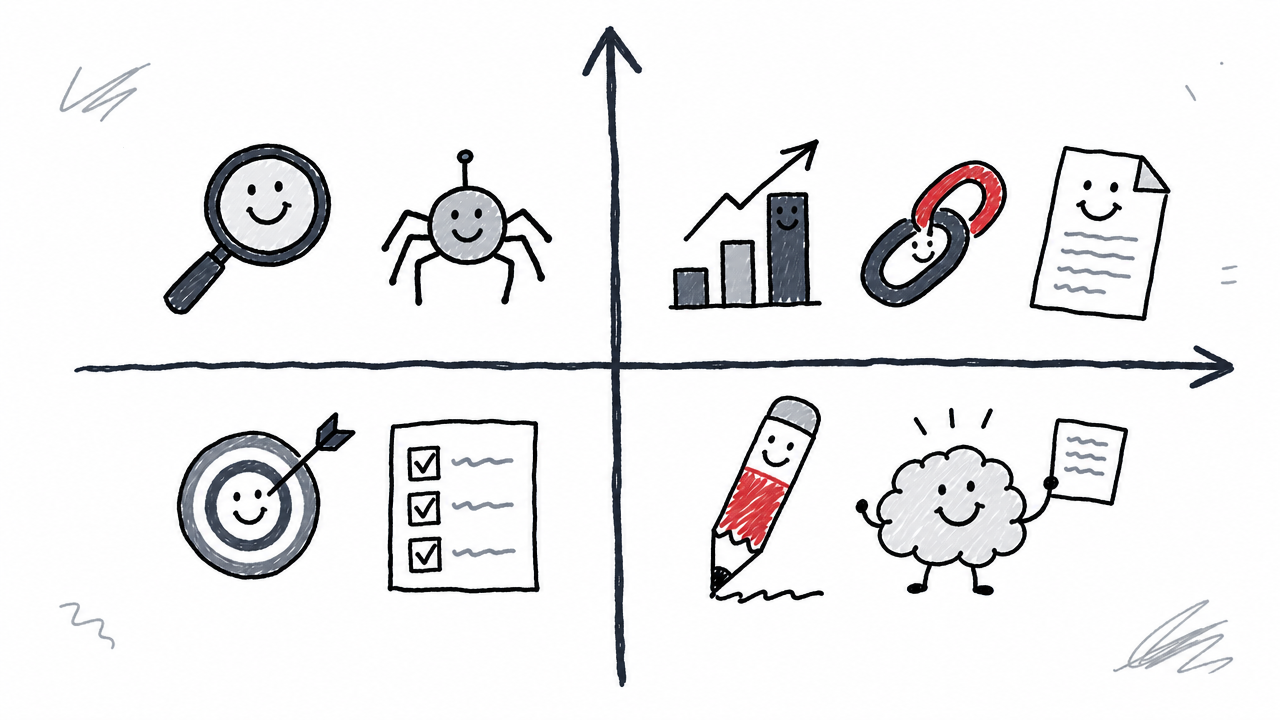
The evaluation framework: 10 criteria that matter for rankings
Every tool in this comparison was assessed on the same ten criteria, chosen because they reflect what Google's helpful-content and E-E-A-T guidance rewards.
- Research quality: Does the tool analyze current SERPs, identify search intent, surface competitor gaps, and map entities and questions?
- Draft quality: Is the output coherent, specific, useful, and grounded in facts rather than generically fluent?
- Originality potential: Can the user inject first-hand expertise, proprietary data, original examples, and unique viewpoints?
- SEO controls: Does it support entity insertion, internal links, metadata, heading structure, and content refresh workflows?
- Citation quality: Does it provide source links or distinguish verified claims from generated text?
- Editorial burden: How much rewriting and fact-checking remains after generation?
- Publishing workflow: Does it integrate with WordPress, Google Docs, Shopify, Webflow, or other CMSs?
- AI-search support: Does it track or improve visibility in Google AI Overviews, ChatGPT, Perplexity, Gemini, or Microsoft Copilot?
- Cost per useful article: Compare plan limits against the number of articles a team can realistically approve and publish.
- Post-publication measurement: Can the buyer connect the workflow to Google Search Console, ranking tracking, traffic analysis, and content decay alerts?
For a deeper look at how these criteria fit into end-to-end workflows, see our SEO automation guide covering tools and workflows.
Tool-by-tool breakdown
Surfer AI: best SERP-driven optimizer and generator
Surfer AI pairs the industry's deepest on-page analysis with a capable article generator, making it the strongest choice when SERP-driven optimization is the priority.
The Content Editor analyzes 500+ ranking factors across live SERPs, covering keyword optimization, entities, link equity, relevance, topic coverage, and topical authority. Surfer AI then generates full articles from a keyword, competitor selection, outline, and any knowledge you supply. Internal linking suggestions and entity recommendations are built into the editing workflow.
At $99/month billed yearly, Surfer is not the cheapest option. Editorial burden is medium: drafts are well-structured and topically aligned, but they still need fact-checking, first-hand examples, and voice refinement before publishing.
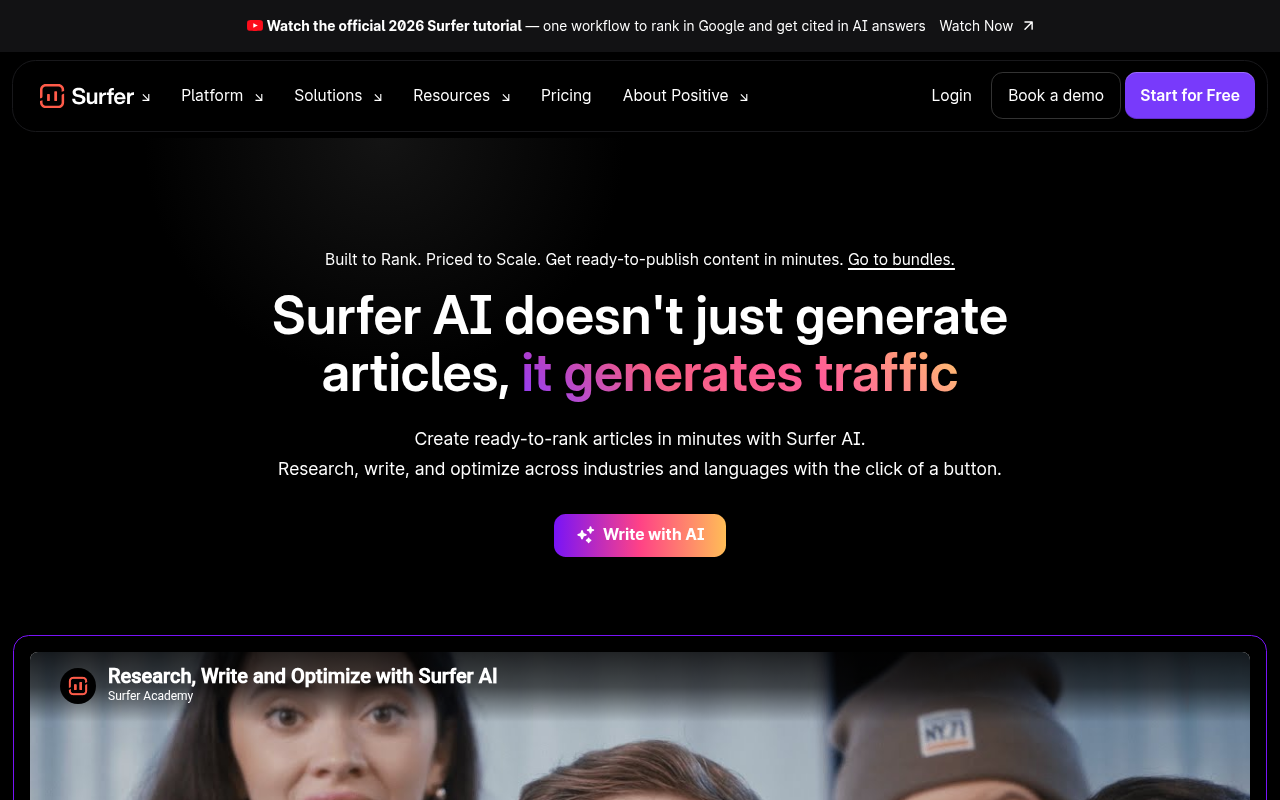
Frase: best integrated research-to-draft workflow
Frase connects research, brief creation, writing, and optimization in a single pipeline, cutting the tab-switching that slows most AI-assisted workflows.
Its SEO content optimization starts with a SERP-sourced research panel, extracts questions and headings from top competitors, and feeds them into an AI writer. SEO and GEO scoring run live as you edit. Frase also provides AI visibility tracking for ChatGPT and Google AI, a differentiator at its price point. A seven-day free trial (no credit card) lets buyers test before committing.
Starting at $39/month billed yearly for 10 articles/month, Frase delivers strong value. Editorial burden is medium: research grounding is solid, but generated prose sometimes needs specificity upgrades.
Jasper: best brand-voice and governed marketing platform
Jasper excels at brand control, not at SERP-level keyword optimization, and that distinction matters.
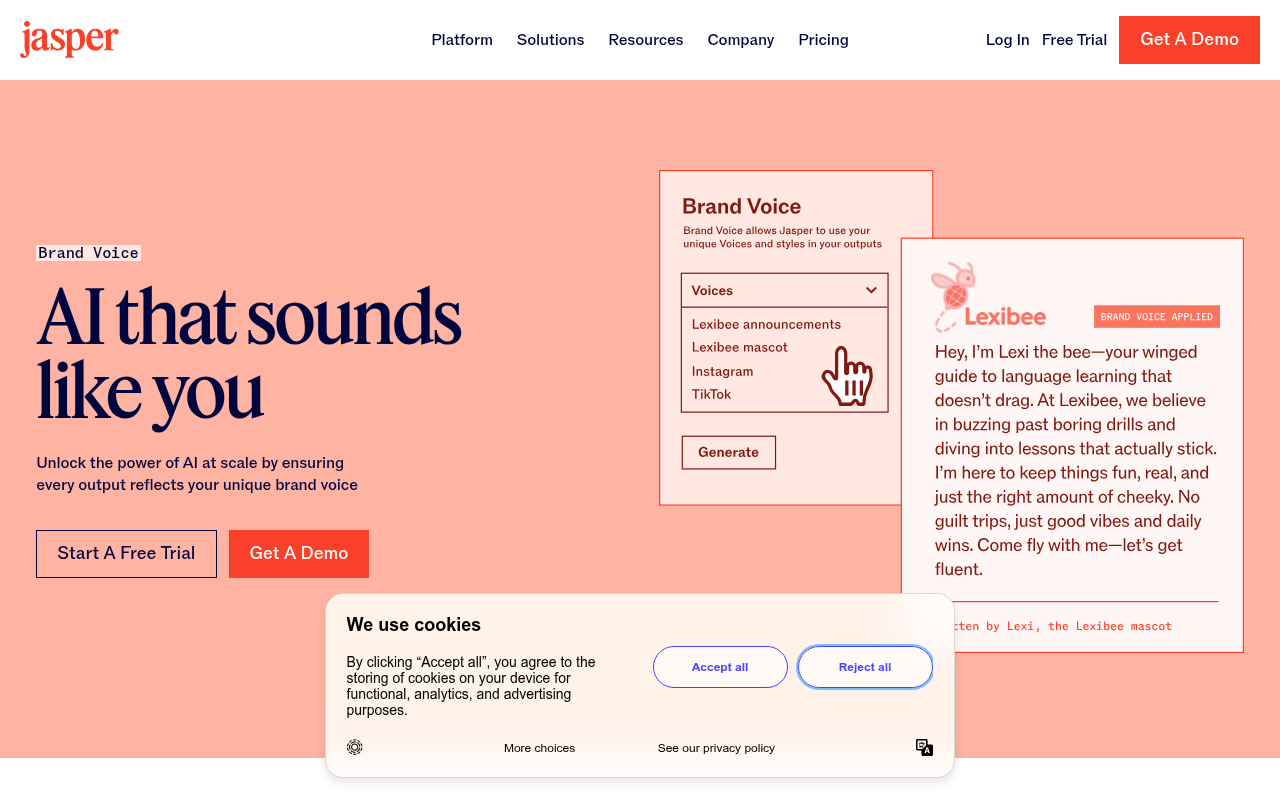
Brand Voice lets teams define tone, style, terminology, and knowledge guardrails so every output sounds consistent. Enterprise workflows, approval chains, and multi-channel repurposing are Jasper's real strengths. Jasper is not designed as a standalone SERP optimizer: teams typically pair it with Surfer (a native integration exists) or another optimization layer.
At $59/month billed yearly for the Pro plan ($69/month monthly), pricing is competitive for brand-governed content. Editorial burden is medium to high from an SEO perspective because you need an external optimization step.
Writesonic: best SEO/GEO article pipeline with citations
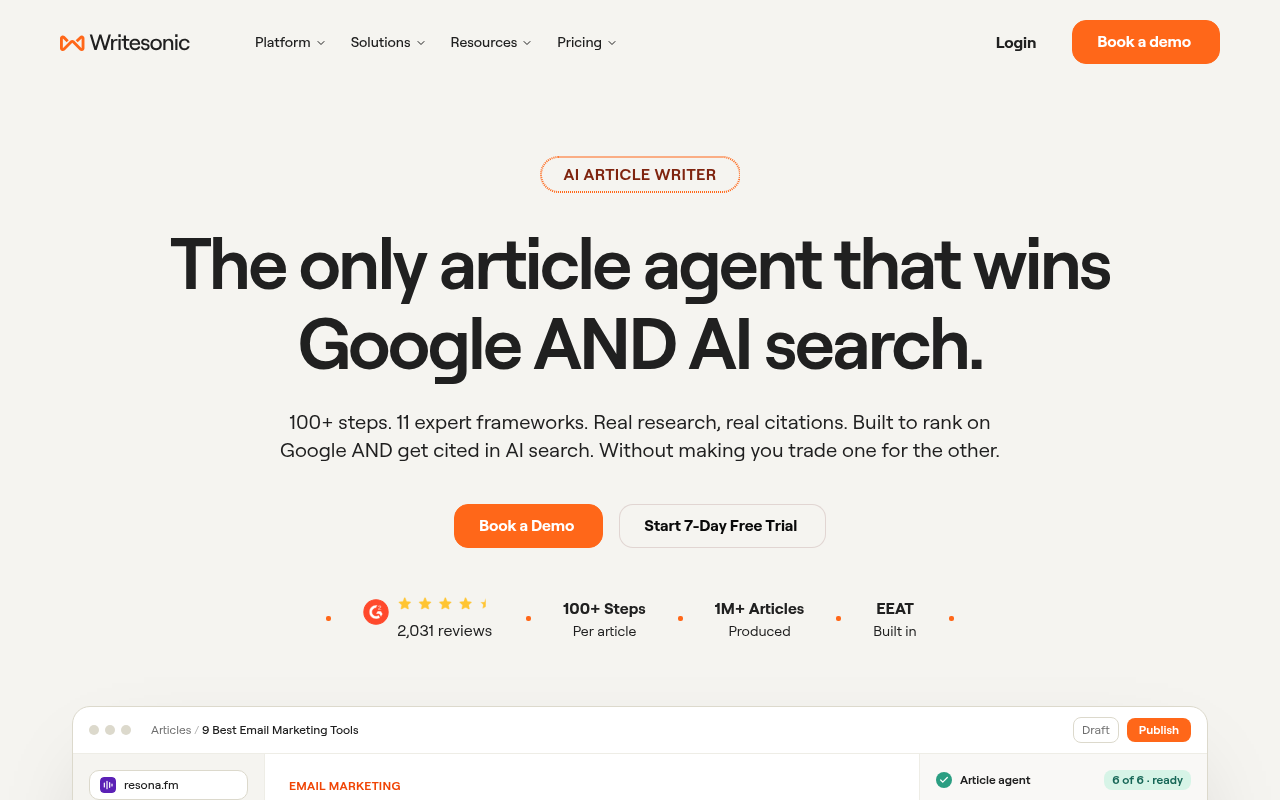
Writesonic's AI Article Writer claims a 100+ step workflow that includes research, competitor analysis, citations, and expert frameworks. These are product claims, not independently verified outcomes. The inline citation feature, however, is a genuine differentiator: drafts link to sources, giving editors a head start on fact-checking.
AI-search tracking covers ChatGPT, Gemini, and Google AI Overviews, with 50 prompts and answers tracked daily on the Starter plan. At $79/month billed yearly for 15 AI articles/month, cost per article is moderate. Editorial burden is medium: citations save time, but their accuracy still requires verification.
KoalaWriter: best low-cost starting point
KoalaWriter is the most accessible entry point for teams testing AI content generation before committing to a larger platform.
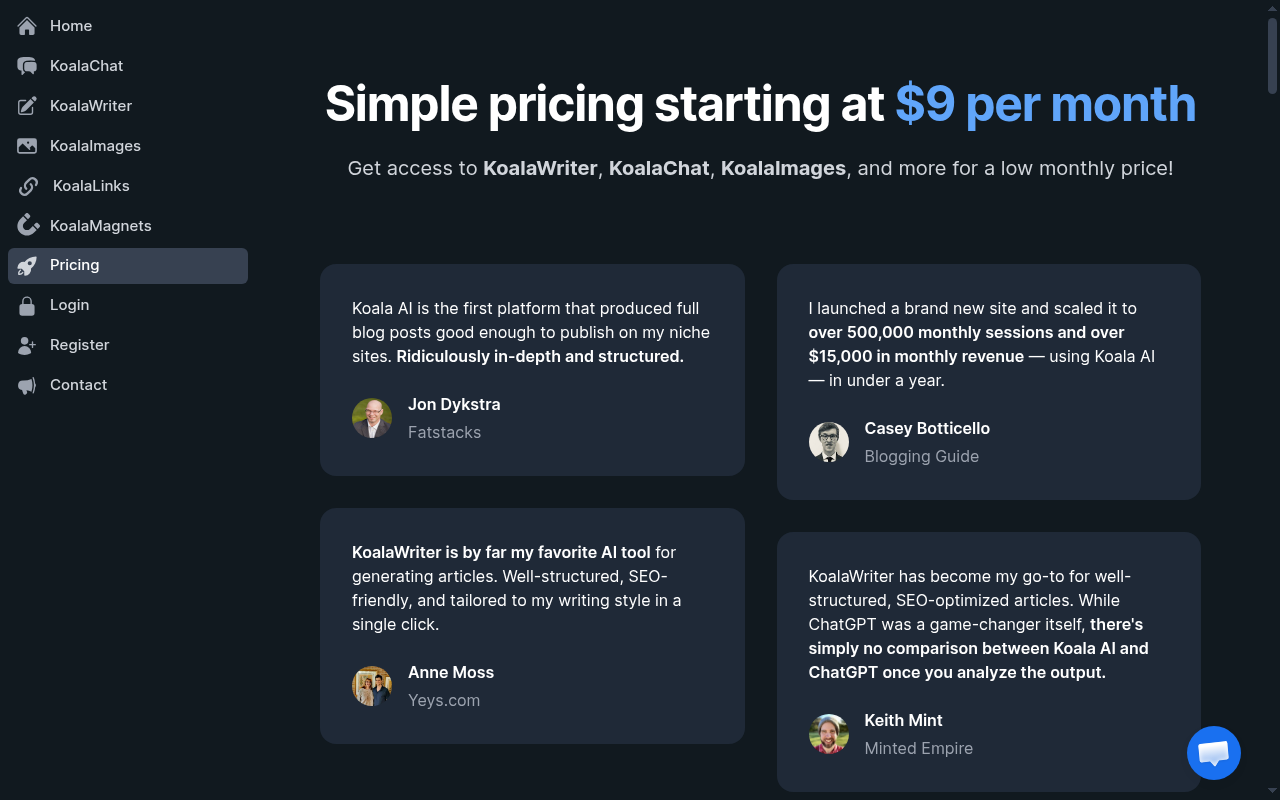
The Essentials plan at $9/month includes 15,000 KoalaWriter words, AI-powered SEO optimization, real-time factual data, and basic integrations. The Professional plan at $49/month adds deep research, AI editing, automatic internal linking, and WordPress publishing. SERP analysis is built in but less granular than Surfer's or Frase's.
Editorial burden is medium to high: drafts are functional starting points but often read generically. Budget buyers should plan for meaningful rewrites before publishing.
Scalenut: best integrated SEO/GEO workflow for growing teams
Scalenut combines GEO article creation, content optimization, keyword clustering, AI visibility tracking, and prompt tracking in a single platform built for scaling teams.
The current pricing page shows a Starter plan at $59/month, with a promotional annual price of $24/month (60% off). This annual discount is promotional and time-sensitive. Features include AI-generated articles with GEO optimization, cluster-based content planning, and visibility across AI engines.
Editorial burden is medium. The platform's cluster approach helps maintain topical authority, but individual article quality still benefits from human expertise and original examples.
NEURONwriter: best budget optimization platform
NEURONwriter offers SERP-based content optimization at a price point that suits freelancers and small teams.
The Bronze plan at $19/month billed annually ($23/month monthly) includes 25 content-writer analyses and 15,000 AI credits. Higher-tier Gold plans ($69/month) add one-click Content Designer articles, content planning, Google Search Console integration, WordPress/Shopify publishing, and AI monitoring. The platform's strength is structured competitor analysis rather than fluent long-form generation.
Editorial burden is medium. Optimization recommendations are solid; AI-generated text requires more polish than pricier competitors.
Clearscope: best premium optimization and AI-visibility layer
Clearscope is an optimizer and companion layer, not a one-click generator. It pairs best with skilled writers or existing AI drafts that need rigorous topical alignment.
At $129/month, the Essentials plan includes 50 tracked prompts, 50 tracked pages, 20 topic explorations, and 20 monthly drafts. AI-visibility tracking across prompts is a premium differentiator. The editorial burden is low in the sense that Clearscope is the editing step: it tells writers exactly which terms, questions, and structures to add.
Best for teams that already produce quality content and need a measurement layer confirming topical completeness and AI-search presence.
Can AI-generated content rank on Google?
Yes, but the evidence shows that heavily AI-generated pages underperform compared to human-led, AI-assisted content. Google does not penalize AI use itself; it penalizes low-value, scaled content regardless of how it was produced.
Google's official position is clear. According to Google Search's guidance on using generative AI content (last updated 2025-12-10), generative AI can help with research and structure, but generating many pages without adding value may violate the scaled content abuse policy. Google's broader AI-content guidance states that AI does not provide a special ranking advantage: useful, original content demonstrating E-E-A-T may perform well, while low-value content may not.
What the data shows: Ahrefs' July 2026 study analyzed roughly 1 million pages across 100,000 SERPs. Only 5.3% of top-ranking results were classified as 100% AI-generated, and 82.2% of top-three results contained less than 50% AI content. Estimated indexation dropped from 49.28% for low-AI pages to 40.35% for very-high-AI pages, and low-AI pages received 2–3 times more organic impressions (Ahrefs, 2026).
Semrush's April 2026 study of 20,000 keywords and 42,000 blog posts found that purely AI-generated content appeared in position one only 9% of the time, compared to 80% for human-written content. Notably, 64% of surveyed SEOs reported using a human-led, AI-assisted workflow (Semrush, 2026).
Important caveat: both studies rely on AI-content detectors, which are imperfect. Neither proves that human authorship itself causes higher rankings. The safe conclusion: AI help is not an automatic penalty, but heavily AI-generated content tends to overlap with quality problems (thin topical depth, missing first-hand experience, generic structure) that Google's systems are designed to deprioritize.
Do content scores predict Google rankings?
No. A Surfer, Frase, or Clearscope content score measures topical coverage or similarity to current top-ranking competitors. It is not a proxy for Google's ranking algorithm.
A high score is a useful editorial signal: it confirms that a page addresses the terms, entities, and subtopics that competitors cover. But chasing a perfect score can lead to keyword stuffing, bloated word counts, and formulaic structure, all of which may hurt rankings. Think of the score as a checklist for thoroughness, not a guarantee of position one. The real ranking factors (backlinks, domain authority, user engagement, content freshness) sit outside any optimization tool's scoring model.
How much human editing does AI SEO content need?
Every AI draft requires meaningful human work before it is ready to rank. The editorial layer is not optional; it is the ranking differentiator that separates commodity AI output from content that earns organic traffic.
Key tasks that remain after generation:
- Fact-checking: Verify every claim, statistic, and date. AI tools hallucinate confidently.
- Adding first-hand experience: Insert original observations, screenshots, proprietary data, and expert commentary that no LLM can generate.
- Replacing generic sections: Find paragraphs that any competitor could publish and rewrite them with unique angles.
- Adding original media: Include custom images, charts, videos, and examples.
- Checking citations and links: Confirm that every source URL loads, is current, and supports the claim made.
- Aligning with search intent: Re-read the target query and make sure the page answers it directly, not tangentially.
- Reviewing brand voice: Match tone, terminology, and style to your audience.
A human-in-the-loop workflow is what the data supports. Semrush's study found 64% of SEOs use a human-led, AI-assisted model (Semrush, 2026). For a deeper playbook, see our guide on how to automate SEO content writing without losing quality.
What about AI search visibility (GEO and AEO)?
Answer Engine Optimization (AEO) and Generative Engine Optimization (GEO) are approaches designed to make content appear in AI-generated answers from Google AI Overviews, Google AI Mode, ChatGPT, Perplexity, Gemini, and Microsoft Copilot. Several tools in this comparison track or claim to improve visibility in this emerging channel, but no tool can guarantee citation in any AI-generated answer.
Here is what each tool offers:
- Frase: SEO/GEO scoring and AI visibility tracking for ChatGPT and Google AI.
- Writesonic: AI-search tracking across ChatGPT, Gemini, and Google AI Overviews with daily prompt monitoring.
- Scalenut: GEO article creation, AI visibility tracking, and prompt tracking.
- Clearscope: AI-visibility tracking with 50 tracked prompts on Essentials.
- NEURONwriter: AI monitoring on higher plans.
The distinction between "AI visibility tracking" (monitoring whether your pages appear in AI answers) and actual citation growth matters. Tracking tells you where you stand; it does not directly increase citations. The factors that help, based on current understanding, include authoritative sourcing, structured data (FAQPage schema, Article schema), concise direct answers, and retrieval-augmented generation (RAG) compatibility. AI crawler monitoring also matters: make sure your robots.txt and server responses allow AI crawlers to index your content.
For a broader look at how GEO and AEO fit into automated workflows, see the complete guide to SEO automation.
Is a dedicated tool better than ChatGPT or Claude with a manual brief?
A skilled SEO professional can produce competitive content using ChatGPT, Claude, or Gemini with a carefully crafted manual brief. Dedicated AI SEO content generators add value through workflow automation, not through superior language generation.
The dedicated-tool advantages: live SERP data, competitor analysis, entity and topic maps, content scoring, internal linking suggestions, and one-click CMS publishing. These features save hours per article and reduce the chance of missing important subtopics.
The manual-brief advantages: full control over prompt engineering, no subscription lock-in, and the ability to use the latest model instantly.
When a dedicated tool delivers clear ROI: Teams publishing 10+ articles per month, writers without deep SEO expertise, and agencies managing several clients benefit most from structured workflows.
When a manual brief works just as well: Solo SEOs with strong keyword research skills, writers targeting low-competition niches, and teams already using a separate rank tracker and research tool can achieve comparable results without a new subscription.
Recommendation by use case
No single AI SEO content generator is best for everyone. The right choice depends on your team's size, editorial resources, budget, and whether you need generation, optimization, brand governance, or AI-search visibility.
- Best SERP-driven optimizer and generator: Surfer AI. Deepest on-page analysis (500+ factors) paired with a capable article generator.
- Best integrated research-to-draft workflow: Frase. Research, brief, writing, and SEO/GEO scoring in one pipeline at a competitive price.
- Best brand-voice and governed marketing platform: Jasper. Unmatched brand control; pair with an external optimizer for SEO depth.
- Best SEO/GEO article pipeline with citations: Writesonic. Inline citations and AI-search tracking across several engines.
- Best low-cost starting point: KoalaWriter. $9/month entry point for teams testing the category.
- Best integrated SEO/GEO workflow for growing teams: Scalenut. Keyword clusters, GEO articles, and AI visibility in a single seat.
- Best budget optimization platform: NEURONwriter. Solid SERP analysis at $19/month for freelancers and small teams.
- Best premium optimization and AI-visibility layer: Clearscope. The measurement and optimization companion for teams that already produce quality content.
What counts as ranking evidence
A tool's content score is not a ranking. A vendor case study is not a controlled comparison. A page appearing in a tool's sample output is not proof of organic performance. The most defensible test is publishing comparable pages on the same domain, targeting the same keyword cluster, with documented backlinks, domain strength, and human edits. Track indexation, Google Search Console impressions, and position changes over 30–90 days. Anything less is anecdotal.
FAQ
Does Google penalize AI-generated content?
No. Google does not automatically penalize content for being AI-generated. It penalizes low-value, scaled content created primarily to manipulate search rankings, regardless of whether a human or an AI produced it (Google Search's guidance on AI content).
Which AI SEO content generator is best for a small budget?
KoalaWriter Essentials at $9/month is the lowest entry point (checked 2026-08-05). NEURONwriter Bronze at $19/month billed annually adds deeper SERP optimization. Both require meaningful human editing to produce ranking-quality content.
Can AI SEO tools improve visibility in ChatGPT or Perplexity?
Several tools (Frase, Writesonic, Scalenut, Clearscope) track AI citations across ChatGPT, Perplexity, Gemini, and Google AI Overviews. No tool can guarantee inclusion. Structured data, authoritative sourcing, and concise direct answers are the most cited factors that help.
What is the difference between an AI writer and an SEO content optimizer?
An AI writer generates drafts from a keyword or prompt. An SEO content optimizer scores and improves existing content against SERP competitors. Some tools (Surfer AI, Frase, Scalenut) combine both functions in a single workflow.
What should a buyer test before paying for an AI SEO content generator?
Test with a real keyword you want to rank for. Check SERP research depth, draft accuracy, citation quality, editorial burden, and CMS integration. Use free trials where available (Frase offers a seven-day trial; several tools offer limited free plans). Publish a test article and track Google Search Console data for 30–90 days before committing to a full subscription.