
Semantic Keyword Clustering Explained
Learn how semantic keyword clustering groups queries by meaning rather than matching words, see how it differs from lexical and SERP-based methods, and follow a three-layer workflow to turn raw clusters into confident page assignments.

Semantic keyword clustering groups search queries by shared meaning, concepts, and context rather than by matching words or stems. Two queries can use entirely different vocabulary yet belong in the same cluster because they describe the same idea for the same audience. The output is a discovery hypothesis, not a final page-assignment decision: useful clustering also requires intent review and SERP validation. This article breaks down how semantic clustering works, where it differs from other grouping methods, and how to turn raw clusters into a reliable content plan.
What is semantic keyword clustering?
Semantic keyword clustering groups queries that share meaning even when they use different words. Instead of looking for repeated terms, it asks: "Are these searchers trying to learn, do, or buy the same thing?"
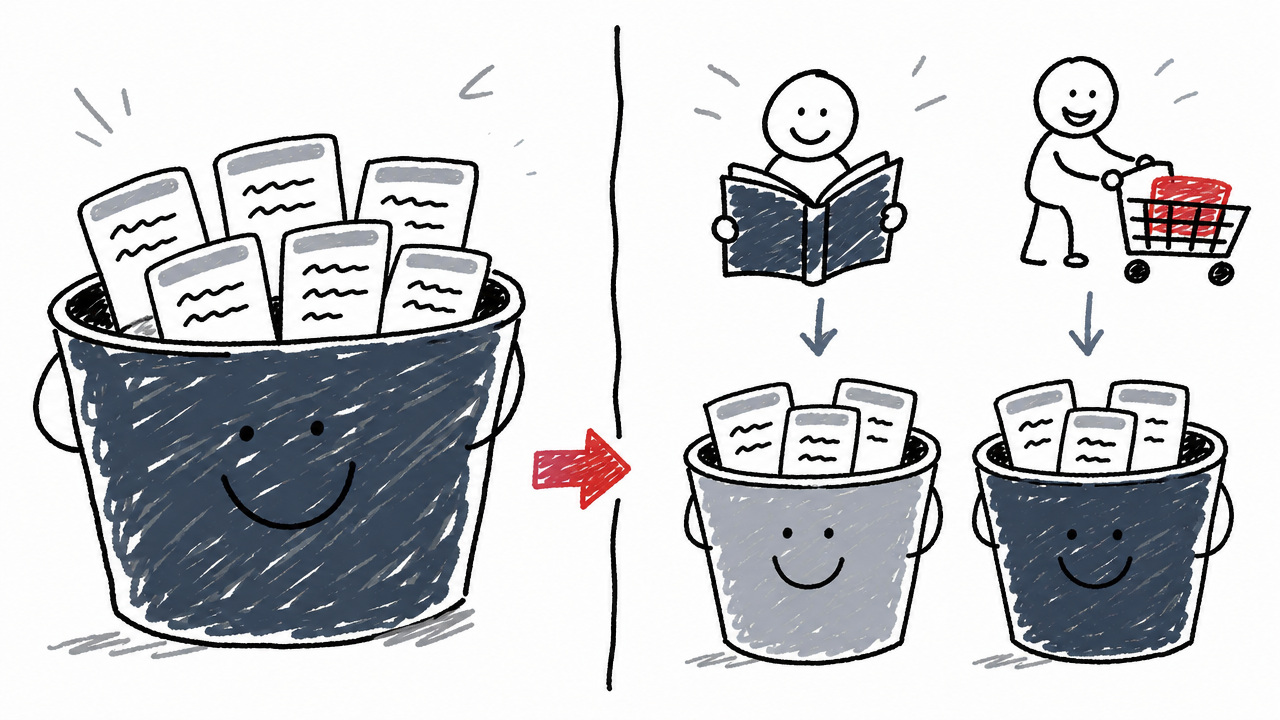
Think of a librarian sorting books by subject rather than by title words. A book called Running Faster and another called Jogging for Speed sit on the same shelf because they cover the same topic, even though their titles share no words. Semantic clustering applies the same logic to search queries. "Best running shoes" and "top sneakers for jogging" have zero word overlap, yet they describe the same buying decision and belong together.
Two distinctions up front. First, Google performs its own "clustering" during indexing, grouping pages with similar content and selecting a representative canonical page (How Google Search works). That is a separate, internal process, not the same as an SEO team grouping keywords. Second, the term "LSI keywords" appears often in SEO discussions, but Latent Semantic Indexing is an older retrieval technique. It should not be treated as an official Google ranking method or as a synonym for semantic keyword clustering.
Why semantic keyword clustering matters for SEO
Semantic clustering cuts duplicated effort, lowers the risk of keyword cannibalization, and surfaces subtopics a flat keyword list can miss. When dozens of query variations point to the same user need, you can build one strong page instead of five thin ones.
It also supports people-first content. Google prioritises content created to benefit people rather than content designed to manipulate rankings (Creating helpful, reliable, people-first content). Grouping by meaning keeps your focus on what searchers actually need, aligning every page with a clear user goal.
Clustering feeds topic/content-cluster planning and internal linking. By finding the semantic boundaries of a subject, you can map a pillar page, supporting pages, and the links between them with more precision. For a deeper walkthrough of clustering methods and the full process, see Keyword Clustering: The Complete Guide for SEO.
A caveat: clustering improves the quality of your plan, but it does not guarantee rankings, traffic, or topical authority. Google's AI Overviews and AI Mode use query fan-out to gather related information, which reinforces covering a topic well. Still, Google states that publishers do not need to create separate content for every possible query variation (Google's AI optimization guide).
What is the difference between semantic clustering and traditional keyword grouping?
The core difference: lexical grouping matches words; semantic grouping matches meaning. Both are useful at different stages, but mixing them up leads to either over-merging or over-splitting your keyword list.
Lexical (word-match) grouping
Lexical grouping collects queries that share the same root words, stems, or modifiers. If the string "semantic SEO" appears in a query, it goes into the "semantic SEO" bucket. The method is fast, clear-cut, and easy to run with a spreadsheet filter or regular expression. Its weakness is that it misses synonyms, related concepts, and intent nuances. It also pulls in queries that look alike but serve different purposes.
Semantic grouping
Semantic grouping connects queries by meaning, entities, and conceptual ties. It can place queries that share no surface words into the same cluster, and it can separate queries that look alike but address different user goals.
Worked example
Consider six queries around the topic "semantic SEO":
Lexical grouping lumps all six together because they share the modifier "semantic SEO." Semantic grouping combined with intent analysis keeps the first three together (one informational page could cover them) and separates the last three into one or two clusters because the searcher's goal, expected page format, and content type all differ.
How does semantic keyword clustering work?
At the technical level, semantic clustering converts queries into numbers, measures how close those numbers are, and then groups the closest ones. Each step involves choices and trade-offs.
Vector embeddings and language models
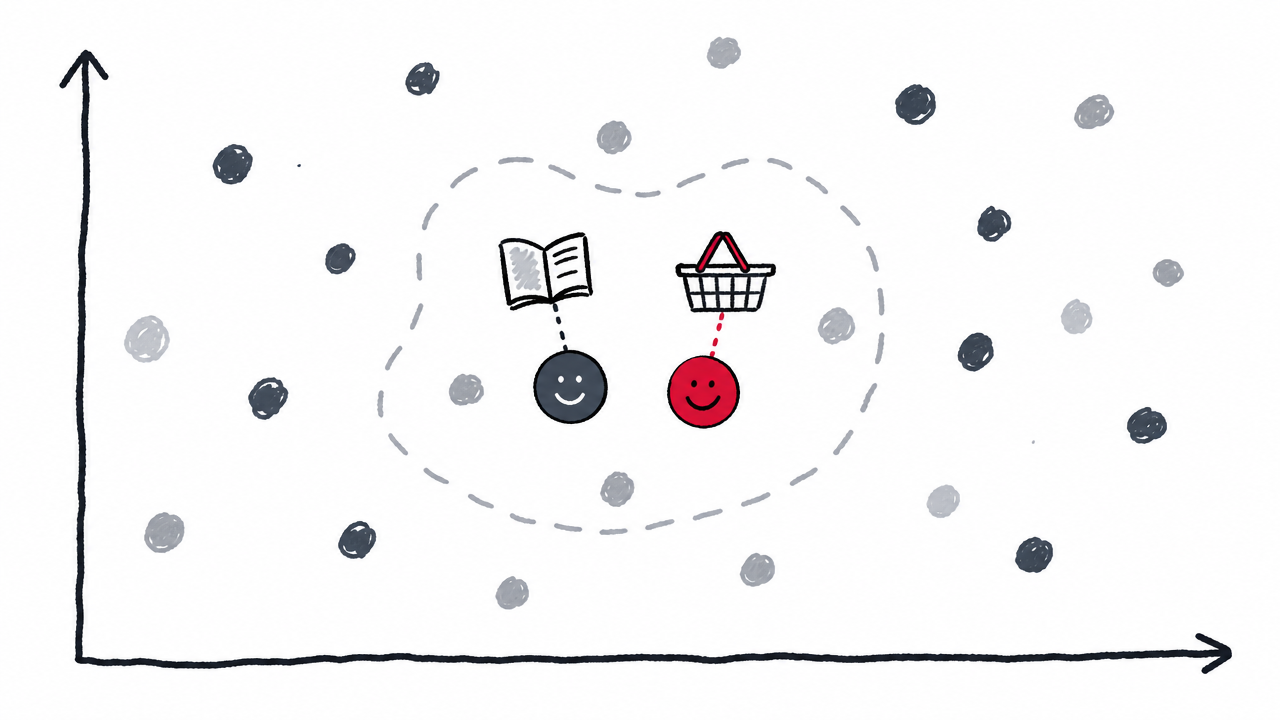
Words and phrases are turned into number arrays called embeddings. Each embedding sits in a high-dimensional space where distance stands for meaning: queries about the same concept land near each other; unrelated queries land far apart.
Modern embedding models are typically built on transformer architectures. Google confirms that BERT helps it understand how word combinations express different meanings and intent, and that RankBrain helps relate words to concepts so it can return relevant content even when a page lacks every exact word in a query (Google Search ranking systems guide). Third-party clustering tools use similar (though not identical) models to generate embeddings for keyword lists.
No single model or vector size is universally correct. The embeddings you get depend on the model, its training data, and how your queries are pre-processed.
Measuring semantic similarity
Once queries are vectors, the most common comparison method is cosine similarity: a score between −1 and 1 where 1 means the vectors point in exactly the same direction (identical meaning) and 0 means they are unrelated. A high cosine similarity score tells you two queries are conceptually close. It does not automatically mean they belong on the same page; it means they share the same general topic.
Clustering algorithms
After computing pairwise similarity, an algorithm assigns queries to groups:
Different algorithms and parameters produce different groupings from the same data. No single output is "the answer."
Limitations of embeddings
Embedding models capture conceptual closeness, not intent. "How to roast coffee" and "buy roasted coffee" sit close in embedding space because both involve roasted coffee, yet one is informational (a how-to guide) and the other is transactional (a product page). Over-grouping is the most common failure mode: the model says "these are related," and the practitioner skips the intent check.
Embedding-based clusters are a hypothesis about relatedness, not a map of what Google ranks together. They need a second layer of review.
Semantic clustering vs. SERP-based clustering
SERP-based clustering takes a different approach: it compares which URLs rank for different queries and groups queries that produce overlapping results. If eight of the top ten results for Query A also appear for Query B, the two queries likely belong together because Google already treats them as one result set.
The advantage is empirical grounding. You are working with what Google currently serves, not with a language model's abstraction. The disadvantage is instability. SERP overlap varies by country, device, language, location, personalisation, date, and SERP features (local packs, featured snippets, People Also Ask, AI Overviews). No universal overlap threshold (e.g., "40% overlap = same cluster") is reliable across all markets and niches.
The strongest approach is a hybrid: use semantic clustering for scale and discovery, then confirm with live SERP checks before making final page assignments. Semantic grouping tells you what could belong together; SERP validation tells you what Google currently treats together.
The three-layer workflow: from semantic groups to page assignments
This workflow is the article's core practical takeaway. Each layer narrows the candidate clusters until you have confident, testable page assignments.
Layer 1: semantic grouping for discovery
Start with a broad keyword list from your research tools. A dedicated keyword-research tool can surface related queries, estimated metrics, trend data, and SERP references during this upstream stage. Keyword Research by Timothe AI is one paid option that provides seed keyword metrics, related keyword rows, estimated volume, CPC, competition, monthly trends, and organic SERP snapshots. (Note: estimated volume, CPC, and competition figures are approximations and do not guarantee rankings, traffic, or conversions.) It is a research input, not an automatic clustering tool.
Once you have your list:
- Normalise terms. Lowercase, strip extra whitespace, and remove true duplicates.
- Group by meaning. Use an embedding model and a clustering algorithm for large sets (hundreds or thousands of queries). For smaller sets, careful manual review works: read each query, note its topic and what the searcher wants, and sort into groups.
- Label each group with a short semantic theme (e.g., "semantic SEO definition," "semantic SEO tooling").
Treat the output as candidate clusters, not finished assignments.
Layer 2: intent and business-context review
For each candidate cluster, classify every query's intent:
- Informational: the searcher wants to learn or understand.
- Commercial investigation: the searcher is comparing options.
- Transactional: the searcher is ready to buy, sign up, or download.
- Navigational: the searcher wants a specific site or page.
Also check audience, funnel stage, location, language, device context, and business value. Split clusters where intent diverges, even if the semantic theme is the same. The "semantic SEO" worked example above shows this: the informational queries stay together, while the tool-comparison and agency queries become separate clusters.
Layer 3: SERP validation for page mapping
Pull current SERPs for one or two representative queries from each candidate cluster:
- Inspect content type (blog post, product page, comparison table, directory listing).
- Check dominant format (long-form guide, listicle, video carousel, local pack).
- Note SERP features (People Also Ask, featured snippet, AI Overview).
- Compare URL overlap. If most of the same URLs appear for both queries, Google is treating them as one result set.
Apply the decision test: "Would the same page fully answer both searches?" If yes, merge. If not, keep them separate.
Assign each final cluster to one primary URL with its supporting queries. For ambiguous cases, record a confidence level and plan to test rather than assume. You can track which URL ranks for which queries in Google Search Console and adjust later.
For a deeper walkthrough of clustering methods and the full process, see Keyword Clustering: The Complete Guide for SEO.
How to map semantic clusters to URLs
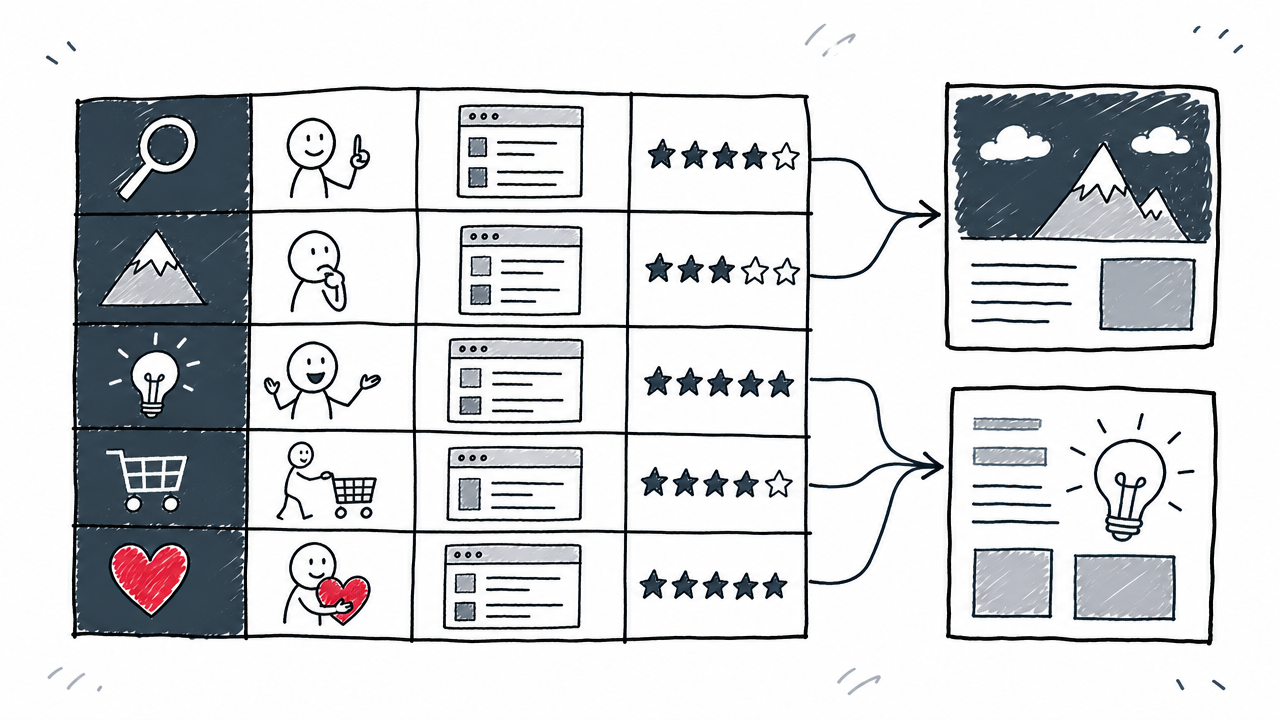
A cluster map is the artifact that bridges keyword research and content production. Use a simple spreadsheet or database with these columns:
Three structures readers often mix up need to stay distinct:
- Keyword cluster: the set of queries that one URL can serve.
- Topic/content cluster: several related pages (pillar + supporting) covering a broader subject, connected by internal links.
- Keyword group for tracking: a reporting set used to watch performance over time, which may or may not map 1:1 to a keyword cluster.
Google's language-matching systems can relate a page to queries even without exact-match terms (Google SEO Starter Guide). You do not need to stuff every query variation onto the page. Use natural language that serves the reader; the systems handle synonyms and varied phrasing.
Quick decision framework
Use this table when deciding whether to merge queries onto one page or split them across separate pages.
Google advises against creating separate content for every possible query variation (Google's AI optimization guide). When in doubt, favour fewer, stronger pages over many thin ones.
Common mistakes to avoid
- Treating semantic similarity as proof that queries belong on one page. Similarity means "related," not "same purpose."
- Relying on a single similarity score without SERP and intent checks. A 0.85 cosine similarity in one niche may be meaningless in another.
- Confusing a keyword cluster with a topic/content cluster. One is a set of queries for a single URL; the other is a multi-page architecture.
- Creating thin pages for every long-tail variation. This contradicts Google's guidance and usually produces weaker content.
- Equating clustering with guaranteed topical authority or rankings. Clustering improves planning; it does not automatically earn authority.
- Presenting "LSI keywords" as an official Google concept. Modern search systems use far more advanced language models than Latent Semantic Indexing.
FAQ
Can you do semantic keyword clustering by hand?
Yes, for small keyword sets. Review each query's meaning and intent, compare SERPs for representative terms, and group queries that a single well-crafted page could cover. Manual review gets impractical past a few hundred queries. At that scale, NLP tools help generate candidate groups, but those groups still need human review against intent and SERP evidence before you commit to page assignments.
How many keywords should be in a semantic cluster?
No fixed number works for every case. A cluster should hold every query that the target page can answer well: sometimes three, sometimes thirty. Size depends on the breadth of the topic and the range of intent within the group, not on an arbitrary cap. If adding another query would force the page into a different format or purpose, that query belongs in a different cluster.
Does keyword clustering prevent keyword cannibalization?
It lowers the risk by assigning each cluster to one primary URL, making it less likely that several pages compete for the same queries. Cannibalization can still happen if new content drifts into an existing cluster or Google picks a different URL than you intended. Regular checks of which URLs rank for which queries (via Google Search Console or a rank tracker) remain necessary.
Do you need exact-match keywords when using semantic clustering?
No. Google's systems understand synonyms, related concepts, and varied phrasing (Google Search ranking systems guide). Write in natural language that serves the reader. Exact-match repetition is unnecessary and risks keyword stuffing, which Google's own guidelines warn against (Google SEO Starter Guide).
Are "LSI keywords" the same as semantic keywords?
Not really. "LSI" (Latent Semantic Indexing) refers to a specific retrieval technique from the late 1980s. Modern search engines use far more advanced language models, including transformer architectures like BERT. The term "LSI keywords" persists in SEO discussions as shorthand for related terms, but it should not be treated as a current Google ranking method or as a direct synonym for semantic keyword clustering.