
How to Do Keyword Clustering: A Step-by-Step Guide
Learn how to do keyword clustering in 11 clear steps, from building your keyword list and comparing SERPs for overlap to mapping clusters to URLs and measuring


How to do keyword clustering: a step-by-step guide
Keyword clustering is the process of grouping search queries that can be served by the same page, based on shared intent and SERP overlap rather than similar wording alone. This guide delivers an 11-step, tool-independent workflow that takes you from scoping your market and building a keyword list through SERP comparison, merge/split decisions, URL mapping, and post-publication measurement. You will find a ready-to-use spreadsheet schema and a worked example showing when to merge terms onto one page and when to split them apart.
What is keyword clustering (and why it is not just sorting by topic)
Keyword clustering means deciding which search queries a single page can reasonably target, confirmed by intent alignment and SERP evidence. It is not the same as sorting keywords into topical folders by shared words.
Three terms appear throughout this guide, and each means something different:
- Keyword grouping: organizing terms by topic, modifier, or theme. Useful for discovery, but on its own not enough for page-level decisions.
- Keyword clustering: determining which terms one page can serve, using intent classification and SERP overlap as evidence.
- Topic/content cluster: a set of interconnected pages (often a pillar page plus supporting articles) covering a broader subject.
The distinction matters because similar wording does not prove keywords belong together. "Keyword clustering tool" and "how to do keyword clustering" share a root phrase, yet the searcher behind each query expects a different kind of page.
Google does not define "keyword clustering" as a named ranking factor. It is a practitioner workflow that aligns with Google's own guidance on grouping topically similar pages and reducing duplicate content (Google SEO Starter Guide). For a deeper conceptual overview, see Keyword Clustering: The Complete Guide for SEO.
What you need before you start
Before pulling any keyword data, confirm you have:
- A defined target market. Country, language, and device context. SERPs differ by locale; clustering with mixed-country data produces unreliable groups.
- At least one keyword research source. Google Keyword Planner (Google Ads Help), Google Search Console (Getting Started), competitor pages, autocomplete, or customer questions all work.
- A spreadsheet application. Google Sheets or Microsoft Excel.
- Access to a search engine in the target market for live SERP checks.
- Optional: a paid keyword research or SERP inspection tool such as Keyword Research by Timothe AI for upstream keyword discovery and SERP data. This is a paid research input, not an automatic clustering tool.
The 11-step keyword clustering process

Step 1: Set the scope
Define the country, language, device, and business goal before pulling any data. A keyword cluster built from UK SERPs will not match US results for the same query.
Record the scope in your spreadsheet header or a dedicated tab. For example: "Target: United States, English, desktop + mobile, goal: organic blog traffic for SaaS product." Every SERP check and volume estimate in later steps should stay within this scope.
Step 2: Build a broad keyword list
Collect queries from every available source. Cast a wide net now; you will trim later.
- Seed brainstorming. Start with the core terms your audience uses.
- Google Keyword Planner. Discover keyword ideas and monthly search estimates. Note that Keyword Planner requires a Google Ads account with billing information, and very low-volume or sensitive queries may not appear (Google Ads Help).
- Google Search Console. Export the queries and pages your site already ranks for. This reveals existing URL ownership and demand you are already capturing (Search Console documentation).
- Competitor page analysis. Review the headings, titles, and visible keywords on pages that rank for your seed terms.
- Autocomplete and related searches. Type your seed terms into Google and record the suggestions.
- Customer questions. Check support tickets, sales calls, forums, and community posts.
- Paid-search query reports. If you run ads, export actual search terms that triggered impressions.
Resist filtering too aggressively at this stage. Long-tail terms with low individual volume can strengthen a larger cluster once you confirm them in Step 5.
Step 3: Clean and normalize
Remove exact duplicates, obvious spam, and terms outside your scope (wrong language, unrelated product, etc.).
Normalize capitalization and punctuation so "Keyword Clustering" and "keyword clustering" do not appear as separate entries.
Preserve potentially meaningful variants. Keep both "keyword clustering" and "keyword clusters" until SERP evidence in Step 5 tells you whether Google treats them as the same search task. Premature de-duplication can hide real distinctions.
Step 4: Assign a first-pass intent and page type
Classify each keyword using four broad intent categories:
Assign a likely page type alongside the intent: guide, tool page, comparison, product page, category, glossary entry.
Treat automated intent labels from any tool as a starting hypothesis. Two queries can share vocabulary yet require different page formats. "What is keyword clustering" calls for a definition, while "how to do keyword clustering" demands a step-by-step process. Do not cluster them automatically just because they contain the same root phrase.
Step 5: Compare SERPs for overlap
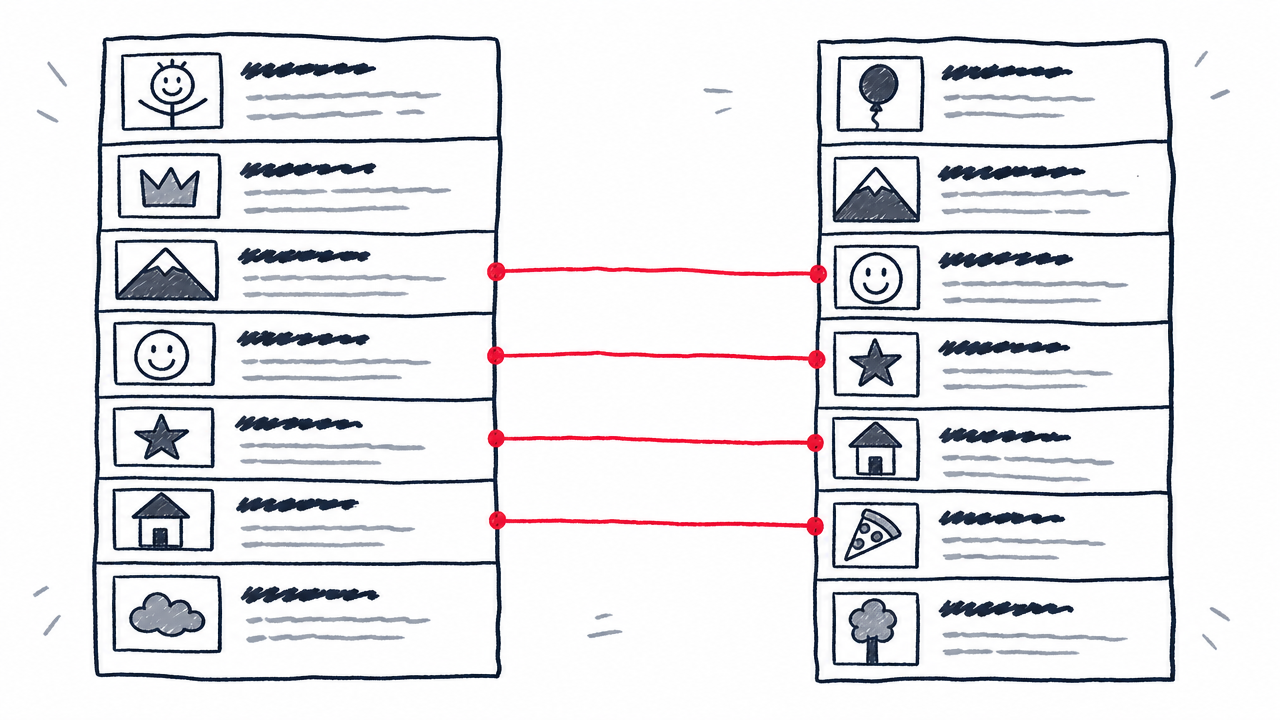
This is the core analytical step. SERP overlap is the strongest practitioner evidence for whether two queries belong on the same page.
The process:
- Search for each keyword (or a representative sample in large sets) within your defined market.
- Record the top 5–10 organic URLs for each query.
- Compare URL overlap between keyword pairs. If Query A and Query B share most of their top results, Google is likely treating them as the same search task.
- Note page types. Even if URLs overlap, check whether the dominant format differs (listicle vs. tutorial vs. product page). A format mismatch is a signal to investigate further.
- Inspect borderline cases manually. Automated overlap scores are only a starting point; always verify ambiguous pairs.
On thresholds: some tools let you set a number of shared URLs (e.g., 3 out of 10) to trigger a merge. No authoritative Google source defines a universal overlap threshold. Treat any number as a configurable starting point that depends on your market, query set, and SERP volatility. When in doubt, open both SERPs side by side and ask: "Would a single page make sense here?"
Step 6: Create the clusters
Group terms that share compatible intent and strong SERP overlap into a single cluster. Assign each cluster a stable ID and a human-readable name.
For a small keyword set (under 100 terms), a spreadsheet with manual SERP checks is practical. For larger sets, an automated tool can speed up the first pass. Tool categories include Semrush Keyword Strategy Builder, SE Ranking Keyword Grouper, Keyword Insights, and Ahrefs, among others.
Regardless of method, treat automated output as a draft to review. Software groups by algorithmic rules; your business context, site structure, and page-level judgment refine those groups into an actionable plan.
Semantic vs. SERP-based clustering
Two common approaches exist, and they solve different problems:
- Semantic (or morphological) clustering groups keywords by shared words, stems, synonyms, or embedding similarity. It is fast, works without live SERP data, and is helpful for organizing a large raw list or discovering subtopics you might have missed. However, it can over-merge terms whose wording overlaps but whose intent diverges. "Keyword clustering tool free" and "keyword clustering definition" are semantically close yet belong on different page types.
- SERP-based clustering groups keywords by how much their actual search results overlap. It reflects how Google currently interprets each query, making it stronger evidence for page-level decisions.
Best practice: use semantic clustering for initial discovery and organization, then confirm (or override) those groups with SERP overlap checks. Neither method alone is enough. Semantic similarity can flag candidates; SERP evidence decides.
Step 7: Apply the merge/split test
For each tentative cluster, ask three questions:
- Would one page fully answer both queries? If a searcher landing on the same page for both terms would find a complete answer, merge.
- Do the queries share the same dominant intent and expected page format? A definition and a tool comparison rarely belong on one page.
- Do the SERPs show similar URLs and page types? If the top results diverge, the queries likely need separate pages.
If all three answers are yes, merge. If any answer is no, split.
If a large cluster contains a clear parent topic and distinct subtopics, consider a pillar-plus-supporting-page structure rather than one oversized page. A cluster around "keyword clustering" might have a pillar guide, a separate tools comparison, and a separate glossary entry for the definition.
Step 8: Select the primary keyword
Choose the term that best represents the page's dominant intent, reads naturally in a title and H1, and aligns with business priority.
Do not default to the highest estimated search volume. A high-volume head term may be too broad or too competitive to capture realistically. The primary keyword should be the term you want the page to be known for.
All other terms in the cluster become secondary (supporting) keywords. They guide H2s, subheadings, and body copy, without forced repetition.
Step 9: Map each cluster to a URL
For each cluster, decide its URL destination:
This step directly prevents keyword cannibalization by ensuring one intended URL per cluster. Record the Status field in your spreadsheet so every cluster has a clear owner.
Step 10: Build and connect the content
Use the cluster to inform page structure: primary keyword in the title and H1, secondary keywords guiding H2s and coverage.
Link related clusters' pages to each other where genuinely useful. A how-to guide about keyword clustering might link to a tools comparison and to a broader keyword clustering guide.
Distinguish keyword-cluster-informed on-page work from broader content-cluster architecture. A keyword cluster maps queries to one page. A content cluster connects pages into a coherent topic hub. Both matter, but they operate at different levels.
Google's SEO Starter Guide recommends descriptive URLs, helpful internal links, and anticipating readers' search terms (Google SEO Starter Guide). Your clusters give you the raw material to follow that advice with precision.
Step 11: Measure and revise
After publication, track the cluster's performance using Google Search Console. Segment by query, URL, country, and device. The key metrics:
- Impressions: how often the page appears for the cluster's queries.
- Clicks: actual visits from search.
- CTR: the ratio of clicks to impressions.
- Average position: a diagnostic signal that is best read alongside impressions and clicks, not in isolation.
- Conversions: leads, signups, purchases, or whatever matters to your business.
Compare a fixed reporting period against a baseline. Google's traffic-drop documentation advises that impressions and clicks are more useful indicators of site performance than position alone (Google Search Central).
Review clusters at least quarterly, or sooner when you notice sustained ranking shifts, new competitors, or changes in SERP composition. Re-run SERP overlap checks if intent or competition has evolved. A cluster that was valid six months ago may need splitting or merging today.
Recommended spreadsheet schema
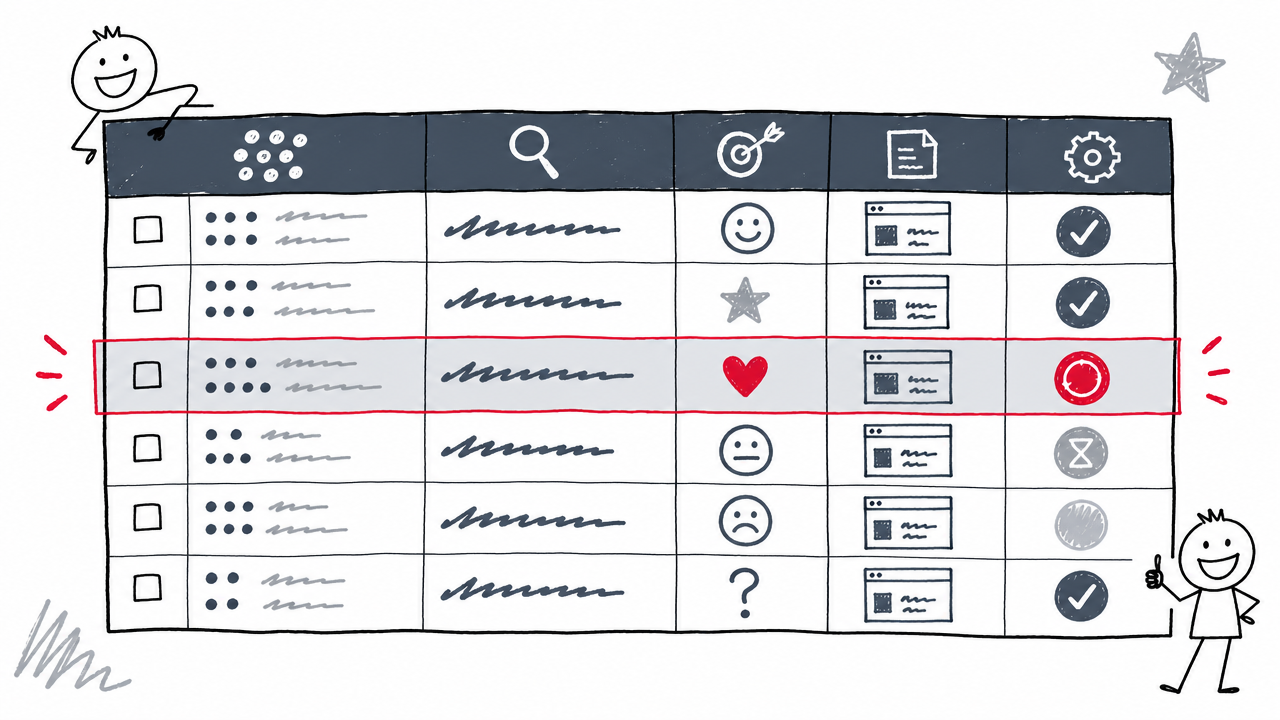
A well-structured spreadsheet keeps your clustering decisions documented and repeatable.
Volume, keyword difficulty, and CPC are estimates from third-party tools or Google Ads. They do not guarantee rankings, traffic, or conversions.
Worked example: merging and splitting in practice
Consider four keywords from the same topic area:
- "what is keyword clustering"
- "how to do keyword clustering"
- "keyword clustering tools"
- "keyword clustering vs keyword grouping"
SERP overlap analysis:
Searching "what is keyword clustering" and "how to do keyword clustering" returns overlapping results. Many of the same guides rank for both. The dominant page type is an in-depth article covering definition, benefits, and process. Verdict: merge. One guide can answer both queries.
Searching "keyword clustering tools" returns a different set of results dominated by comparison pages, tool landing pages, and listicles. Even though the root phrase is the same, the intent is commercial investigation, not informational. Verdict: split. This needs a separate comparison or tool-review page.
Searching "keyword clustering vs keyword grouping" returns a mix: some pages are the same guides that rank for the first two queries (with a section addressing the distinction), while others are standalone comparison posts. Verdict: conditional. If your guide already has a clear definitions section that addresses this question, folding it in is reasonable. If SERP evidence shows standalone comparison posts dominating, consider a separate page.
This small example illustrates the principle: shared root words do not determine clusters. Intent, SERP overlap, and page type do.
Common mistakes to avoid
1. Clustering by word similarity alone without checking SERPs. Two queries can share every word except one modifier and still require different pages. Always confirm with SERP evidence.
2. Using search volume as the sole deciding factor. A high-volume term that mismatches your page's intent will not convert. Focus on intent alignment and realistic opportunity over raw demand estimates.
3. Mixing SERP data from different countries or languages. UK and US results for the same query can differ. Cluster within one market at a time.
4. Creating one page per keyword (over-splitting). This produces thin, competing pages that dilute your authority. If SERPs overlap, consolidate.
5. Forcing every related query onto one oversized page (over-merging). A 10,000-word mega-page that tries to cover informational, commercial, and navigational intent at once serves none of them well. Split when intent diverges.
6. Treating automated tool output as final without manual review. Software applies algorithmic rules. It cannot assess your site structure, business goals, or the nuance of borderline SERPs. Always review important clusters yourself.
7. Equating average position with business impact. A cluster's average position dropping from 8 to 12 is a reason to investigate. Check impressions, clicks, CTR, and conversions before deciding whether content needs rewriting.
FAQ
What is keyword clustering?
Keyword clustering is the practice of grouping search queries that a single page can reasonably target. The grouping is based on shared search intent and overlapping SERPs, not just similar wording.
How do you cluster keywords for SEO?
Follow the 11 steps in this guide: set your scope, build a broad keyword list, clean and normalize it, assign intent and page type, compare SERPs for overlap, create clusters, apply the merge/split test, select a primary keyword, map each cluster to a URL, build the content, and measure results.
How do you cluster keywords manually?
For small sets (under ~100 terms), use a spreadsheet. List each keyword in a row, search for it in your target market, record the top organic URLs, and compare overlap between keyword pairs. Group terms that share most of their top results and the same intent into one cluster. Steps 5 through 7 above walk through this process in detail.
What tools can automate keyword clustering?
Several tools offer automated or semi-automated clustering: Semrush Keyword Strategy Builder, SE Ranking Keyword Grouper, Keyword Insights, and Ahrefs. They typically compare SERP overlap or semantic similarity at scale. Treat their output as a first draft and review important groups manually (see Step 6).
How many keywords should be in a cluster?
There is no fixed number. A cluster can range from two or three terms to dozens. Size depends on how many queries share the same intent and can be served by one page. A cluster with 50 terms is fine if SERP overlap supports it.
Should keywords with similar wording always be grouped together?
No. Similar wording does not guarantee shared intent. Check SERP overlap and the dominant page type. Queries like "keyword clustering guide" and "keyword clustering tool" often require different pages despite sharing the root phrase.
What is SERP-based keyword clustering?
SERP-based clustering groups keywords by how much their actual search results overlap. If two queries return mostly the same top-ranking URLs, Google is likely treating them as the same search task, and one page can target both.
What is semantic keyword clustering?
Semantic clustering groups keywords by shared words, stems, synonyms, or embedding similarity. It works without live SERP data and helps with initial organization and discovery. However, it can over-merge terms whose wording is similar but whose intent differs, so it should be confirmed with SERP overlap checks.
Can low-volume keywords be included in a cluster?
Yes. Long-tail terms with low individual volume can collectively represent meaningful demand and help a page cover a topic more thoroughly. The keyword "how to cluster keywords" shows only an estimated 10 monthly searches, yet it reinforces the same intent as higher-volume variants.
Is keyword clustering the same as a topic cluster?
No. A keyword cluster maps related queries to one page. A topic or content cluster is a set of interconnected pages (often a pillar page plus supporting articles) covering a broader subject. Keyword clustering informs which queries each page within a content cluster should target. For the full relationship between these concepts, see Keyword Clustering: The Complete Guide for SEO.
How should keyword clusters be prioritized?
Combine three factors: business value (does this topic drive revenue, leads, or strategic goals?), intent alignment (can your site deliver what the searcher expects?), and realistic ranking opportunity (given current competition and your domain's authority). Volume alone is a poor prioritization signal because a high-volume cluster you cannot rank for, or one that attracts unqualified visitors, delivers little return.
Should keyword clustering be done separately for each country and language?
Yes. SERPs, intent, and competition vary by market. A cluster built from US results may not hold for the UK, Australia, or non-English markets. Define your scope (country, language, device) in Step 1, and run separate clustering rounds for each market you target. Mixing SERP data across locales is one of the most common clustering mistakes (see Common Mistake #3 above).
How often should keyword clusters be reviewed?
Review clusters at least quarterly or whenever you notice sustained ranking shifts, new competitors, or changes in SERP composition. Intent and competition evolve; a cluster that was valid six months ago may need splitting or merging today. Use Google Search Console data to detect when a cluster's performance has changed.
How do you measure the performance of a keyword cluster?
Track the cluster's intended URL in Google Search Console, segmented by the cluster's queries, country, and device. Compare impressions, clicks, CTR, and conversions against a baseline period. Average position is useful as a diagnostic detail but should be read alongside traffic and conversion data, not in isolation (see Step 11).