
Keyword Clustering: The Complete Guide for SEO
Learn what keyword clustering is, how SERP-based and semantic methods work, and follow a step-by-step workflow to group keywords, prevent cannibalization, and b

Keyword clustering is the practice of grouping search queries that share the same user intent so a single page can target them together, rather than creating one page per keyword. It prevents content overlap, strengthens topical coverage, and produces a more efficient content plan. This guide covers the definition of keyword clustering, the methods behind it (SERP-based and semantic), a step-by-step workflow you can follow right away, the tools that support the process, and how to measure results.
What is keyword clustering?
Keyword clustering means grouping keywords with overlapping search intent and similar SERP results so they can be addressed by one URL. Instead of writing a separate article for "how to brew pour-over coffee," "pour-over coffee technique," and "best way to make pour-over," you recognize that these queries seek the same answer and serve them with a single, thorough page.
A keyword cluster is a defined set of queries mapped to one page, with a clear primary keyword and supporting secondary keywords. It goes beyond a loose list of related terms. The distinction matters: "coffee brewing methods" and "pour-over coffee technique" are related, but they may require different pages because searchers want different depths and formats.
Here is the core vocabulary:
- Primary keyword: the single term that best represents the page's scope and intent.
- Secondary keywords: related queries, synonyms, and long-tail variants within the same cluster.
- Search intent: the underlying goal behind a query (informational, commercial, transactional, or navigational).
- SERP overlap: the degree to which two queries share the same top-ranking URLs, signaling that Google treats them as the same intent.
Think of it like organizing a library. Books on the same narrow topic share one shelf (one page). Books on a broader subject span an entire section (a topic cluster with several pages). A keyword cluster defines which books belong on the same shelf. As the Ahrefs blog explains, the goal is to group similar-intent keywords so each page covers a coherent set of queries rather than splitting effort across many thin pages.
Why keyword clustering matters for SEO
Clustering is not a ranking factor by itself. No Google documentation says "cluster your keywords and you will rank higher." But it addresses three structural problems that hold sites back: missed query coverage, keyword cannibalization, and unfocused content plans.
Capture more queries per page
A well-structured page can rank for dozens or even hundreds of related queries. When you cluster keywords before writing, you ensure that the page's headings, subtopics, and examples cover those variants on purpose.
One common misconception: adding the search volumes of every keyword in a cluster and calling it "total traffic potential." The same users often search several variations, and the same URLs rank across them. Shared search volume does not equal unique additive traffic. Treat cluster volume as a relevance signal, a directional guide rather than a traffic guarantee.
Prevent keyword cannibalization
Cannibalization happens when several pages on your site compete for the same intent. Google has to choose which one to show, and it may pick neither consistently. The result: diluted link equity, split impressions, and unstable rankings.
Clustering solves this by assigning each intent group to exactly one URL. If "keyword clustering" and "keyword grouping" share the same SERP results, they belong to one page. You do not create two articles and hope Google figures it out.
Build a focused content plan
Without clustering, keyword research often produces a sprawling list of topics that overlap in unpredictable ways. Clustering reveals genuine content gaps versus redundant ideas. It supports pillar-and-spoke architecture and builds topical authority by ensuring each page covers a complete, coherent set of queries.
Google's own guidance on creating helpful, people-first content stresses thorough, original pages that add real value. Clustering is the planning step that makes this practical at scale.
Keyword cluster vs. topic cluster vs. keyword mapping
These three terms are often used interchangeably, but they describe different things at different levels of scope.
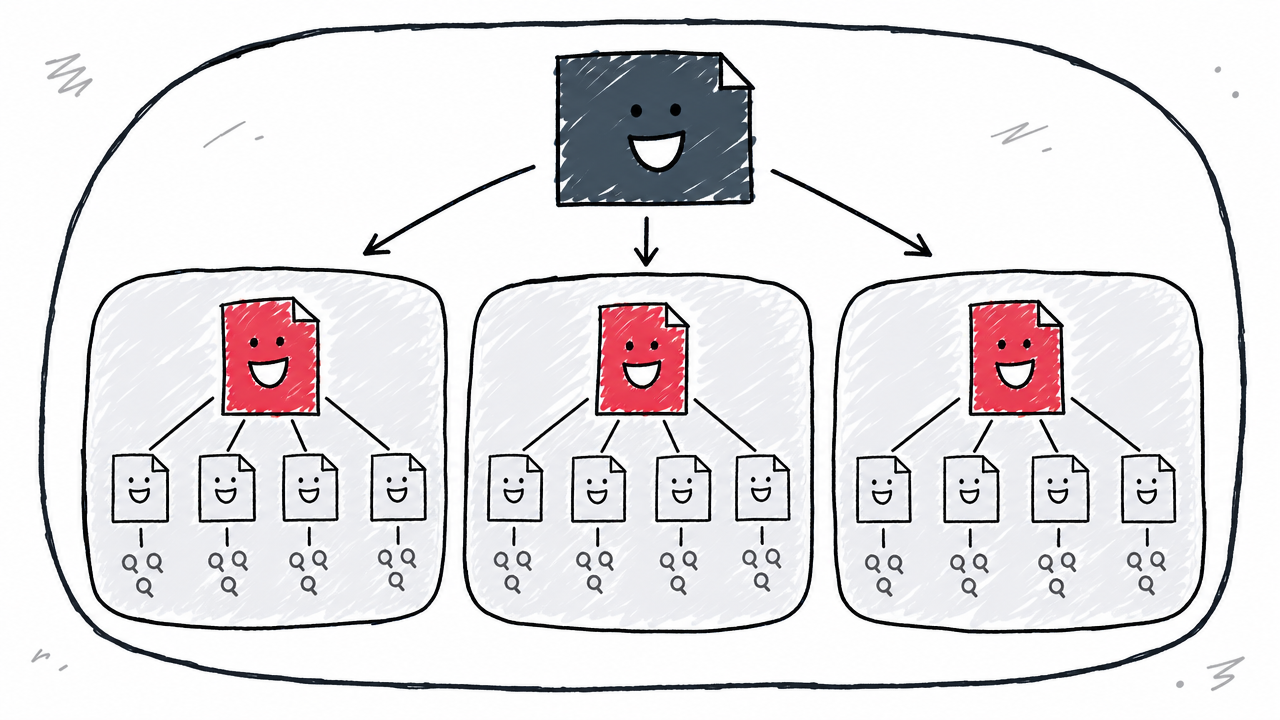
A keyword cluster is a group of queries assigned to one page. A topic cluster is a site-architecture pattern: a pillar page linked to several spoke pages, each covering a subtopic. A topic cluster contains several keyword clusters. Keyword mapping is the broader spreadsheet exercise of assigning every keyword cluster to a specific URL across the entire site.
Clarity here prevents a common mistake: treating "keyword clustering" and "topic clustering" as the same task. You cluster keywords to decide what goes on a single page. You build topic clusters to organize how those pages relate to each other across your site.
How SERP-based keyword clustering works
SERP-based clustering relies on a straightforward principle: if two queries return largely the same set of top-10 URLs, Google treats them as the same intent, and one page can serve both.
Here is a mini-example. You check the top 10 organic results for "keyword clustering" and "keyword grouping." Four of the same URLs appear in both result sets. That strong overlap signals that these queries belong in one cluster and should target the same page.
The heuristic often cited is three or more shared top-10 URLs as a starting threshold. The HubSpot clustering article describes this approach. This heuristic is a useful working guideline, not a Google rule or ranking factor. No official threshold exists.
The heuristic breaks in several situations:
- The same URLs appear, but the page types differ. One query triggers mostly how-to guides while another triggers product pages. Ranking overlap alone does not prove intent alignment.
- Featured snippets or search features diverge. One query produces a People Also Ask box focused on definitions, while the other surfaces comparison tables. The user needs differ even if some organic URLs overlap.
- The overlap sits right at the threshold. Borderline cases need manual inspection: look at the pages that rank, the content they provide, and whether your single page could genuinely cover both queries.
SERP-based clustering is the most reliable method because it uses Google's own reading of intent as evidence. The limitation is speed: checking live results for thousands of keywords by hand is impractical, which is why tools and automation matter.
What is semantic keyword clustering?
Semantic clustering groups keywords by linguistic or topical similarity: synonyms, shared modifiers, and closely related concepts. It relies on the words themselves to find relationships, without querying live search results.
This approach is useful for speed and initial drafts. You can process thousands of keywords quickly using NLP embeddings, cosine similarity scores, or AI-powered tools. "Best running shoes," "top running shoes," and "running shoe reviews" would land in the same group because their words overlap semantically.
The limitation matters: semantic similarity alone does not prove shared search intent. "Running shoes for flat feet" and "running shoes for marathons" look similar but may return completely different SERP formats and address different user needs. One might trigger product pages, the other informational guides.
For technically inclined readers, common algorithmic approaches include k-means clustering, agglomerative (hierarchical) clustering, and DBSCAN. The scikit-learn clustering documentation covers these methods in detail. These algorithms group data points by mathematical distance, not by Google's ranking behavior. An NLP cluster is a hypothesis about intent, not proof of it.
SERP-based vs. semantic clustering: which should you use?
Use both. The recommended approach is a hybrid workflow: semantic grouping for discovery and speed, SERP checking for final decisions.
Semantic tools generate candidate groups quickly. You then check representative keywords from each group against live search results to confirm or split the clusters. SERP evidence is the decision point; semantic tools save time getting there.
Both the Ahrefs and Semrush blogs describe workflows that combine these methods. The key insight: never skip SERP checking. A semantically perfect group that targets two different intents will produce a page that serves neither audience well.
Step-by-step keyword clustering workflow
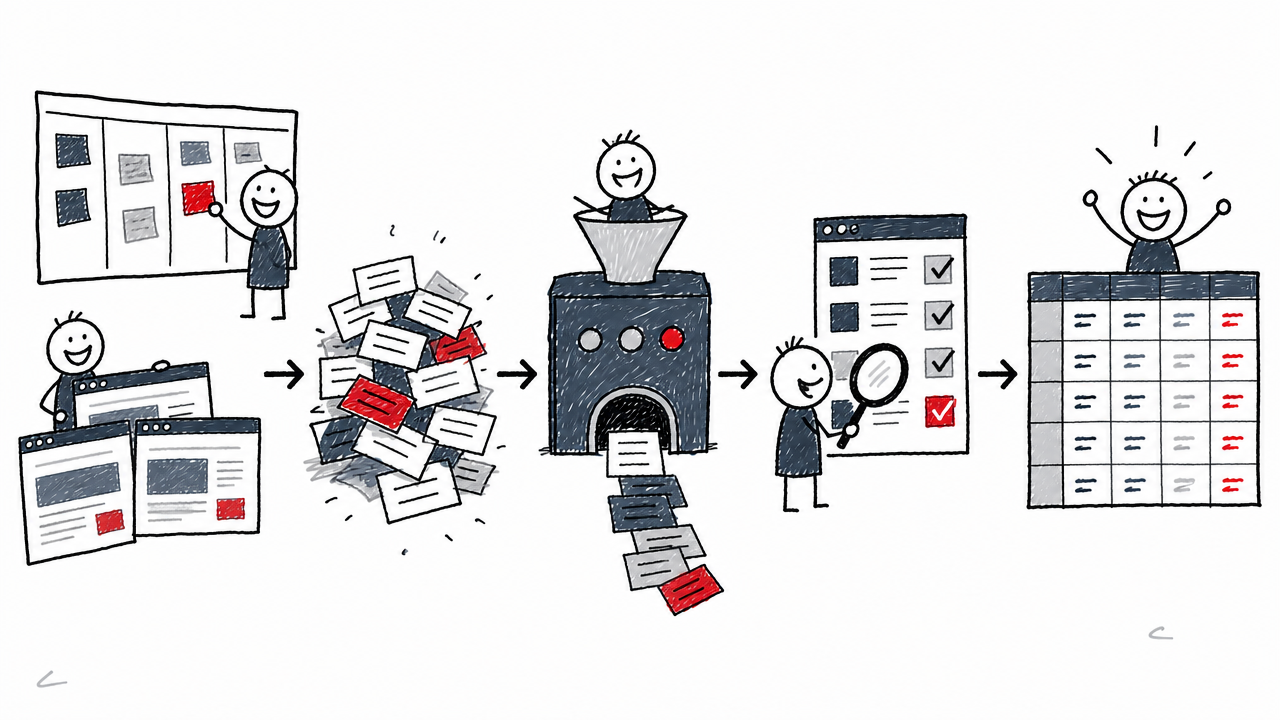
This workflow moves from raw keyword research to validated clusters mapped to specific URLs. Each step narrows the list and increases confidence in your content plan.
Step 1: collect a broad keyword set
Start wide. Pull keywords from several sources to avoid blind spots:
- Google Keyword Planner for keyword ideas and search trends (note: this is primarily an advertising tool; its volume data is directional, not a precise organic-traffic forecast)
- Google Search Console for queries your site already receives impressions on
- Competitor analysis through tools like Semrush or Ahrefs Keywords Explorer
- Google Autocomplete and People Also Ask for real user phrasing
- Internal site-search logs for what visitors type on your site
- Related searches at the bottom of Google results pages
At this stage, quantity matters more than precision. You will clean the list next.
Step 2: clean and normalize the list
Remove exact duplicates. Standardize plurals ("keyword cluster" / "keyword clusters") and spelling variants so they do not create false separate entries.
Drop irrelevant brand or location modifiers that change intent. "Keyword clustering tool Semrush" is a navigational query for a specific product, not the same intent as "keyword clustering tool" in general. Separate them or remove the navigational variants depending on your goals.
Step 3: classify search intent and page type
Tag each keyword with its intent category:
- Informational: "what is keyword clustering"
- Commercial investigation: "best keyword clustering tools"
- Transactional: "keyword insights pricing" (buying intent)
- Navigational: "Semrush keyword grouping" (seeking a specific brand page)
Then note the likely page format: guide, product page, comparison, category page, or local page. This step is critical because keywords on the same topic but with different intents must not be forced into the same cluster. "How to cluster keywords" (informational guide) and "keyword clustering tool free" (tool-seeking, possibly transactional) belong on different pages even though the topic overlaps.
Step 4: create draft semantic groups
Use AI tools, NLP embeddings, or simple manual grouping by shared root terms and modifiers. The goal is speed: sort hundreds or thousands of keywords into rough buckets.
Treat the output as a draft. Semantic groups are hypotheses about which keywords might share a page. They are not the final URL plan.
Step 5: check against live SERP results
This is the most important step. For each draft group, pick two or three representative keywords and compare their top-10 organic results.
- Apply the shared-URL heuristic: three or more shared top-10 URLs is a practical starting point for grouping.
- Split groups when the ranking URLs, page types, or user needs diverge. If one keyword's results are dominated by product pages and another's by how-to guides, they need separate pages regardless of semantic similarity.
- Investigate borderline cases by hand. Open the ranking pages and assess whether a single piece of content could answer both queries.

Step 6: assign a primary keyword and target URL
For each validated cluster, choose one primary keyword. Base the choice on:
- Closest intent match to the page you plan to create
- Business relevance (does this query attract your target audience?)
- Realistic ranking opportunity (keyword difficulty relative to your site's authority)
- Search volume as a tiebreaker, not the primary factor
List secondary and long-tail variants beneath the primary keyword. These inform the page's subheadings, FAQ sections, and natural language coverage.
Do not force every related phrase into one article. If a secondary keyword calls for a very different depth or format, it may deserve its own cluster.
Step 7: map the broader topic architecture
Decide which clusters become standalone pages and which become sections within a pillar page. Not every cluster needs its own URL: some work best as a subsection of a larger guide.
Plan internal links connecting related pages. A pillar page on "SEO keyword research" might link to spoke pages on "keyword clustering," "keyword difficulty," and "search intent analysis." Use a pillar page only when the broader topic warrants several supporting pages; do not create one for the sake of having one.
How to audit existing content before publishing new clusters
Before creating a new page for a keyword cluster, check whether your site already has a page ranking for those queries. Publishing a new page that competes with an existing one is the cannibalization problem clustering is meant to solve.
Use Google Search Console to find overlapping pages. In the Performance report, filter by query to see which URLs receive impressions and clicks for keywords in your cluster. If two URLs split impressions for the same query, you have a conflict.
Decision framework:
Do not use rel="canonical" to hide pages that serve different intents. According to Google's canonicalization documentation, canonical tags are signals for duplicate or very similar URLs, not a tool for managing distinct content. Also avoid using robots.txt as a canonicalization method: it prevents crawling but does not combine ranking signals.
A practical spreadsheet template for keyword clusters
A spreadsheet is the operational backbone of keyword clustering. Whether you use Google Sheets or Excel, here are the recommended columns:
Tips for keeping the spreadsheet useful:
- Color-code rows by intent (e.g., blue for informational, green for commercial) so you can scan at a glance.
- Sort by cluster name to see all keywords in a group together.
- Add a column for Search Console check status: "confirmed," "conflicting URL found," or "not yet checked."
Best keyword clustering tools
No single tool handles every phase of clustering. Most workflows combine a discovery tool, a checking method, and a spreadsheet.
Google Keyword Planner is free and useful for initial keyword discovery. It provides search trends and keyword ideas. Remember that it is an advertising tool; its volume estimates support SEO planning but are not precise organic-traffic forecasts.
Google Search Console is essential for auditing existing rankings and finding query overlaps. It shows which URLs already receive impressions for keywords in your clusters.
Keyword Research by Timothe is our own tool. It turns one seed keyword into up to 700 related keyword rows with volume, CPC, and competition data, and shows the top organic Google results next to the table so you can inspect intent while you group. Export the rows as CSV to feed the spreadsheet template above. It is priced per search rather than per month, which fits occasional clustering projects.
Semrush offers keyword grouping features and SERP-based analysis alongside its broader keyword research suite. It combines volume, intent classification, and difficulty data in one interface.
Ahrefs Keywords Explorer groups keywords by "Parent Topic," which identifies the broader query a page is most likely to rank for. This is a form of automated clustering based on ranking data.
Keyword Insights is a dedicated SERP-based clustering tool that checks live search results and groups keywords by URL overlap.
Google Sheets / Excel remain the best option for smaller sites or when you want tighter manual control over grouping decisions.
AI and NLP tools are useful for draft semantic grouping, especially with large keyword sets. They lack real-time SERP data unless paired with a SERP API. Use them to generate candidates, then confirm with live results.
How to choose the primary keyword for a cluster
The primary keyword should be the term that most accurately represents what the page covers. Consider these factors in order:
- Intent match: does this keyword describe exactly what the page delivers?
- Business relevance: does ranking for this term attract your target audience?
- Search volume: use it as a tiebreaker between otherwise equal candidates, not the sole deciding factor.
- Keyword difficulty: can your site realistically compete for this term?
- Current ranking position: if you already rank for one variant, it may be the natural primary.
Example: A page covering "how to group keywords for SEO" might have candidates like "keyword clustering" (higher volume), "keyword grouping" (lower volume), and "how to cluster keywords" (long-tail). If the page is a how-to guide, "keyword clustering" works as the primary because it is the broadest term matching the guide format. "How to cluster keywords" becomes a secondary keyword that informs a step-by-step section.
Do not default to the highest-volume term if it misrepresents the page's scope.
How many keywords should be in a cluster?
No universal number exists. Clusters range from 3 to 5 tight variants for a narrow topic to 50 or more long-tail queries for a broad informational guide.
The quality check is simple: can the page answer every keyword in the group without stretching its scope? If adding a keyword forces the page to cover a subtopic that deserves its own dedicated treatment, that keyword belongs in a separate cluster.
If a cluster grows too broad, split it by sub-intent or page type. A cluster around "email marketing" might need to split into "email marketing strategy" (guide), "email marketing tools" (comparison), and "email marketing examples" (gallery/listicle) because each requires a different kind of page.
How to measure the performance of a keyword cluster
Track performance at the URL level in Google Search Console. For the target URL of each cluster, watch:
- Impressions: how often the page appears in results for queries in the cluster
- Clicks: how many searchers visit the page
- Click-through rate (CTR): the ratio of clicks to impressions
- Average position: the page's mean ranking across cluster queries
The most important diagnostic: is one URL gaining visibility across the cluster, or are several URLs splitting impressions? If two of your pages appear for the same cluster queries, cannibalization may be occurring despite your planning.
When rankings stall or internal pages compete, recheck SERP intent. Google's reading of a query can shift over time, and a cluster that was valid six months ago may need splitting or merging.
Clusters are not set-and-forget. Revisit them quarterly or whenever you notice ranking changes. Update the spreadsheet, re-check against live SERPs, and adjust your content plan.
Does keyword clustering help with AI search and answer engines?
Structured, intent-focused content may improve visibility in AI Overviews and answer engines, but no authoritative evidence guarantees this outcome. No Google documentation or independent study confirms that clustering itself leads to AI citations.
What clustering does encourage is thorough query coverage and clear page structure: defined sections, direct answers to specific questions, and logical organization. These qualities are broadly useful for any system that extracts information from web pages, whether a traditional search engine or an AI-powered answer engine.
Do not restructure your clustering strategy for AI search alone. Build pages that answer the user's intent well, and you are already doing the work that matters.
FAQ
Does every keyword need its own page?
No. Keywords that share intent and SERP results should target a single page. Separate pages are only needed when user needs or result types differ. Creating one page per keyword leads to thin content and cannibalization.
Can one page rank for many keywords?
Yes. Most pages that rank well appear for many related queries. Clustering formalizes which queries a page should target, ensuring the content covers them on purpose rather than by accident.
How many shared search results show that keywords belong together?
A common starting heuristic is three or more shared top-10 URLs, as described by HubSpot. This is a guideline, not a rule. Always confirm that intent and page type also align before merging keywords into one cluster.
Should keywords with different search volumes be in the same cluster?
Yes, if they share the same intent and SERP results. A low-volume long-tail query often belongs in the same cluster as a higher-volume head term. Volume differences do not point to intent differences.
Is there a free keyword clustering tool?
Google Keyword Planner and Google Search Console are free and support the discovery and audit phases. Manual clustering in Google Sheets costs nothing. Dedicated SERP-based tools like Keyword Insights may offer limited free tiers, but full automation usually requires a paid plan.
A keyword cluster is a group of queries that one page can answer better than separate pages, confirmed by shared intent and sufficiently similar live search results. Start with a small cluster, check it against SERPs, map it to a single URL, and iterate as you learn. The process is simple in concept and powerful in practice: fewer, better pages that capture more of the queries your audience searches.