
Backlink Automation - Safe Strategies, Tools & Google Penalty Risks
Learn which parts of link building you can safely automate, which tools handle research and outreach, and where Google draws the line on backlink automation.

Backlink automation is safe when it handles research, prospecting, outreach administration, and monitoring. It becomes dangerous the moment it manufactures, inserts, or places links to manipulate search rankings. The core principle: automate the workflow, never the editorial endorsement. This guide lays out field-tested practices for drawing that line, the real consequences Google imposes on sites that cross it, and the tools that keep the process efficient without creating risk.
What backlink automation means (and what it does not)
Backlink automation refers to using software for the repetitive, data-heavy parts of link building: finding prospects, enriching contact data, sequencing outreach emails, deduplicating lists, and monitoring acquired links. It does not mean software that creates or inserts links on external websites without genuine editorial involvement.
Most vendor landing pages blur this boundary. Phrases like "fully automated backlinks" and "autopilot link building" imply that every step, including placement, happens without human judgment. That conflation is where risk enters. Google's spam policies are explicit: "using automated programs or services to create links to your site" is listed as link spam. The concern is not the use of software itself but the artificial creation of links designed to manipulate rankings.
The practical distinction is straightforward. If the automation gathers information and manages logistics, it is a productivity tool. If it fabricates the endorsement a link is supposed to represent, it is a policy violation waiting to surface. For a broader look at where automation fits across SEO disciplines, see SEO Automation: The Complete Guide to Automated SEO Tools & Workflows.
The four-zone automation matrix
Link-building tasks carry different levels of risk. The matrix below sorts common activities into four zones based on how much human oversight they require. Use it as a decision framework before automating any part of your workflow.
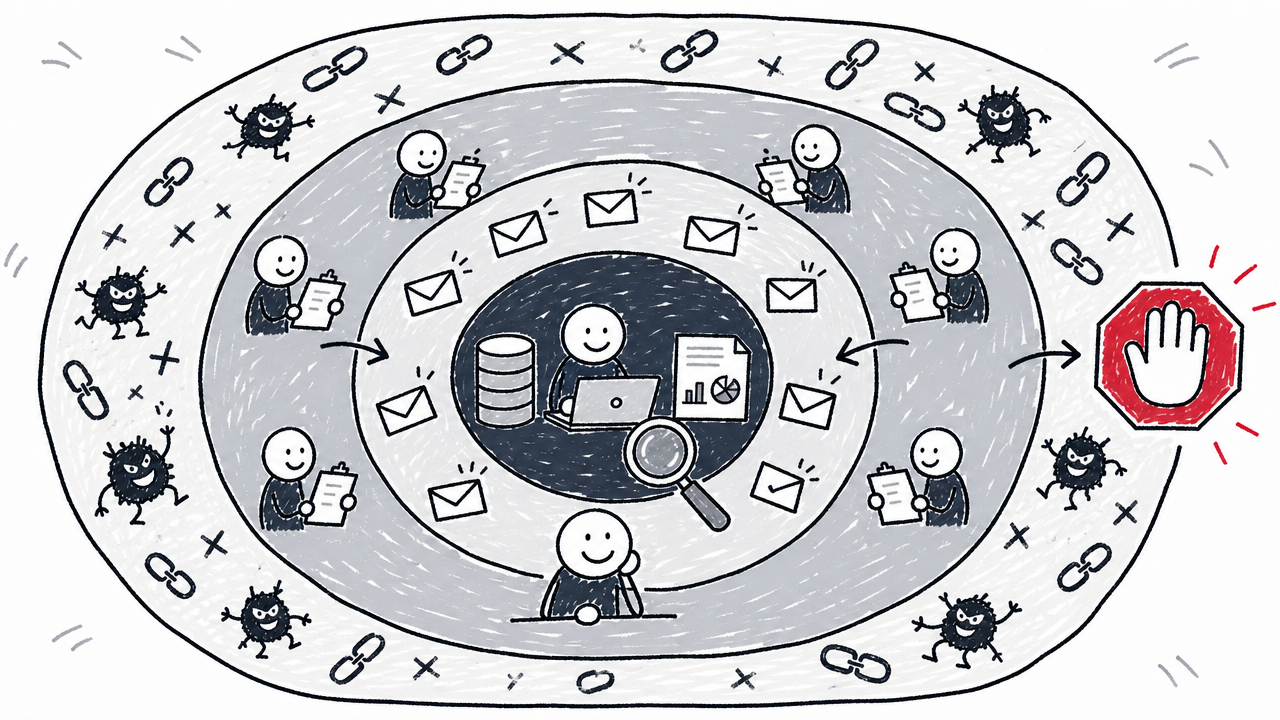
Zone 1: Safe to automate by default
Prospect discovery, deduplication, data enrichment, schedule reminders, link monitoring, and reporting are pure data operations. No external publisher is affected, no link is created, and no editorial signal is manufactured. Automating these tasks frees hours for the judgment-intensive steps that determine campaign quality.
The main risk is poor data quality, not a policy violation. A badly configured scraper may surface irrelevant prospects, but that wastes time rather than triggering a manual action.
Zone 2: Automate with human approval gates
Prospect qualification, email drafts, outreach sequences, content angle suggestions, and negotiation templates all gain from automation but need a human checkpoint before anything reaches a publisher. An AI-generated pitch may be fluent yet factually wrong about the recipient's site. A sequence that fires without review can send identical messages to competing publications in the same vertical.
The principle: generate drafts and queue sends, but insert a review gate before execution. One person scanning 50 drafted emails catches errors that no template logic will.
Zone 3: High-risk (compliance-sensitive)
Paid placements, guest-post campaigns, link exchanges, and anchor-text selection are not inherently forbidden, but they demand strict disclosure and editorial judgment. A paid link must carry rel="sponsored" or rel="nofollow" per Google's outbound-link qualification guidance. Guest posts need genuine editorial standards, not keyword-stuffed filler published on sites that accept anything for a fee.
Anchor-text selection is especially sensitive. Letting automation pick keyword-rich anchors across dozens of placements creates a spam footprint that algorithmic detection is designed to find.
Zone 4: Never automate
Link insertion at scale, blog-comment spam, forum-profile links, PBN publishing, mass directory submissions, and link-farm placement are explicitly listed in Google's spam policies. No amount of throttling, IP rotation, or anchor-text variation makes these safe. They are the textbook definition of automated link creation for ranking manipulation.
Why Google's "penalty" is not a single thing
Google does not impose a single, undifferentiated "penalty." The consequences exist on a spectrum, and understanding where your site sits on that spectrum determines the correct response.
Algorithmic neutralization is the quietest outcome. SpamBrain, Google's AI-based spam detection system, can identify sites buying links and sites created to pass outgoing links. When it does, the ranking credit from those links is lost. Google's December 2022 link spam update announcement confirmed that unnatural links could be neutralized at scale. You may never receive a notification; you just stop seeing the ranking gains those links were supposed to deliver.
Ranking demotion is a step further. Pages or the entire site may drop in search results without a formal manual action.
Manual action is the most severe documented outcome. According to Google's manual actions report documentation, a manual action means a human Google reviewer has determined that pages do not follow Google's spam policies. Some or all of the site may be omitted from Google Search entirely. The site owner must fix every listed issue, then submit a reconsideration request. Most reviews take several days or weeks; link-related requests may take longer.
Google's March 2024 spam-policy expansion added explicit policies for expired domain abuse, scaled content abuse, and site reputation abuse. Scaled content abuse applies regardless of whether the content was produced by AI, humans, or both. The concern is the production of low-value content at scale for ranking manipulation, not the tools used.
"Google penalty" remains useful shorthand because searchers use it. But the reality is a layered enforcement system, and the right recovery path depends on which layer has acted.
Is backlink automation safe for SEO?
Safety depends entirely on what you automate. Research, prospecting, contact discovery, email sequencing logistics, and link monitoring are workflow operations. Automating them is no different from using a CRM or a spreadsheet. Google's spam policies target the artificial creation and placement of links, not the use of project management software.
What is not safe: any system that creates, inserts, or places links on external sites without genuine editorial involvement. That includes PBN publishing tools, automated blog-comment bots, mass directory submitters, and any "autopilot" service that promises links without human oversight on the placement side.
A critical caution: no verified "safe link velocity," anchor-text percentage threshold, or guaranteed penalty probability exists. No research in this analysis found a specific number of links per day that triggers action, nor a universal anchor-text ratio that avoids detection. Claims to the contrary are marketing, not evidence.
Proprietary metrics like Domain Rating (DR), Domain Authority (DA), Authority Score, and Spam Score are third-party estimates. They are not Google ranking factors, and they do not represent Google's internal evaluation of a link's quality or risk.
A human-in-the-loop workflow that scales safely
The safest approach treats automation as the engine and human judgment as the steering. The workflow below is a set of principles, not a rigid procedure. Each stage identifies where automation handles the load and where a person must step in.
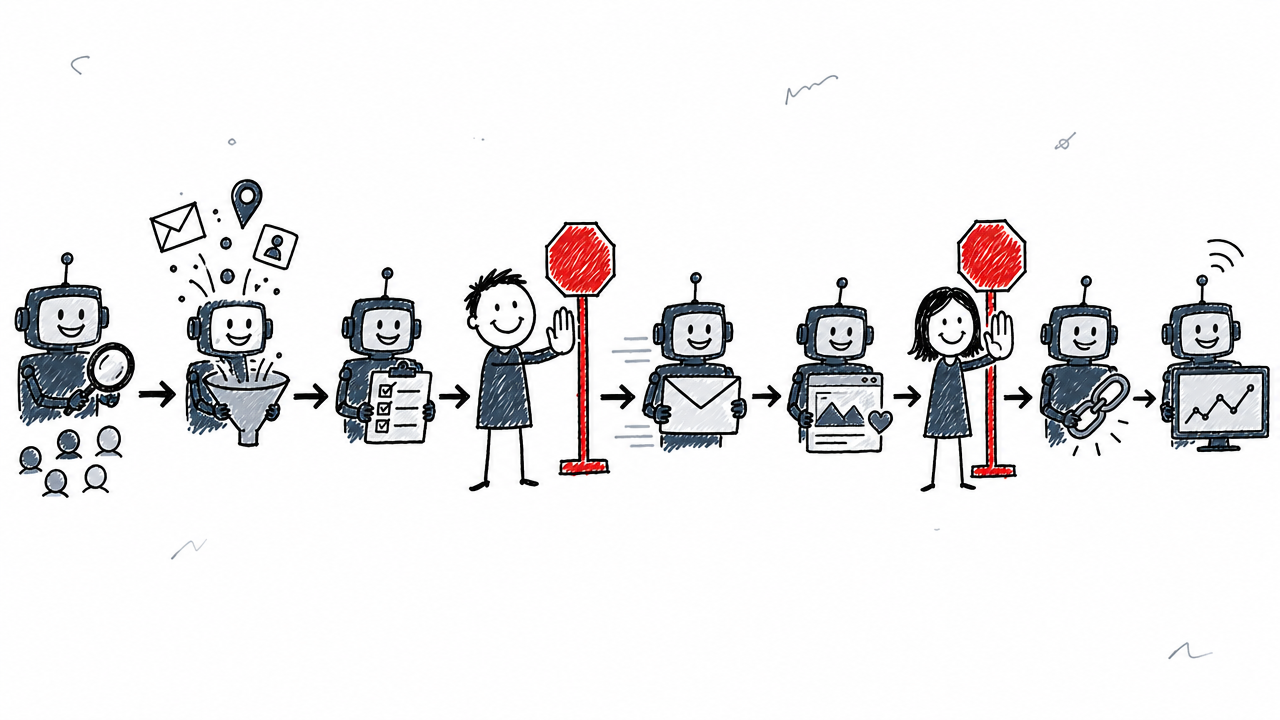
Discovery and enrichment
Start by defining the page, its audience, and the legitimate reason a link to it would be useful. Without that foundation, automation just generates noise faster.
Tools handle the data gathering: competitor backlink analysis, backlink gap analysis, unlinked brand mentions, broken-link opportunities, and digital PR angle identification. Ahrefs Site Explorer, Semrush backlink analysis, and Google Search Console's Links report all provide raw data at this stage. Deduplicate the resulting list, enrich it with contact data, and filter out domains that fail basic relevance checks.
Humans define the strategic intent and the linkable asset. No tool can decide whether your content genuinely deserves a link from a given publication.
Qualification beyond vanity metrics
DR, DA, Authority Score, and Spam Score are useful for rough triage, but they should never be the sole qualification criteria. They are third-party estimates built on proprietary crawl data; Google does not use them.
A stronger qualification checklist:
- Topical relevance: Does the prospect's content overlap with your topic?
- Real audience: Does the site have organic visibility and genuine readership?
- Editorial standards: Does it publish original, well-written content?
- Page-level context: Would the link appear in a relevant editorial setting?
- Outbound-link patterns: Does the site appear to sell links or publish large volumes of unrelated sponsored content?
- Geographic relevance: Does the site serve your target market?
- The human-reader test: Would this link be useful to a reader even without SEO value?
A human must approve the final prospect list. Automation can score and sort; it cannot assess editorial credibility.
Outreach that protects deliverability and relationships
Send from authenticated mailboxes (SPF, DKIM, DMARC configured). Use restrained sequence limits: two to three follow-ups, not seven. Review every draft before it enters the queue, especially when AI has generated the personalization. Suppress follow-ups the moment a recipient replies or opts out.
The risks here extend beyond Google. Spam complaints degrade your sending domain's reputation. Identical, impersonal pitches burn publisher relationships you may need later. Duplicate outreach to the same editor from different team members signals disorganization and gets your domain blocked.
Placement verification and ongoing monitoring
After a link goes live, verify the URL, page relevance, link status (followed, nofollowed, or sponsored), anchor text, and rel attributes. Automation can check these parameters on a schedule. A human should review any discrepancy: an anchor text that was changed, a rel attribute that was stripped, or a page that was redirected to irrelevant content.
Track lost links over time. Record the business value each placement delivers, including referral traffic, brand exposure, and conversions. A dashboard that tracks only quantity incentivizes the wrong behavior.
Tool categories for safe backlink automation
The tools below are organized by function, not ranked. Each category addresses a specific workflow stage. None of them, alone or combined, removes the need for human editorial judgment.
Backlink indexes and competitor research
Ahrefs Site Explorer (ahrefs.com/site-explorer) provides competitor backlink-profile analysis, referring-domain research, linked-page identification, and historical backlink data. Ahrefs reports an index of 35 trillion live backlinks and 21.0 billion pages; these are the vendor's own marketing figures, not independently verified statistics.
Semrush backlink analysis (semrush.com/features/backlink-analysis/) offers backlink-profile audits, backlink-gap analysis, competitor research, and brand-mention monitoring. Semrush claims a database of 43T+ backlinks and 808M+ domain profiles. Again, these are Semrush's own database claims.
Outreach CRM and campaign management
BuzzStream (buzzstream.com/outreach/link-building/) manages prospect research, relationship-based outreach, follow-up reminders, campaign tracking, and team task coordination. It automates the logistics of managing hundreds of conversations. It does not place links on external sites; it manages the human relationships through which links are earned.
Contact discovery and email verification
Hunter (hunter.io) provides domain search, email finding, email verification, and personalized sequences sent from the user's own Gmail, Google Workspace, or Outlook account. It integrates with CRMs and supports API and Zapier workflows.
Finding a contact does not guarantee a link. Hunter is infrastructure for reaching people; the editorial decision to link remains with the publisher.
First-party monitoring and manual-action checks
Google Search Console provides two critical reports. The Links report shows top linked pages, top linking sites, and top linking text. Tables are limited to 1,000 rows, the report is not a full backlink inventory, it does not show whether a link is marked nofollow, and it may include links that have since been removed.
The Manual actions report shows whether a human Google reviewer has flagged your site for policy violations.
For a full audit, combine Search Console data with a third-party backlink index and your own campaign records. For broader monitoring workflows, see SEO Automation: The Complete Guide to Automated SEO Tools & Workflows.
What types of backlink automation violate Google's policies?
Google's spam policies page is specific. The following are listed as link spam:
- Automated link creation programs: software that creates or inserts links on external sites without editorial involvement.
- Private blog networks (PBNs): sites created primarily to pass outgoing link signals.
- Link farms: networks of interconnected sites whose primary purpose is exchanging links.
- Low-quality directory and bookmark-site links.
- Blog-comment and forum-profile spam.
- Keyword-rich, hidden, or low-quality widget links.
- Widely distributed footer or template links.
- Excessive link exchanges ("Link to me and I'll link to you") done at scale.
- Buying or selling links for ranking purposes without proper
relattribute qualification.
The policy concern is ranking manipulation, not the use of software per se. Using Ahrefs to research competitors is not link spam. Using a bot to inject links into 10,000 blog comments is.
On AI-generated content: Google's scaled content abuse policy targets low-value content produced at scale for ranking manipulation. The tool (AI, human, or hybrid) is irrelevant; the intent and quality are what matter.
How to handle rel="sponsored", rel="ugc", and rel="nofollow"
Three rel attributes let publishers communicate the nature of a link to Google, as defined on Google's outbound-link qualification page (last updated 2025-12-10):
Values can be combined (e.g., rel="ugc nofollow"). Links with these attributes will not be followed for ranking purposes in most cases, though Google may discover the destination through other means.
Normal editorial links, where a publisher genuinely chooses to reference your content, need no special attribute.
A critical clarification: these attributes disclose the link relationship accurately. They do not make a manipulative campaign compliant. Adding rel="sponsored" to a link you bought does not legitimize the broader campaign if it still amounts to link spam.
Common pitfalls and anti-patterns to avoid
These are the most damaging mistakes in automated link-building campaigns:
- Treating third-party "toxicity" scores as Google's judgment and mass-disavowing every unfamiliar domain. You may remove beneficial links that were helping your rankings.
- Sending identical outreach templates at scale with no personalization. Publishers recognize and ignore these right away, and your sending domain's reputation suffers.
- Selecting anchor text by keyword-stuffing targets rather than fitting the natural editorial context of the host page. This creates a detectable spam footprint.
- Relying on a single proprietary metric (DR, DA) to qualify prospects while ignoring topical relevance, editorial quality, and audience reality.
- Ignoring
relattribute requirements on paid or sponsored placements. This is a straightforward policy violation. - Assuming "nofollow" or "sponsored" tags make any link-acquisition tactic safe. The attributes disclose the relationship; they do not sanitize a manipulative scheme.
- Running outreach from unauthenticated or shared mailboxes. Failed SPF/DKIM/DMARC checks land your emails in spam and burn your domain for future campaigns.
- Treating link quantity as the goal instead of relevance and editorial quality. Ten relevant, editorially earned links outperform a thousand directory submissions.
How to recover from spammy or artificial backlinks
If you suspect artificial or spammy backlinks are affecting your site, follow a structured remediation path rather than panic-disavowing everything.
Step 1: Check for manual actions
Open Google Search Console's Manual actions report. If a manual action exists, Google will identify the affected patterns and pages. You must fix every listed issue.
Step 2: Audit your backlink profile
Export links from Google Search Console's Links report, cross-reference with a third-party index (Ahrefs, Semrush), and review your own campaign records. Identify links that are clearly artificial, purchased, or placed on spam sites.
Step 3: Request removal
Contact the linking site owners and request that the problematic links be removed or properly qualified with the right rel attribute. Document every removal attempt.
Step 4: Disavow only when warranted
Google's Disavow Links tool documentation is clear: most sites do not need this tool. Use it only when a considerable number of spammy, artificial, or low-quality backlinks exist and the links have caused, or are likely to cause, a manual action. The disavow file supports up to 100,000 lines and 2 MB. Google may take a few weeks to incorporate a submitted list. Disavowed links may continue to appear in the Links report.
Step 5: Submit a reconsideration request
Submit only after you have completed full remediation. Partial fixes lead to denied requests and wasted review cycles.
The disavow tool is advanced and can hurt search performance if misused. Blindly disavowing every unfamiliar domain is not remediation; it is guesswork that may remove links that were helping your site.
FAQ
Can Google penalize a site for automated backlinks?
Yes, if the automation creates or places links to manipulate rankings. Google may neutralize the links algorithmically via SpamBrain, demote the site in rankings, or issue a manual action that removes pages from search results. Workflow automation (prospecting, outreach administration, monitoring) is not what Google's spam policies target.
Are automated directory submissions still effective?
In most cases, no. Google's spam policies explicitly list low-quality directory and bookmark-site links as link spam. A handful of high-quality, editorially curated directories may still provide referral value, but mass automated submissions carry risk with little return.
Should I disavow every backlink a tool labels "toxic"?
No. Third-party toxicity scores are proprietary estimates, not Google data. Google states most sites do not need the disavow tool. Use it only when a considerable number of artificial or spammy links exist and a manual action has occurred or is likely. Blindly disavowing can remove beneficial links and hurt performance.
Is automated outreach the same as automated link building?
No. Automated outreach uses software to find contacts, send personalized emails, and manage follow-ups. Automated link building typically means software creates or inserts links without editorial involvement. The first is a workflow efficiency; the second is what Google's policies warn against.
What should I look for when choosing a backlink automation tool?
Focus on tools that automate research, prospecting, verification, and monitoring rather than link placement. Look for human-approval gates, sequence controls, authenticated sending, and transparent reporting. Avoid any tool that promises "guaranteed" backlinks, "autopilot" link placement, or claims to be "penalty-proof."