
Which AI Models Watermark Their Text? - Claude vs. ChatGPT vs. Gemini vs. Open Models
Gemini uses SynthID Text, Claude embeds watermarks in supported models from Aug 2026, ChatGPT has no public text watermark, and open-weight models can't enforce

As of August 2026, Google's Gemini has the most established production text-watermarking system through SynthID Text. Anthropic's Claude has begun embedding text watermarks in supported new models launched on or after August 2, 2026, applied worldwide. OpenAI has not publicly released a text watermark for ChatGPT despite reported internal work. Open-weight models like Meta's Llama and Mistral cannot enforce watermarking once operators control the inference pipeline. A text watermark is a statistical signal hidden in token choices during generation: invisible to readers, but detectable with the matching tool.
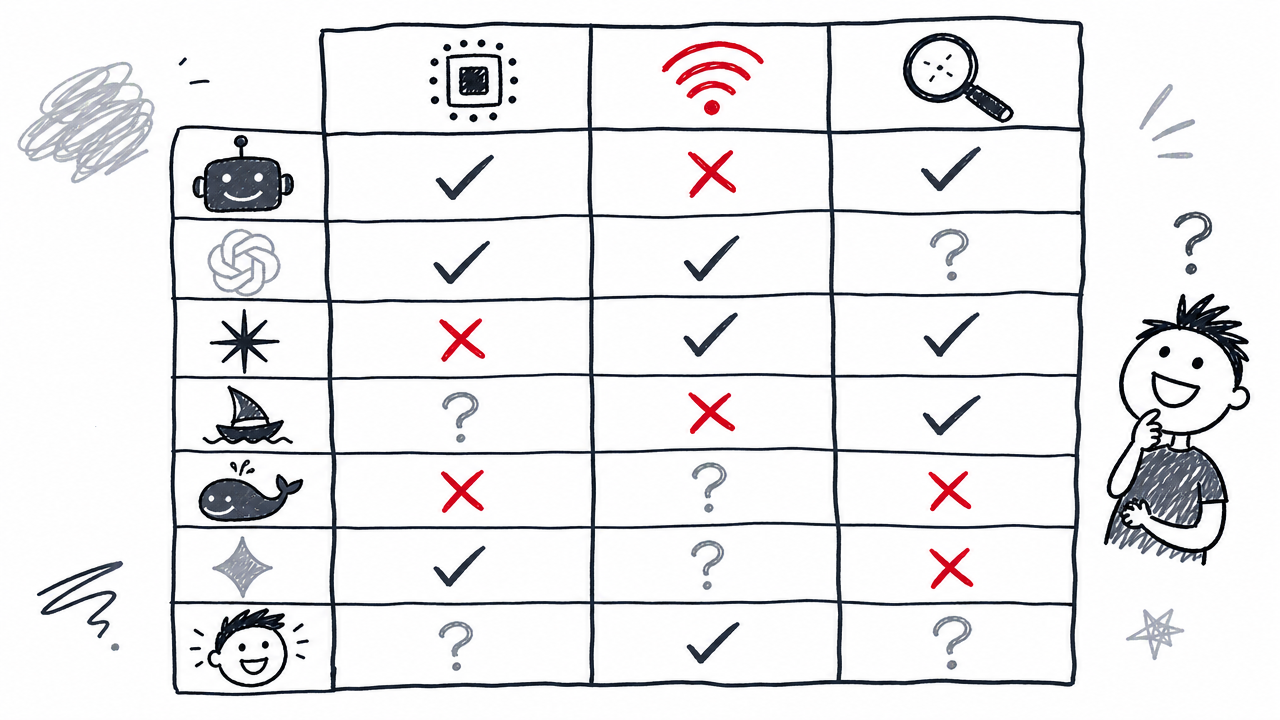
AI text watermark comparison table
Last verified: August 13, 2026. Provider capabilities, detector access, and regulatory status are changing fast. Recheck official docs before relying on any row.
The table below scores each provider on three separate dimensions: (1) whether a mark is embedded in production text today, (2) what kind of signal is used, and (3) who currently has access to detection. A provider can embed a mark without offering public detection, or open-source a detector without deploying the mark itself.
What counts as a text watermark?
Three concepts get mixed up in AI-content discussions. They solve different problems and fail in different ways.
Text watermark: A statistical signal embedded during token sampling. The model shifts probability distributions slightly as it picks each token, creating a pattern that readers cannot see but a matched detector can find. The signal lives in the text itself, not in file metadata.
C2PA / provenance metadata: Signed metadata attached to a file (image, audio, video, SVG). Re-saving, screenshotting, or copying text out of a file strips it. C2PA is not a text watermark and does not survive plain-text extraction.
AI detector (style-based): A separate tool that guesses authorship from writing patterns. It does not read a provider's embedded watermark and is not tied to a specific generation pipeline.
A provider-specific watermark detector usually cannot spot another provider's mark. SynthID detects SynthID marks; it cannot find Claude's watermark, and the reverse is also true. The SynthID Nature paper describes how the sampling-level approach differs from post-hoc style classification.
Does Claude watermark text?
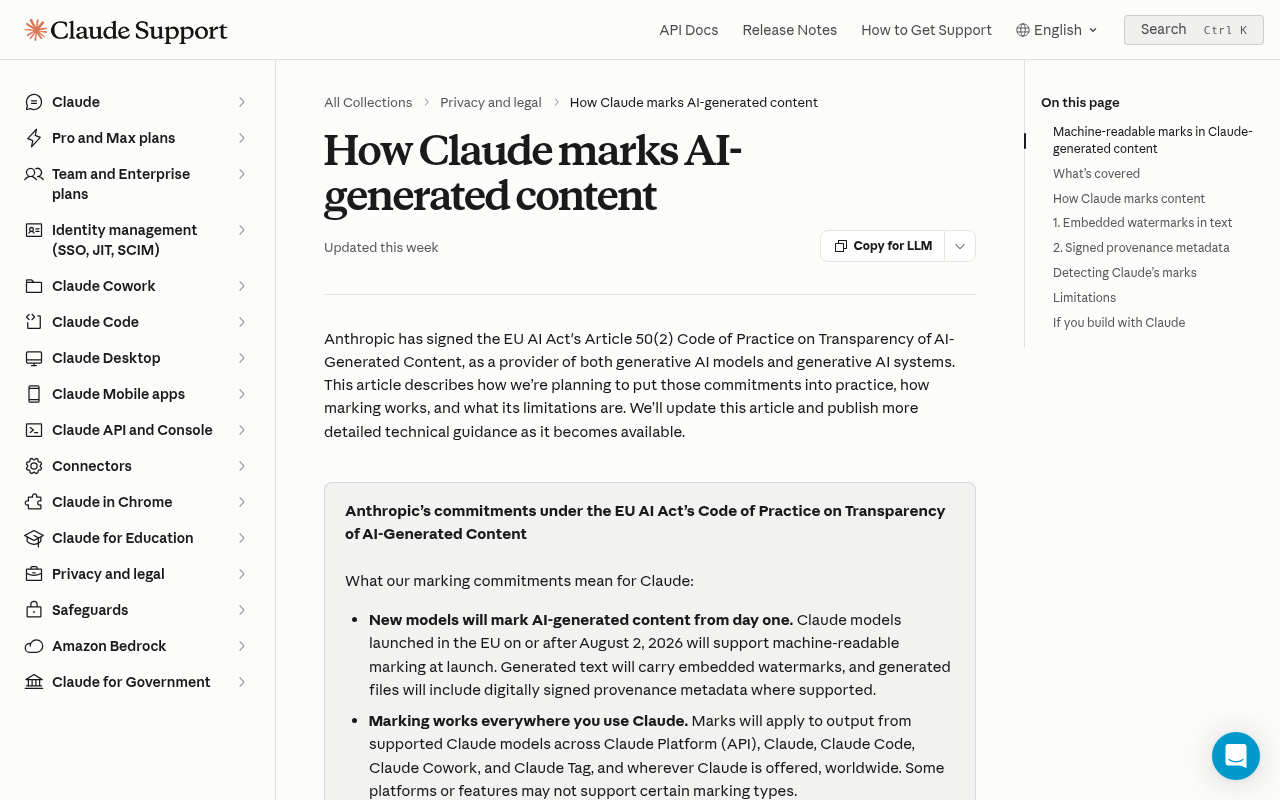
Yes. Supported Claude models launched on or after August 2, 2026 carry embedded text watermarks. Those marks apply worldwide wherever the supported models are used, not only in the EU.
Marking works at the model level across Claude Platform/API, Claude, Claude Code, Claude Cowork, and Claude Tag. The Anthropic Help Center says a detected mark shows content "may have been processed by Claude." That phrasing is deliberate: the signal does not prove Claude was the original author of the ideas or the sole source of the passage.
Detection support and technical docs are described as forthcoming. Do not assume a public detector is live; verify when you read this.
Anthropic lists several detection limits:
- Heavy editing, paraphrasing, or translation can weaken the signal.
- Mixing Claude output with other text may block detection.
- Short passages and low-entropy text (code, lists, single sentences) may lack enough signal.
- Older models and unsupported features may not embed the mark.
Claude also uses C2PA signed provenance metadata for supported image and SVG files. That is a separate system from the text watermark.
Does Gemini watermark text?
Yes, and Google's system is the most mature production text watermark publicly documented. Google confirms SynthID Text is deployed in the Gemini app and web experience (Google DeepMind SynthID page).
Mechanism. SynthID Text is a logits processor that shifts token-generation probabilities with a pseudorandom function and private configuration keys. It changes the sampling procedure, not the model weights, so it can be added to existing models without retraining.
Scale. The Nature paper reports a live experiment covering nearly 20 million Gemini responses with no measured drop in model quality on standard benchmarks or human side-by-side ratings in the tested settings.
Open-source access. SynthID Text is open-sourced with a production-grade build in Hugging Face Transformers v4.46.0+ and a reference build on GitHub. The GitHub repo supports weighted-mean and Bayesian detection but warns that the code is for research, not production use.
Detection. Results are probabilistic, returning one of three outcomes: watermarked, not watermarked, or uncertain. Thresholds can be tuned to balance false-positive and false-negative rates. The public SynthID Detector portal mainly covers image, video, and audio with journalist and media early testing. Check whether unrestricted public text detection is available before counting on it.
Does ChatGPT watermark text?
No. OpenAI does not document a production text watermark for ChatGPT as of the research date. The OpenAI Help Center provenance page covers C2PA Content Credentials and SynthID watermarks for supported images (including DALL·E 3 output) and SynthID for supported audio. Text is absent.
The reported internal project. The Wall Street Journal reported in 2024 that OpenAI had built a text-watermarking method described in internal documents as roughly 99.9% effective when ChatGPT generated enough new text. That figure comes from 2024 internal documents, not a shipping product, and should not be read as a general accuracy rate for all text lengths or languages.
Reported concerns about releasing the tool included:
- Circumvention techniques.
- Possible effects on non-native English speakers.
- User loss: a reported internal survey found nearly one-third of loyal ChatGPT users would be discouraged by watermarking.
OpenAI did not publicly release the reported system at that time.
Current public tools. OpenAI Verify checks supported image and audio files for OpenAI provenance signals. It does not cover text.
Stated goal. OpenAI says it aims to expand provenance signals to all modalities, including text. OpenAI is listed among Section 1 signatories of the EU Code of Practice on Transparency of AI-Generated Content. Signing the Code does not prove a text watermark has been deployed.
Do open-source AI models watermark their output?
No provider-deployed text watermark was verified for Meta AI text output, Mistral models, or other major open-weight families in the reviewed official sources. Watermarking cannot be reliably enforced once users control a model's local inference stack.
Meta / Llama. Meta documents image-level provenance through Content Seal for images generated by Muse Image (Meta Muse blog). That coverage does not extend to text output from Llama or Meta AI's text features.
Mistral. The Mistral models page lists models including Mistral Large 3, Mistral Small 4, Ministral 3, and Devstral 2. Several are open-weight. The page does not mention a text-watermarking system.
Both Meta and Mistral are listed as Section 1 signatories of the EU Code of Practice. Signing does not confirm a live text watermark.
xAI. City A.M. has reported that xAI declined the EU Code of Practice. That is single-source reporting, not confirmed by an official xAI or European Commission source. Declining the Code, or not appearing as a signatory, does not by itself show whether xAI watermarks text. No verified public xAI text-watermark detector was found.
Why open-weight models create a two-tier watermarking world
The most important structural fact about AI text watermarking is the gap between closed and open-weight deployment.
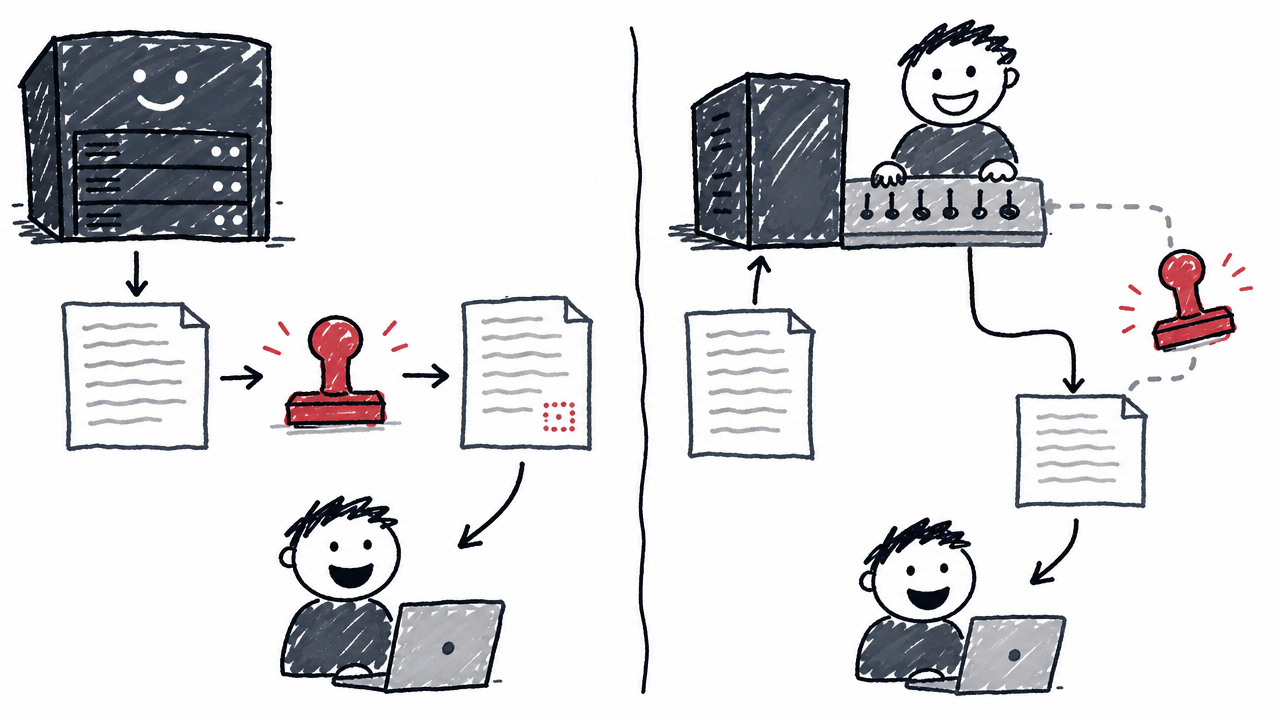
A closed hosted model (Claude, Gemini, ChatGPT) can embed a watermark inside the provider-controlled serving pipeline before text reaches the user. The user never touches the sampling code.
An open-weight model (Llama, Mistral, many others) may ship with optional watermarking code, but the person who downloads and runs the weights controls the full inference and sampling pipeline. That operator can disable, replace, or skip any bundled watermark sampler.
The result is a two-tiered ecosystem. Compliant closed models emit marked text. Open or self-hosted models may not. This is not a bug in any single provider's design; it follows directly from how open-weight distribution works.
Key takeaway: A marked passage may carry a provider-specific provenance signal, but an unmarked passage does not establish human authorship or non-use of AI.
This gap has direct consequences for anyone evaluating text. A missing watermark could mean the text was human-written, that it came from an open-weight model, or that a closed model generated it but edits pushed it below detection thresholds. No current watermarking system resolves that ambiguity.
Can a watermark prove AI authorship?
A text watermark is a provenance signal. It can indicate that a provider's model likely processed the text, but it cannot assign authorship on its own. Grasping that limit matters for anyone making decisions based on detection results.
What a positive detection means
A positive result shows the text may have been processed by a specific provider's model. It does not equal sole authorship.
Think about common AI-assisted workflows: a human writes a draft and asks Claude to refine the language, or a model generates a first draft that a human then restructures. Both cases may trigger a positive detection without the model being "the author" in any real sense.
Anthropic's Help Center uses the phrase "may have been processed by Claude," deliberately avoiding authorship claims. The terms "AI-generated," "AI-assisted," "processed by Claude," and "authored by Claude" are not interchangeable.
What a missing watermark means
A missing mark does not prove that text was human-written or free of AI involvement.
Possible reasons for a missing mark:
- The text came from a model that does not embed a watermark (including open-weight models).
- Heavy editing, paraphrasing, or translation pushed the signal below detection thresholds.
- The passage was too short or too low-entropy (code, lists, formulaic phrases) for statistical detection.
- An older model version that predates watermark support generated the text.
- File-level metadata (C2PA) was stripped during copy-paste or format conversion.
Why providers are adding watermarks now
EU AI Act Article 50 transparency obligations apply from August 2, 2026 (verify current transition and deferral status in the official text before relying on this date). These rules require providers of AI systems to mark and enable detection of AI-generated content.
The voluntary EU Code of Practice on Transparency of AI-Generated Content supports the binding Act. The European Commission reported roughly 190 organizations had signed by the end of July 2026. Signatories include Anthropic, Google, Meta, Mistral, OpenAI, and Microsoft.
Signing the Code does not itself create the legal obligation; the AI Act does. The Code does not replace the Act or the Commission's guidelines.
This comparison is informational, not legal advice. Whether a provider, deployer, publisher, or platform has obligations depends on the applicable jurisdiction, system, content, and publication context.
FAQ
1. Can one detector find watermarks from every AI provider? No. Each provider's watermark uses its own keys and setup. A SynthID detector checks for SynthID marks; it cannot find Claude's watermark, and the reverse holds too. No universal cross-provider text-watermark detector exists.
2. Can AI watermarks survive editing, paraphrasing, or translation? That depends on the scope of changes. Light edits and copy-paste usually keep the signal. Heavy paraphrasing, translation, or mixing with other text can weaken or remove it. No provider guarantees survival through all workflows.
3. Does Google penalize watermarked or AI-generated text in search? No current Google Search Central documentation says Google penalizes AI-generated or watermarked text. Watermark presence is not established as a Google ranking signal.
4. Is SynthID Text a watermark or an AI detector? A watermark system: it embeds a statistical signal during generation and ships a matched detector. It is not a general-purpose AI-content detector that reads writing style.
5. Can short passages be reliably checked for a watermark? Usually not. Statistical detection needs enough tokens to tell a watermarked distribution from a random one. Short or low-entropy text (code, lists, single sentences) may return an uncertain result rather than a clear classification.
Sources
All sources were last checked August 13, 2026. Recheck before relying on time-sensitive claims.
- Anthropic Help Center: How Claude marks AI-generated content
- Google AI for Developers: SynthID Text documentation
- Google DeepMind: SynthID
- Nature: Scalable watermarking for identifying large language model outputs (2024)
- GitHub: google-deepmind/synthid-text
- OpenAI Help Center: Provenance signals in OpenAI-generated content
- OpenAI: Supporting Europe's work in ensuring a trustworthy AI ecosystem
- WSJ report on OpenAI text watermarking (archived)
- Meta AI: Introducing Muse Image and Muse Video
- Mistral AI: Models
- European Commission: Code of Practice on Transparency of AI-generated Content
- EU AI Act Article 50
- European Commission: Strong backing for the Code of Practice