
Will AI Text Watermarks Hurt Your SEO? What Google Actually Says
No evidence shows an AI watermark affects SEO rankings. Here's what Google actually says, why one viral "penalty" study falls apart, and where the real risks li

An AI text watermark is a hidden statistical signal embedded during text generation that only the provider's detector can later identify. No current evidence shows that an AI text watermark itself harms Google rankings. Google's public guidance scores content on quality, relevance, originality, helpfulness, and spam intent, not on whether text carries a provider-specific watermark. Google has not said its Search ranking systems read Claude's text watermark. "No evidence today" does not guarantee future policy, but it reflects the documented reality right now.
What is an AI text watermark, and why does it matter now?
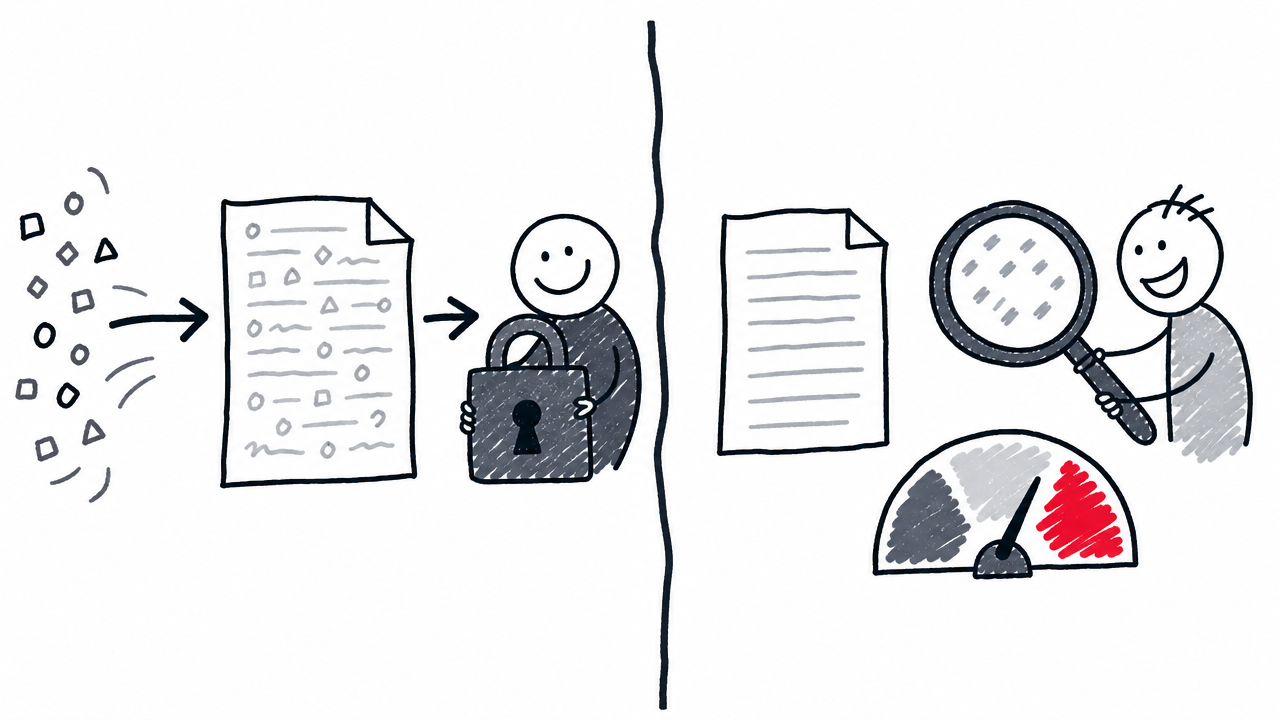
An AI text watermark subtly changes the statistical pattern of token selection while a language model generates text. The change is invisible to readers and does not affect meaning, quality, or readability. Only a matched detector, held by the provider, can later flag the text as likely model-processed.
Think of it like an invisible serial number woven into the fabric of a banknote: you need the right scanner to see it.
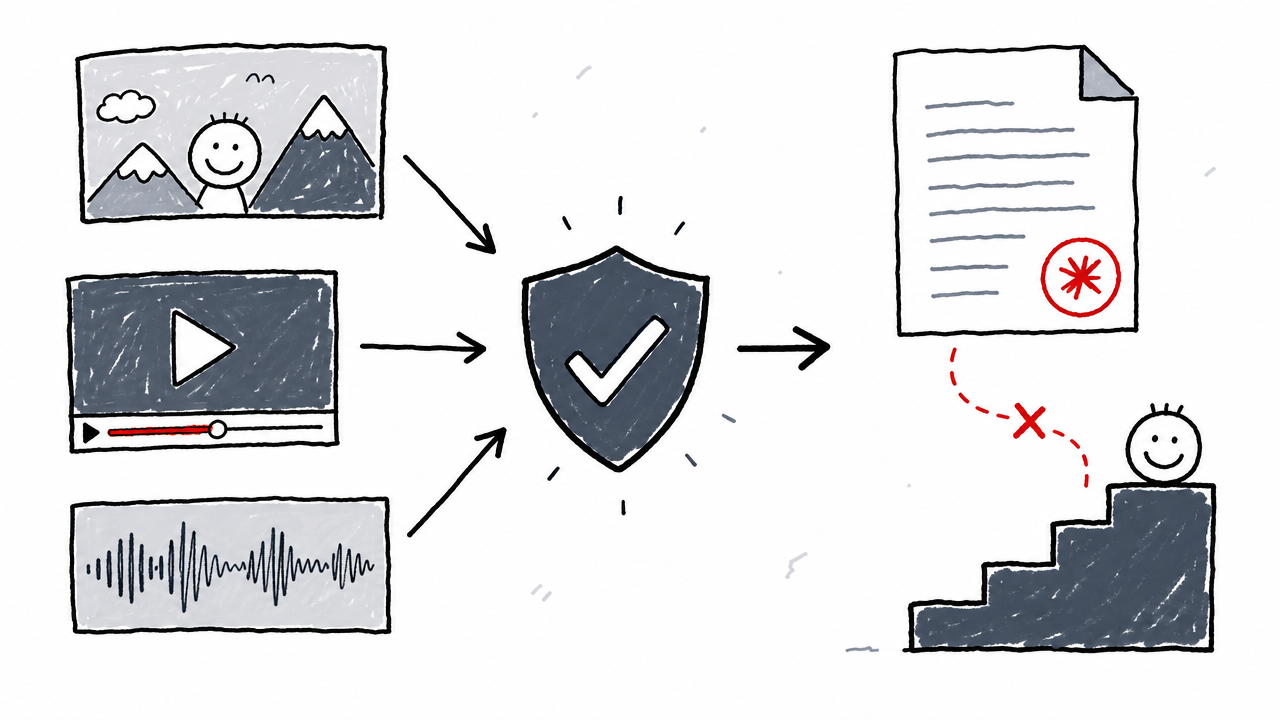
Text watermarking is distinct from C2PA signed provenance metadata, which applies to files such as images, not to inline text. The two solve different problems and have different failure modes.
This matters now because Anthropic's Help Center article describes Claude models supporting embedded text watermarks, with supported models launched in the EU on or after August 2, 2026, and marks applying worldwide wherever those models are used. Detection documentation is described as forthcoming. Existing models are still being worked on (Anthropic Help Center).
Several distinctions are critical throughout this article:
- "AI-generated" is not the same as "authored by Claude."
- "Processed by Claude" does not mean "created from scratch by Claude."
- A detected watermark is a provenance signal. It tells you the text may have passed through a model, not who wrote the original ideas.
- A missing watermark does not prove human authorship.
What does Google say about AI content?
Google's position, expressed across several official documents, is that content quality and intent shape ranking outcomes, not production method. No Google Search Central page mentions a text watermark as a ranking factor.
February 2023: "Rewarding high-quality content, however it is produced"
Google's central statement is plain: "Using AI doesn't give content any special gains. It's just content." The February 2023 guidance says Google's focus is on content quality rather than how it is produced. AI-generated content is not automatically against guidelines; it becomes a spam issue only when its primary purpose is manipulating rankings (Google Search Central, Feb 2023).
March 2024: Scaled content abuse is method-agnostic
The March 2024 policy update targets pages created primarily to manipulate Search rankings, "no matter how it's created," whether through automation, humans, or a combination. The trigger is manipulative intent at scale, not the tool used (Google Search Central, March 2024; current spam policies).
Current guidance on generative AI content
Google says generative AI can help with research and adding structure to original content, but generating many pages without adding value may violate the scaled content abuse policy. Publishers should focus on accuracy, quality, and relevance and may give users context about how content was created (Google Search Central, Using gen AI content).
People-first content and E-E-A-T
Google's ranking systems favor helpful, reliable, people-first information. The "Who, How, and Why" framework applies to AI-assisted content just as it applies to any other. Google asks whether content provides original information, research, analysis, and real value. Nowhere does this documentation describe a text watermark as a ranking factor (Google Search Central, Creating helpful content).
Can Google detect AI-generated content?
Google can spot low-quality, repetitive, or manipulative patterns through systems like SpamBrain. That ability is not the same as reading a provider-specific text watermark. Three concepts are often conflated and should stay separate.
AI-pattern detection and spam detection. Google's ranking and spam systems look at content quality, originality, usefulness, and manipulative intent. They can flag thin, repetitive, or scaled content. That does not mean they identify which AI model generated a passage or verify a statistical watermark.
Third-party AI classifiers. Tools from companies like Originality.ai or Ahrefs estimate AI-likeness using their own models. Their output does not represent Google's internal classification and does not detect provider-specific watermarks.
Provider-specific watermark verification. A statistical text watermark embedded by Claude generally requires Anthropic's secret key or authorized detection method. A normal web crawler can read the visible text but cannot verify the watermark just by fetching a page (SynthID documentation; Nature: SynthID-Text).
No public evidence shows Google Search reads Claude's embedded text watermark today. Google may develop or gain detection capability later, but that is speculation, not documented policy.
Can Google read Claude's text watermark?
No documented mechanism lets Google Search verify Claude's text watermark today. The watermark is encoded during token sampling using parameters only Anthropic controls. Verification requires the provider's detector, key, or an authorized API.
Anthropic's Help Center says detection details and technical documentation are "forthcoming." No public Claude text-watermark detector or API has been documented as available (Anthropic Help Center).
Without access to Anthropic's detector, Google would have no documented way to confirm Claude's watermark simply by crawling a page. This does not prevent Google from judging any page on its standard quality, relevance, and spam signals.
Google's May 2026 provenance announcement expanded Search-side verification around images, video, and audio via SynthID and Content Credentials. It does not announce that Google's organic ranking systems read Claude's embedded text watermark or penalize text based on it (Google provenance blog; Google ranking systems guide).
Does AI content already rank on Google? The data
AI-assisted content already holds a large share of top Google results. Two independent datasets show this clearly.
Ahrefs study: 86.5% of top-20 pages contain some AI
Ahrefs analyzed 600,000 pages from the top 20 results for 100,000 random keywords. The findings:
The correlation between AI-content percentage and ranking position was 0.011, effectively zero. Among top-three results, 5.3% scored as 100% AI-generated and 82.2% had under 50% estimated AI content.
Ahrefs' conclusion: "Google doesn't punish AI content; it punishes bad content" (Ahrefs; Ahrefs).
Caveat: Ahrefs used its own detector. These results reflect AI-likeness estimates, not confirmed authorship or watermark status.
Originality.ai tracker: AI share of top results over time
Originality.ai's longitudinal tracker of sampled top-20 results shows growth from roughly 2.27% in February 2019 to roughly 19.56% in July 2025, with fluctuations, including a decline around the March 2024 core update (from 8.48% in December 2023 to 7.43% in early March 2024) (Originality.ai tracker).
The long-term trend is upward, though individual core updates can push the share up or down. "AI detected" reflects Originality.ai's own detector and sample; the label is not the same as "watermarked."
Debunking the First Page Sage "watermark penalty" claim
A widely shared First Page Sage study (published August 11, 2026) claims watermarked content ranks roughly five positions lower in Google and receives fewer AI-platform citations. The study does not establish a watermark penalty. Here is why.
What the study reports:
- 1,682 pieces of content across 139 websites in four B2B industries.
- Unwatermarked content averaged position 6; "watermarked" content averaged position 11.
- Unwatermarked content received a 12% AI-platform citation rate versus 7% for watermarked.
Why this does not establish a watermark penalty:
- No verified watermark detection. The study classified content as "watermarked" based on whether AI tools created it, not by running a provider-specific watermark detector. No such public detector was available at the time of the study.
- No quality control. The study admits it did not control for content quality beyond its own professional standards and that human-produced content may have received more thoughtfulness and judgment.
- Three-day ranking window. Rankings were measured within three days of publication, before longer-term signals such as backlinks, engagement, and indexing maturity could build up.
- Mixed systems. The study blends Google organic rankings, Google AI Overviews, ChatGPT citations, and Claude citations. These are different retrieval systems with different policies.
Verdict: The study cannot show that a watermark caused the ranking gap. Its "watermarked" label effectively meant "AI-generated," making the term misleading. The two groups may also differ in editorial quality, originality, expertise, and site authority. This is not valid evidence of a Google watermark penalty, and it should not be cited as such.
What is the real SEO risk of AI-assisted content?
The genuine ranking risk comes from content traits, not a watermark. Google's policies target the same problems whether a human, an AI model, or a combination produced the content.
Content that tends to perform poorly shares these traits:
- Generic, undifferentiated writing that adds nothing new to a topic
- Factual errors and hallucinations that undermine reliability
- Lack of original experience, analysis, or expertise (E-E-A-T gaps)
- Repetitive pages published at scale with minimal editorial input
- Content created mainly to attract search visits rather than help readers
- Poor editing, thin sourcing, and weak usefulness
Google's scaled content abuse policy is triggered by manipulative intent at scale, not by AI help. The quality bar applies equally to human-written and AI-assisted content.
A watermark is a provenance signal. The ranking outcome depends on what the content offers the reader.
Could AI watermarks affect readers, clients, or platforms?
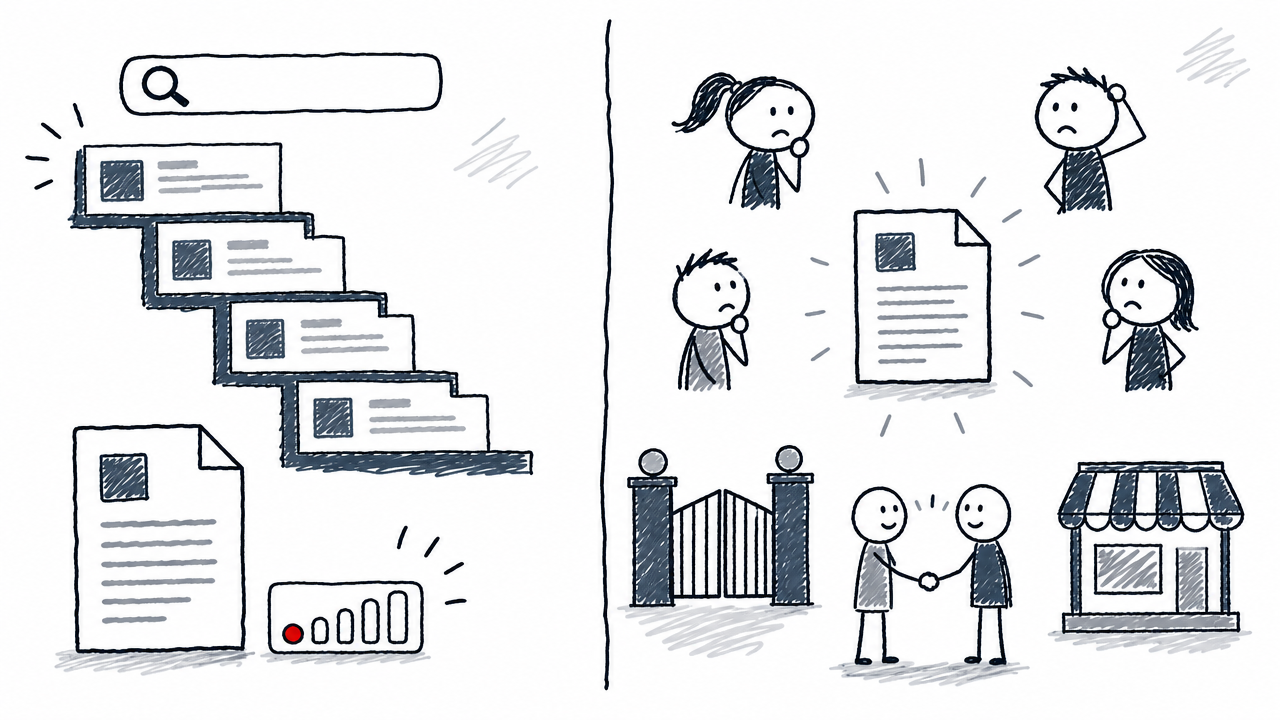
Reader trust, advertiser perception, and platform distribution pose a more concrete near-term risk than a Google ranking penalty, which remains unproven.
Reader trust and the "AI stink"
A Raptive-commissioned study of 3,000 U.S. adults found that perceived AI authorship cut reader trust by nearly 50%, even when the underlying content was not AI-generated. Ads beside suspected AI content were rated 17% less premium, 19% less inspiring, and 11% less trustworthy. Readers who believed content was AI-generated were 14% less likely to consider buying the adjacent advertised product (Raptive; Adweek).
A Gartner survey of 1,539 U.S. consumers (October 2025) found that 50% would prefer brands that do not use GenAI in consumer-facing content, and 68% frequently questioned whether content they see is real (Gartner).
Trust economics cut both ways. A series of 13 experiments found that disclosing AI use reduced trust in the disclosing actor, though effects varied by context (ScienceDirect). Yet 77% of consumers across international markets said companies should explicitly identify when GenAI was used in communications (Smart Communications / Harris Interactive).
Platform policies are a separate risk
Major publishing platforms have their own AI content rules that affect distribution, monetization, and disclosure, independently of Google:
These are platform-level decisions, not Google ranking signals. Review each platform's current policy before publishing; these policies change often.
How should publishers handle watermarked AI text?
There is no special "watermark" metric in Google Search Console. The practical response is the same quality-first approach that has always driven sustainable rankings.
- Review all AI-assisted content for accuracy, originality, and genuine value before publishing.
- Add real expertise: first-hand experience, original data, analysis, or perspective that a model alone cannot provide.
- Check platform and client disclosure rules. Requirements vary by platform, industry, and contract.
- Track Google Search Console and organic performance normally. Look for quality-related drops, not imagined watermark penalties.
- Do not rely on third-party AI detectors as proof of authorship or watermark status.
- Do not panic-rewrite content solely because it may carry a watermark. Focus on whether the content meets quality and usefulness standards.
FAQ
Does Google penalize AI-generated content?
Google does not say AI use alone violates its guidelines. It may act against scaled, unoriginal, low-value content created mainly to manipulate rankings, regardless of production method (Google Search Central, Feb 2023).
Can Google detect Claude's text watermark?
No public evidence shows Google Search reads Claude's embedded text watermark today. Anthropic says detection documentation is forthcoming (Anthropic Help Center).
Does a Claude watermark prove Claude wrote the article?
No. Anthropic says a detected mark indicates content "may have been processed by Claude," not that Claude authored the underlying ideas or text. A missing mark does not prove human authorship either.
Can a watermark survive editing?
Anthropic lists heavy editing, paraphrasing, translation, mixing, and short passages as reasons a mark may not be detected. Whether a specific edit removes the signal depends on how much the text changes; no public tool can confirm the result today.
Should I disclose AI use on my website?
Google says publishers may give users context about how content was created. Some platforms require disclosure. Evidence on whether disclosure helps or hurts reader trust is mixed and depends on context.
Is AI content bad for SEO?
Low-quality, inaccurate, or manipulative content can perform poorly regardless of how it was produced. High-quality, helpful AI-assisted content can rank well. Ahrefs found a near-zero correlation (0.011) between AI-content percentage and ranking position (Ahrefs).
Sources
- Anthropic Help Center: How Claude marks AI-generated content
- Google Search Central: Google Search's guidance about AI-generated content (Feb 2023)
- Google Search Central: March 2024 core update and spam policies
- Google Search Central: Spam policies
- Google Search Central: Using gen AI content
- Google Search Central: Creating helpful content
- Google: Ranking systems guide
- Google: Making it easier to understand how content was created (May 2026)
- Google AI for Developers: SynthID
- Nature: Scalable watermarking for identifying large language model outputs
- Ahrefs: AI-Generated Content Does Not Hurt Your Google Rankings
- Ahrefs: Google Doesn't Punish AI Content
- Originality.ai: AI Content in Google Search Results tracker
- First Page Sage: Impact of AI Watermarking on SEO & GEO Results
- Raptive: The AI stink is real
- Adweek: AI content cuts trust, hurts ad performance
- Gartner: Marketing survey on consumer GenAI preferences (March 2026)
- Smart Communications / Harris Interactive: Consumer disclosure preferences
- ScienceDirect: AI disclosure and trust study
- Medium: AI content policy
- LinkedIn: AI-assisted content guidance
- Amazon KDP: Content guidelines
- Substack: AI text detection guidance