
How to Avoid / Bypass / Remove AI Text Watermarks - Methods That Actually Work
Learn how to avoid AI text watermarks with 8 methods that actually work, from model selection to human rewriting, plus what does nothing and why no tool can gua

The most reliable way to avoid a statistical AI text watermark is to keep the marking model from generating your final prose, or to rewrite the output with a different model or a human editor. Surface-level changes like copy-pasting, reformatting, and whitespace edits do nothing because the signal lives in token choices, not formatting. No public tool can currently confirm that text will pass Anthropic's coming Claude detector. This guide is for content marketers and publishers managing editorial workflows, not academic-integrity evasion.
What is an AI text watermark (and what it is not)
Three technologies are often lumped together. Knowing the difference matters before any removal attempt.
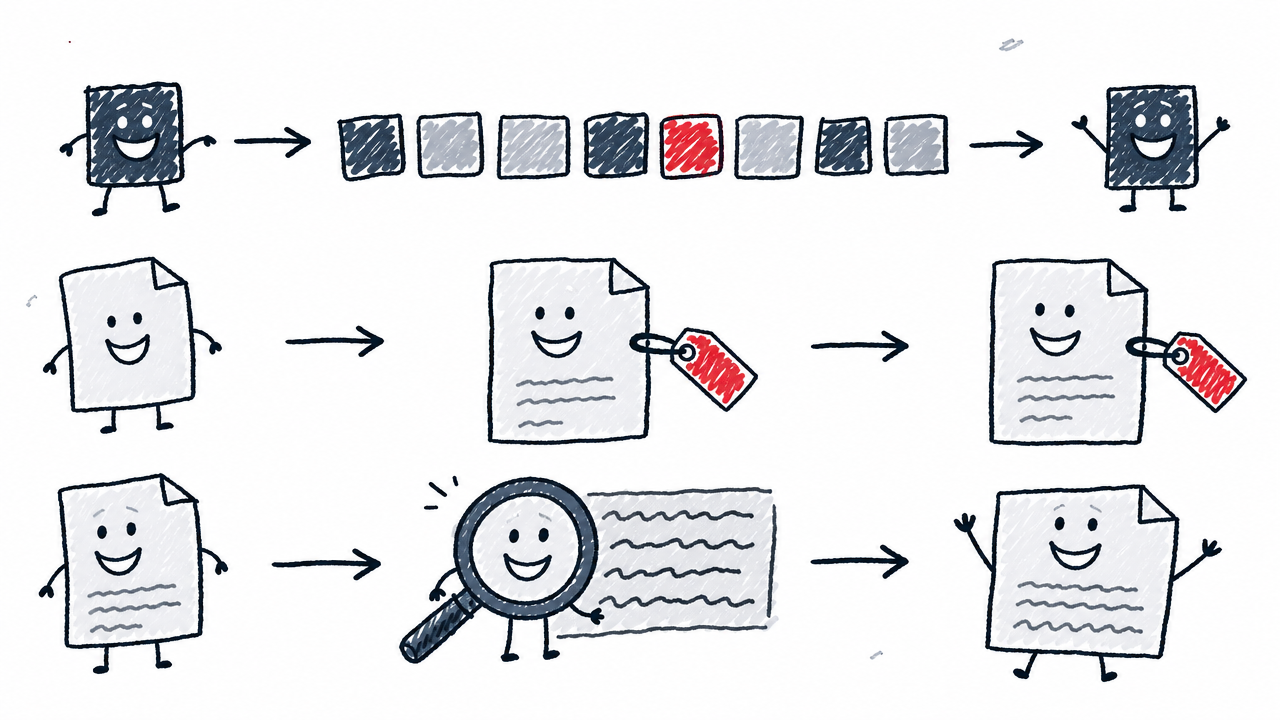
Statistical text watermark. During text generation, the model subtly biases which tokens it selects. The pattern is invisible to readers but detectable by a statistical test that knows the key. This is the technique Anthropic describes for Claude's text output. A detected mark indicates content "may have been processed by Claude," not that Claude authored it (Anthropic Help Center).
Provenance metadata (C2PA Content Credentials). Signed data attached to a file (image, PDF, audio). It records origin and edit history. This is a file-level signal, completely separate from a statistical text watermark.
AI-style classifiers. Tools like GPTZero or Originality.ai make post-hoc statistical guesses about whether text "looks" AI-generated. They do not read a proprietary watermark and are not the same as an official detector.
The core watermarking mechanism (selecting "green-list" tokens and promoting their use during sampling) is described in Kirchenbauer et al., PMLR 2023.
Why rewriting can weaken a statistical watermark
The watermark signal is spread across the tokens the model chose during generation. Every synonym, restructured sentence, or translated phrase that replaces an original token disrupts the statistical pattern the detector relies on.
That is why paraphrasing, translation, and human editing can degrade the mark, while copy-paste and formatting changes cannot: copy-paste keeps the exact token sequence, and formatting changes never touch it.
Robustness varies by watermark scheme, passage length, and the degree of rewriting. Zhang et al. ("Watermarks in the Sand," ICML 2024) argue on theoretical and experimental grounds that strong watermarking is removable under their stated assumptions. This is a robustness result from the research literature, not a practical guarantee for any specific tool or workflow against Claude's future detector.
Before you start
- Identify the source model. Know which model generated the text and whether it currently applies a mark. Anthropic says Claude models launched in the EU on or after August 2, 2026 support marking at launch, with older models still being worked on (Anthropic Help Center).
- Keep internal records. Save drafts, editorial change logs, and contributor notes for your own provenance trail.
- Check current detector status. Anthropic describes its detection details as forthcoming. No public Claude watermark reader exists yet, so results cannot be independently verified.
- Confirm you are authorized. Make sure you own or have the right to edit the content.
8 methods to avoid or weaken an AI text watermark
Each method below covers what to do, why it may work, the main trade-off, and a confidence rating.
1. Generate final copy with a model that does not add the mark
What to do: Produce your final text using an open-weight model you run locally (through tools like Ollama), or a commercial model whose current docs do not describe text watermarking.
Why it works: If the marking system never runs during generation, no mark is embedded. Prevention beats removal.
Trade-offs: Different models produce different quality, voice, and factual behavior. Do not assume any commercial provider is permanently watermark-free. OpenAI's provenance page describes ongoing text-watermarking research without a universal current guarantee for all text products (OpenAI provenance page). Anthropic says older Claude models are still being worked on for marking support.
Confidence: Strong as a prevention principle. Current model inventories need live verification before publication.
2. Paraphrase with a different model
What to do: Rewrite the text sentence by sentence using a model different from the suspected source. Do not paraphrase Claude text with Claude, as this may preserve or reintroduce the same mark. Keep factual claims, names, numbers, and citations intact manually.
Why it works: A different model uses a different token-choice distribution, replacing the original watermark-carrying tokens.
Evidence: Krishna et al.'s DIPPER (an 11-billion-parameter paraphraser) evaded several tested detectors in their setup, cutting DetectGPT detection accuracy from 70.3% to 4.6% at a 1% false-positive rate in one configuration (Krishna et al., NeurIPS 2023). This does not prove the same result against Claude's future detector.
Trade-offs: Loss of voice and precision. Recursive paraphrasing degrades quality fast.
Confidence: Plausible and experimentally supported for some schemes; not universal.
3. Translate through a pivot language and back
What to do: Translate the English text into another language (e.g., French or Mandarin), then translate back to English. Review the result carefully for idioms, legal terms, technical vocabulary, citations, and numbers.
Why it works: Translation replaces nearly every original token choice.
Evidence: He et al.'s Cross-lingual Watermark Removal Attack (CWRA) reduced tested watermark AUC to roughly random-guessing levels in their experiments (He et al., ACL 2024).
Trade-offs: Heavy human review is needed. Idiomatic, legal, and technical language may be garbled.
Confidence: Supported against tested systems; uncertain against future cross-lingual-resistant schemes.
4. Rewrite heavily at the sentence level as a human editor
What to do: Rebuild sentence order and syntax. Add genuine context, examples, and publication-specific judgment. Do not merely swap synonyms or change punctuation.
Why it works: Anthropic's Help Center lists heavily edited text as content that may no longer carry a detectable mark (Anthropic Help Center).
Trade-offs: Time-intensive. Long passages may still hold fragments of the original signal after editing.
Confidence: Strong practical method; no guarantee for very long passages or future detectors.
5. Keep AI passages short and mix with human-written text
What to do: Use AI for outlines, research notes, or short isolated drafts rather than long unbroken passages. Weave short AI-assisted sections together with copy you wrote yourself.
Why it works: Detection confidence depends partly on the amount of available marked text. Kirchenbauer et al. found that roughly 800 observed tokens were needed for detection after strong paraphrasing under a 10⁻⁵ false-positive rate in their setup (Kirchenbauer et al., OpenReview). That figure is not a universal "safe word count," and span-sensitive detectors may still flag a short marked segment inside a larger document.
Trade-offs: Not a standalone removal method. Requires genuine human work.
Confidence: A reasonable statistical limitation, not reliable removal on its own.
6. Prefer low-entropy or structured output (weak, context-dependent)
What to do: Code, formulas, rigid lists, and highly constrained answers leave fewer plausible token choices, which can reduce the freedom available to some watermarking methods.
Why it may not work: Newer research proposes detectors built for low-entropy text. Lu et al. (ACL 2024) and Huang et al. (Findings of ACL 2025) report methods that improve detection on code and mathematics.
Trade-offs: Forcing unnatural structure damages editorial quality for no guaranteed benefit.
Confidence: Weak and scheme-dependent. Do not rely on this.
7. Strip C2PA provenance metadata from files you own
What to do: Re-save, screenshot, or convert the file format to remove embedded C2PA Content Credentials.
Critical distinction: This is a file operation, not a text-watermark removal method. Removing C2PA metadata does nothing to a statistical text watermark already encoded in the prose.
Caution: C2PA supports soft bindings and durable credentials that may help recover provenance records after embedded metadata is stripped (C2PA FAQ). Metadata absence in one file does not prove provenance is gone for good.
Confidence: Deterministic for the local file's embedded metadata; not the same as erasing all possible provenance records.
8. Use the watermarks-remover tool (with its stated limits)
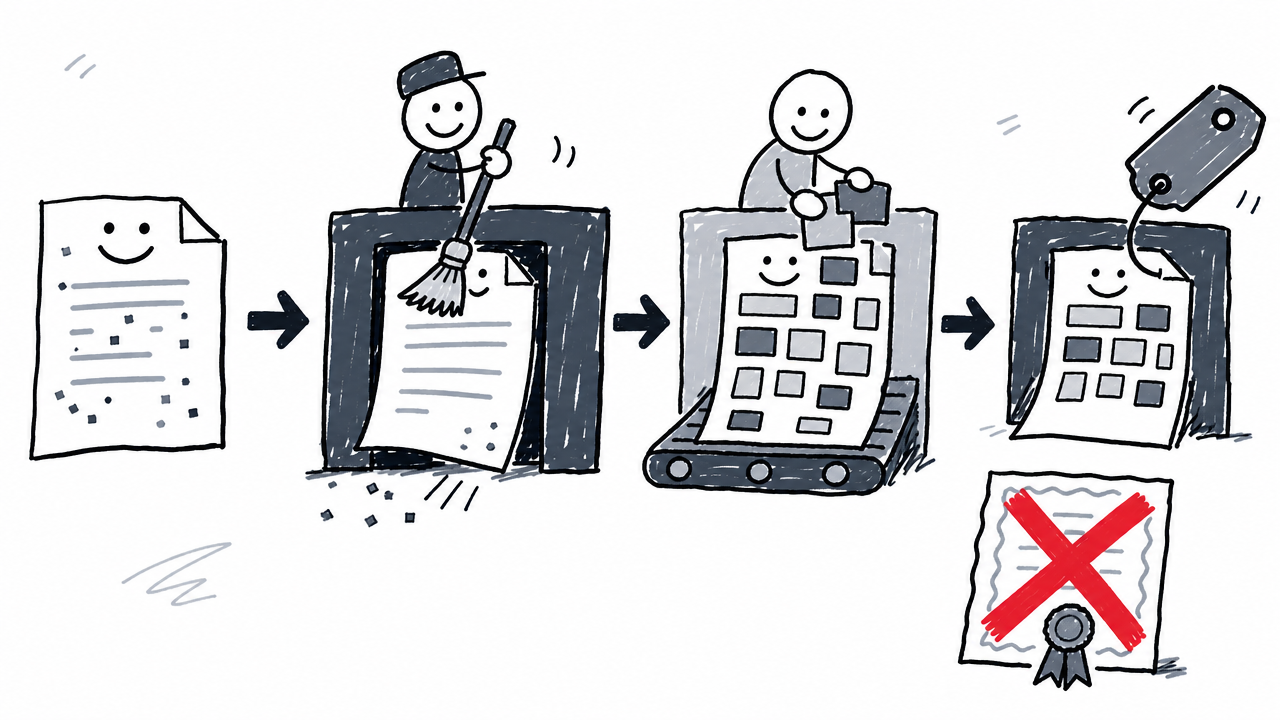
What to do: The open-source watermarks-remover repository (MIT-licensed, roughly 2.2k GitHub stars as of the page reviewed) offers three layers:
The repository's own skill documentation states candidly: no tool can certify that content will pass an official detector check while vendors have not published detectors and keys. Layer B should use a model different from the suspected source. Recheck the repository's star count and release version before relying on it.
What does NOT remove a statistical text watermark?
The mark lives in token choices, not in formatting or invisible characters. These common actions are ineffective:
Can any tool guarantee watermark-free text?
No. Anthropic's official detector and technical docs are still forthcoming (Anthropic Help Center). Third-party AI classifiers (GPTZero, Originality.ai, and similar tools) are not official watermark readers; they do not test for Claude's proprietary mark. A negative classifier result does not prove human authorship or the absence of AI processing.
On the research side, Zhang et al. (ICML 2024) show that strong watermarking is provably removable under their stated assumptions, with only minor quality loss in their experiments. This is an academic robustness finding, not a practical guarantee for any specific tool or workflow today.
Common mistakes and troubleshooting
- Paraphrasing Claude text with Claude itself. The same marking system may reintroduce or preserve the same statistical pattern. Always use a different model.
- Relying on a single synonym pass. Light synonym swaps are not enough. The signal is spread across hundreds of token choices; sentence-level restructuring is the practical floor.
- Treating a third-party AI classifier score as an official watermark result. A "human" label from GPTZero does not mean a text lacks a Claude watermark. These are separate systems.
- Assuming C2PA metadata removal also removes a text watermark. Stripping file metadata does not touch the statistical signal encoded in the prose.
- Treating the ~800-token figure as a hard cutoff. That number comes from one set of conditions in Kirchenbauer et al.'s study at a specific false-positive rate. It is not a universal safe word count.
FAQ
Does copy-pasting remove an AI text watermark?
No. The statistical signal is encoded in the token choices, and those choices travel with the copied text. Anthropic's Help Center confirms the mark persists through copy-paste.
Is there an official Claude watermark detector available?
As of the Anthropic Help Center page reviewed for this article, detection details are described as forthcoming. Third-party AI classifiers are not the same as an official Claude watermark reader.
Can translating text into another language and back remove a watermark?
Research by He et al. (ACL 2024) found their CWRA attack reduced tested watermark detection to roughly random levels. This result covers specific tested systems, not all future detectors. Human review is required afterward.
Does a clean AI-detector result prove text is human-written?
No. A negative result from any classifier or detector does not prove human authorship or the absence of AI processing. Anthropic itself says a missing mark does not establish that content was human-written.
Does removing C2PA metadata also remove a text watermark?
No. C2PA Content Credentials are file-level provenance metadata. Statistical text watermarks are encoded in the prose's token choices. Removing one does not affect the other.
Sources
- Anthropic Help Center: How Claude marks AI-generated content
- Kirchenbauer et al., "A Watermark for Large Language Models," PMLR 2023
- Kirchenbauer et al., "On the Reliability of Watermarks for Large Language Models," OpenReview
- Krishna et al., "Paraphrasing Evades Detectors of AI-Generated Text," NeurIPS 2023
- He et al., "Can Watermarks Survive Translation?" ACL 2024
- Zhang et al., "Watermarks in the Sand," PMLR 235 / ICML 2024
- Lu et al., "An Entropy-based Text Watermarking Detection Method," ACL 2024
- Huang et al., "Low-Entropy Watermark Detection via Bayes' Rule Derived Detector," Findings of ACL 2025
- Google DeepMind, SynthID-Text / "Scalable watermarking for identifying large language model outputs," Nature
- OpenAI, "Understanding the source of what we see and hear online"
- C2PA FAQ
- C2PA Soft-Binding Specification
watermarks-removerGitHub repositorywatermarks-removerskill documentation