
Claude's Watermark Can Flag Text You Wrote Yourself. Here's How.
Claude's watermark can flag text you only sent for proofreading. Learn what a claude watermark false positive really means, what the mark proves, and how to pro

Yes, if you send your own human-written draft through a supported Claude model for proofreading, translation, summarization, or light editing, the returned text may carry an invisible Claude watermark. Anthropic's own documentation says a detected mark indicates content "may have been processed by Claude," not that Claude authored it (Anthropic Help Center). A text watermark is a machine-readable signal embedded in the text itself, invisible to a human reader but detectable by a purpose-built system.
The gap between "processed" and "authored" is the core of the false-positive fear. The mark can be correct about processing and still misleading about who wrote the work.
What "false positive" means for Claude's watermark
The phrase "false positive" blurs two separate problems.
Problem 1: Technical false positive. The detection system flags text that Claude never touched at all. This is a detector error in the classic sense. Anthropic has not published a false-positive rate for its text-watermark detection, and as of mid-August 2026, the detection system's technical details remain described as forthcoming (Anthropic Help Center).
Problem 2: Authorship misinterpretation. The mark correctly identifies Claude processing, but a reader, client, editor, or platform treats that mark as proof that Claude wrote the content from scratch. The mark cannot tell a lightly proofread draft apart from a fully generated passage.
Most current concern falls into the second category. Anthropic's Help Center says outright that "the underlying ideas, text, or data may originate elsewhere" when Claude is used for proofreading, translation, summarization, or file conversion. A detected mark is evidence of possible Claude processing; it is separate from proof of Claude authorship.
Can proofreading with Claude leave a watermark on my own writing?
It can. Any time your human-written text passes through a supported Claude model and you use the output Claude returns, that output may carry an embedded watermark. The mark does not sort your original sentences from whatever Claude changed.
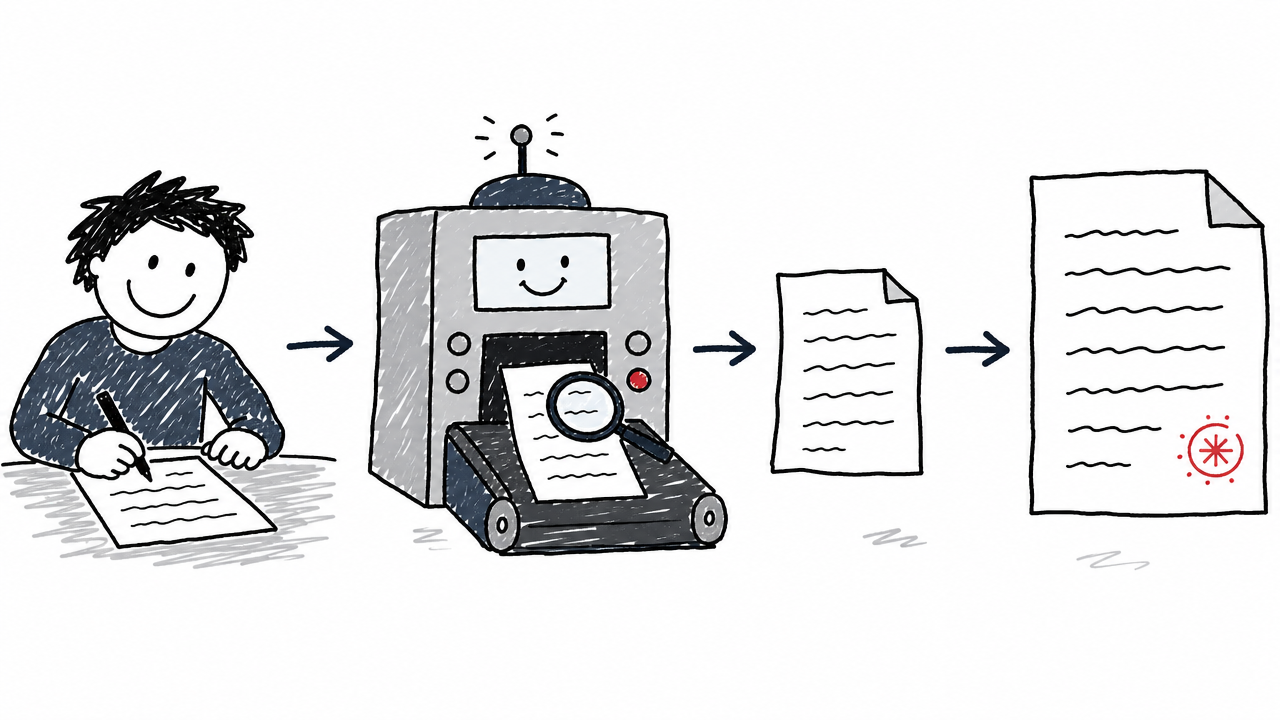
The human-draft-to-marked-output workflow
- You write an original draft. Every idea, sentence, and data point is yours.
- You send it to a supported Claude model for proofreading, grammar correction, or copy editing.
- Claude returns the processed version, possibly with minor corrections applied.
- That output may now carry Claude's embedded text watermark.
The mark does not label which words Claude changed and which it left alone. It does not tag your ideas, research, or data as "human-originated." It signals only that the text passed through Claude.
Other workflows that trigger the same result
Proofreading is just the most relatable example. The same dynamic applies whenever you send your own content through Claude and use what comes back:
- Translation of your own text into another language.
- Summarization of your own notes, reports, or meeting transcripts.
- Light rewriting or reformatting of your existing prose.
- File conversion through a supported Claude product.
Each sends human-originated content through Claude and produces output that may be marked. Anthropic's Help Center lists proofreading, translation, summarization, and file conversion as explicit examples where the underlying material may originate with someone other than Claude (Anthropic Help Center).
What a detected Claude mark does and does not prove
A detected Claude watermark is a narrow provenance signal. Understanding its limits is the single most useful thing a writer can do.
Anthropic uses the qualifier "may have been processed by Claude," not "written by Claude" (Anthropic Help Center).
An analogy: a spellchecker's "Track Changes" metadata tells you the tool touched the document. It does not tell you who wrote the paragraph. Claude's mark works the same way at a higher level. It records that the text moved through Claude's pipeline, not that Claude created it.
Does a missing mark prove text is human-written?
No. A clean detection result is not a certificate of human authorship, and treating it as one is just as wrong as treating a positive result as proof of AI authorship.
Anthropic lists several reasons a mark may be absent even when Claude was involved: heavy editing, paraphrasing, translation, mixing with other material, short passages, use of an unsupported model or feature, and stripped file metadata (Anthropic Help Center). A missing mark tells you nothing definitive about the text's origin.
How this differs from conventional AI-text detectors
Claude's embedded watermark and a third-party AI-writing detector are different systems that fail in different ways. Confusing them adds to the false-positive risk.
Two different systems, two different failure modes
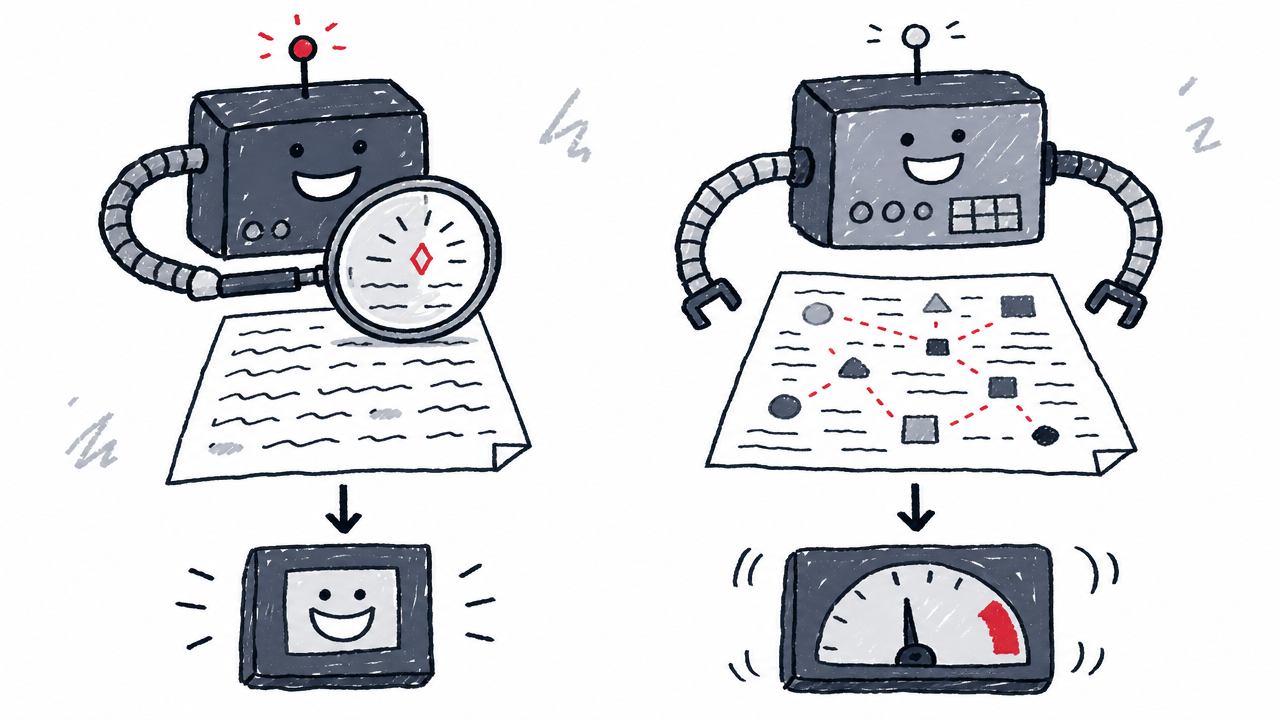
A watermark detector looks for a specific embedded signal placed by the model provider. It answers a narrow question: did this text pass through a supported Claude model?
A style-based AI classifier (such as GPTZero, Originality.ai, or similar tools) estimates the likelihood that any AI produced the text, based on statistical patterns like perplexity and burstiness. It answers a broader, fuzzier question: does this text look like a language model generated it?
Current third-party AI detectors cannot read Claude's proprietary watermark. A score from GPTZero is not a watermark detection result. The two should never be treated as equivalent.
Are non-native English writers especially vulnerable to AI-detector false positives?
Based on published research about style-based classifiers, yes.
Liang et al. (2023) evaluated seven widely used GPT detectors against 91 TOEFL essays written by non-native English speakers. The detectors' average false-positive rate on those essays was 61.22%: nearly two-thirds of human-written essays were misclassified as AI-generated. All seven detectors unanimously flagged roughly 19.78% of the essays. At least one detector flagged 89 of the 91 essays (Liang et al., Patterns, 2023; Stanford HAI summary).
This is evidence about conventional style-based classifiers, not about Claude's embedded watermark. But the point matters: false "AI" attribution existed before watermarking entered the picture. Writers and publishers should understand that different detection methods carry different risks and different evidence standards.
What writers and publishers should do now
The most practical defense against misattribution is evidence, not avoidance. Keep records that establish the human origin and editorial history of your work.
- Preserve the original, unprocessed draft in a dated file, a version-control system (Git, Google Docs version history, Dropbox versioning), or a timestamped cloud backup.
- Maintain research artifacts: outlines, interview notes, source bookmarks, and drafts that predate any Claude interaction.
- Keep an editorial change log. If you sent a draft to Claude for proofreading, note the date, the purpose, and what you used from the output.
- Document which Claude features you used and why: proofreading, translation, generation, summarization, etc. The difference between "Claude proofread my draft" and "Claude wrote my article" may matter to a client or editor.
- Treat any future detection result as one provenance signal among several, rather than a final authorship verdict.
Anthropic says detection details are forthcoming; no public detection tool or API for Claude's text watermark has been documented as of mid-August 2026 (Anthropic Help Center). No one can currently scan your text for the official Claude mark, but the preparation above ensures you are ready once detection becomes available.
Current rollout status
As reported by Anthropic's Help Center and confirmed by TechCrunch (August 11, 2026):
- Supported Claude models launched in the EU on or after August 2, 2026 support marking at launch.
- Marking applies worldwide wherever those supported models are used, not only in the EU.
- Older models launched before that date are still being addressed.
- Detection mechanisms and technical documentation are described as forthcoming.
Do not assume every Claude model, product, or API surface is currently marked. Verify against Anthropic's live documentation before drawing conclusions about a specific model's marking status.
FAQ
Does Google penalize watermarked or AI-assisted text? No evidence supports the claim that Google penalizes text because it carries an AI watermark or was AI-assisted. Any business risk from a detected watermark would come from client, publisher, or platform policies, not from a documented Google ranking penalty.
Can I check right now whether my text has an official Claude watermark? As of mid-August 2026, Anthropic says detection details are forthcoming. No public detection tool or API for Claude's text watermark has been documented. Third-party AI-writing detectors do not read Claude's proprietary embedded signal.
Does copying and pasting marked text into another document remove the watermark? Anthropic says the watermark travels with copied text and may persist through some editing. Do not assume copying alone removes the mark; equally, do not assume it always survives every transformation.
Can someone tell whether Claude only proofread my text or wrote it from scratch? Not from the watermark alone. The mark indicates possible Claude processing. It does not show the degree of Claude's contribution or label which sentences were changed.
Is this the same as C2PA metadata on images? No. C2PA signed provenance metadata applies to supported files such as images. The text watermark is a separate, embedded signal woven into the text itself. The two techniques serve related but distinct purposes.
Sources
- Anthropic Help Center, "How Claude marks AI-generated content": https://support.claude.com/en/articles/16266773-how-claude-marks-ai-generated-content
- Liang, W., Yuksekgonul, M., Mao, Y., Wu, E., & Zou, J. (2023). "GPT detectors are biased against non-native English writers." Patterns, 4(7), 100779: https://doi.org/10.1016/j.patter.2023.100779
- Stanford HAI, "AI Detectors Biased Against Non-Native English Writers": https://hai.stanford.edu/news/ai-detectors-biased-against-non-native-english-writers
- TechCrunch, "Anthropic says it will watermark text generated by its AI models" (August 11, 2026): https://techcrunch.com/2026/08/11/anthropic-says-it-will-watermark-text-generated-by-its-ai-models/
- Forbes, "Claude Will Put Invisible Watermarks On AI Text And Images: And The Internet Isn't Happy" (August 11, 2026): https://www.forbes.com/sites/maryroeloffs/2026/08/11/claude-will-put-invisible-watermarks-on-ai-text-and-images-and-the-internet-isnt-happy/