
Pilates vs Yoga: Which Is Right for You?
Deciding between Pilates and yoga? A friendly, evidence-backed comparison of goals, intensity, cost, and safety to help you find the fit that feels right for you.

Pilates vs yoga: which is right for you?
Neither Pilates nor yoga is universally better, and honestly, that's good news for you. Pilates tends to be the stronger choice for core strength, posture, and controlled rehabilitation. Yoga tends to be the stronger choice for flexibility, mindfulness, balance, and stress relief. The right pick depends on your personal goals, physical condition, class format, and budget. The comparison table below breaks down the real trade-offs so you can match a practice to your situation, not the other way around.
At-a-glance comparison table
Sources: Healthdirect; directional pricing from Junocal and the Mariana Tek 2026 Pilates Industry Report.
What is Pilates?
Pilates is a controlled movement system that emphasizes core strength, spinal alignment, neutral spine positioning, breathing, and muscular endurance. Every exercise is built around precise movement quality rather than high repetitions or heavy loads, which is part of what makes it feel so approachable.
You'll run into two main formats: mat Pilates and reformer Pilates. Mat Pilates uses body weight along with small tools such as resistance bands, a Pilates ring, or a small ball. Reformer Pilates uses a sliding carriage with adjustable springs and a footbar, adding variable resistance and support. Reformer classes are typically smaller, which means more individual attention for you, but also a higher price.
Clinical Pilates is a third category: exercises prescribed or supervised by a physiotherapist or other qualified clinician as part of injury rehabilitation. It's distinct from a general studio class and shouldn't be confused with one (Healthdirect).
What is yoga?
Yoga is a mind-body practice that combines physical postures (asana), breathing techniques (pranayama), meditation, and mindfulness. It originated as a broad philosophical tradition; the yoga practiced in most U.S. studios emphasizes the physical and breathwork components (NCCIH).
Here's something worth knowing before you book a class: "yoga" is an umbrella term covering vastly different styles. The intensity and focus vary enough that generalizing about "yoga" is almost as imprecise as generalizing about "exercise."
Because of this range, any claim about "yoga" should specify which style is being discussed. Keep that in mind as you read studio schedules, too.
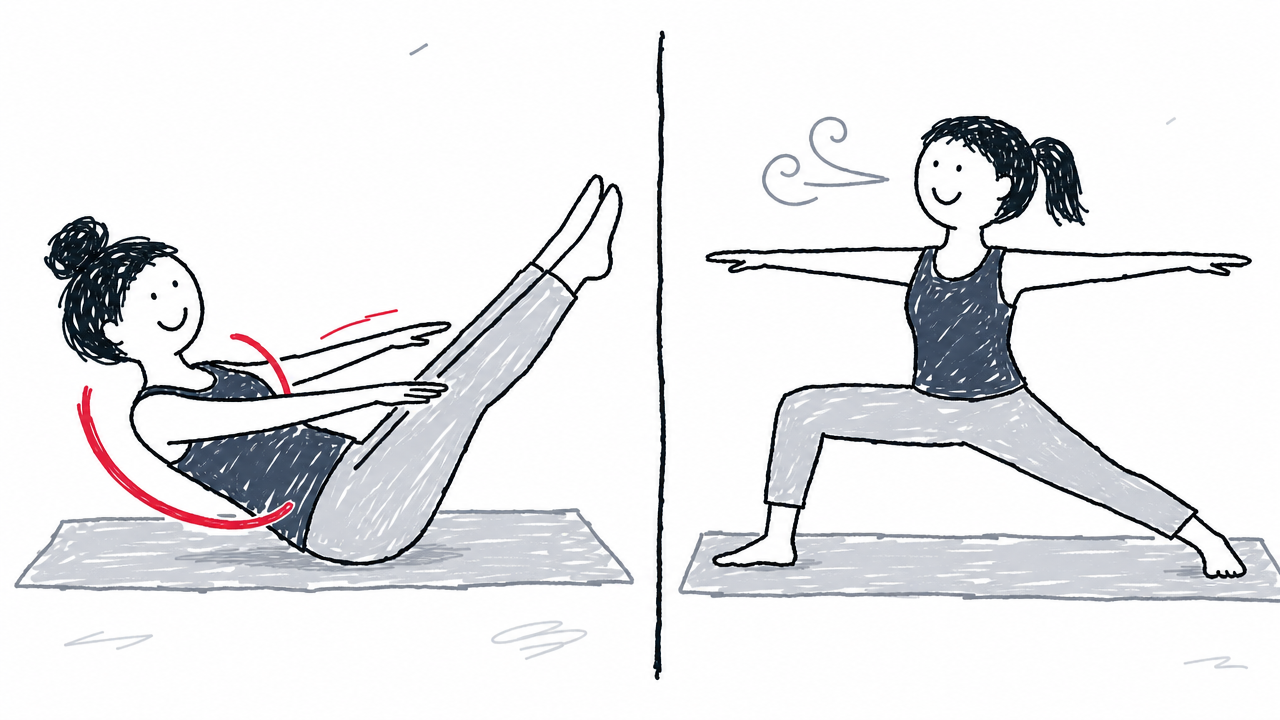
What is the main difference between Pilates and yoga?
The core split is philosophical and practical. Pilates prioritizes controlled repetitions, core stability, and movement quality within a structured exercise system. Yoga prioritizes postures, flow, stretching, breathwork, and meditative awareness within a broader mind-body tradition.
If you're worried about choosing wrong, take comfort in the overlap: both improve strength, flexibility, balance, posture, and body awareness, and both are low-impact (Healthdirect). The difference is emphasis. A Pilates class is unlikely to include savasana or extended meditation. A restorative yoga class is unlikely to include reformer-based resistance drills.
So choosing between them is less about finding the "better" practice and more about finding the better match for what you need right now. And you can always change your mind later.
How they compare by goal
Is Pilates or yoga better for posture?
Pilates has the practical edge for postural control, trunk stability, and spinal alignment. Its exercises are built around neutral spine positioning and sustained engagement of deep stabilizing muscles.
The research backs this up, with caveats. A 2024 systematic review retrieved 651 studies and included nine studies involving 643 participants. The reviewed research reported positive effects of Pilates on posture, spinal deformity measures, quality of life, pain, function, and fitness. The authors concluded that Pilates has potential for improving posture but stated that more research is needed before it can be validated as a physical-therapy treatment for spinal deformity rehabilitation (PubMed 38388449).
Yoga can also improve postural awareness, especially styles like Iyengar that emphasize alignment precision. But Pilates' narrower focus on controlled trunk engagement gives it a more direct path to postural improvement for most people.
One gentle caution: no exercise will "fix" posture overnight. Postural habits are shaped by how you sit, stand, and move throughout the day, not just what happens during a 50-minute class. Be patient with yourself.
Is Pilates or yoga better for flexibility and range of motion?
Yoga has the practical edge for flexibility, because many formats emphasize held stretches, progressive range of motion, and full-body lengthening. A Hatha or Yin class may spend several minutes in a single stretch, which is hard to replicate in a typical Pilates session.
That said, Pilates improves flexibility too. A meta-analytical review of 51 studies involving 2,485 participants aged 55 and older found that Pilates showed moderate effects on flexibility, among other physiological outcomes, when compared with inactive controls (PubMed 34759879).
One distinction worth knowing: flexibility (the passive range of motion of a joint) is not the same as mobility (the ability to move through a range under active control). Pilates tends to build mobility; yoga tends to build both, depending on the style.
Is Pilates or yoga better for stress relief?
Yoga has the practical edge when the class includes breathwork, mindfulness, meditation, or restorative elements. A 2020 review of 12 studies involving 672 healthy adults found beneficial effects of yoga on perceived stress across the included studies (NCCIH).
Restorative yoga, in particular, is built around deep relaxation: supported poses held for extended periods, dim lighting, and guided breathing. If a fast-paced Vinyasa class sounds like the opposite of relaxing to you, know that this gentler end of the spectrum exists.
Pilates' focused breathing and concentrated movement can support relaxation too, and many practitioners come out of a session feeling noticeably calmer. But yoga's explicit integration of meditation and mindfulness gives it a more direct stress-relief pathway.
Is Pilates or yoga better for core strength and muscular endurance?
Pilates has the practical edge for core-specific control and lumbopelvic stability. Every Pilates exercise connects to the core stabilizing muscles, and the system was designed with this focus from the beginning (Healthdirect).
Yoga builds strength through weight-bearing poses (think Plank, Chaturanga, Warrior sequences), but core engagement is one component of the practice rather than its central organizing principle.
To set expectations kindly but honestly: neither practice replaces progressive maximal strength training or a hypertrophy program. Increasing your one-rep-max squat or building significant muscle mass requires resistance training with progressive overload, a stimulus that mat work alone does not provide.
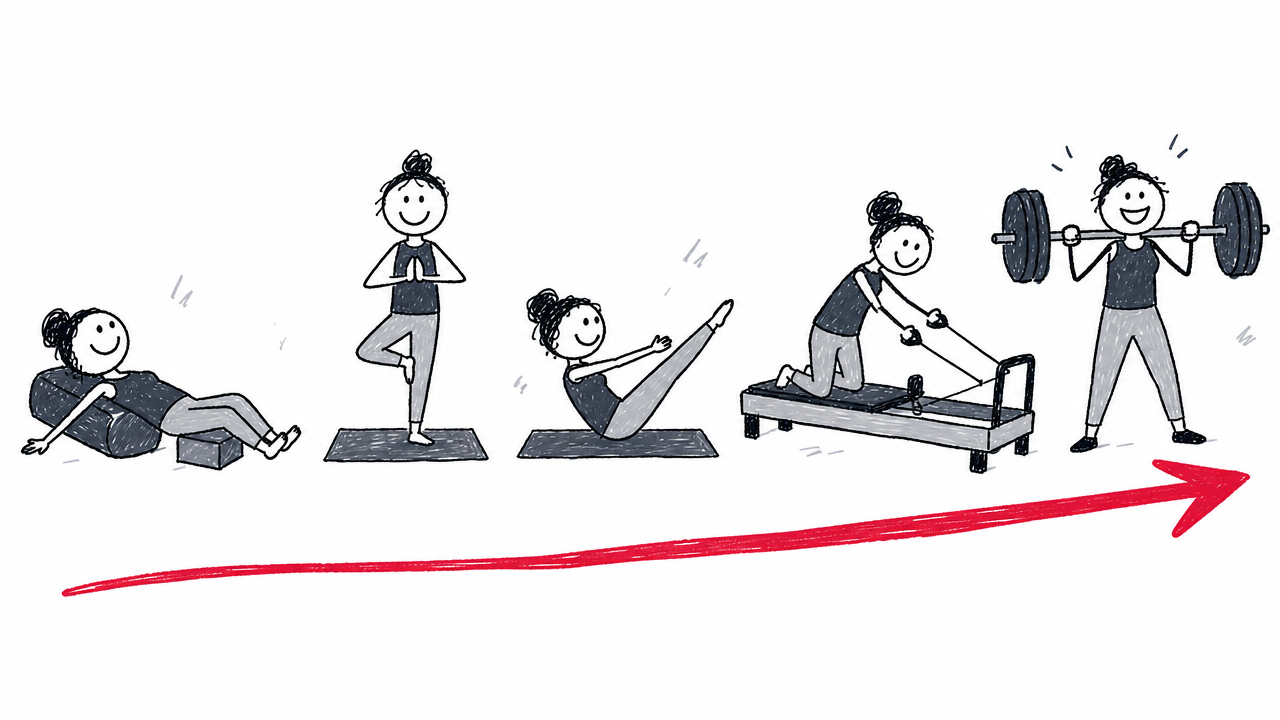
Is Pilates or yoga better for back pain?
There's no universal winner here. Both can help, but the evidence is mixed and individual responses vary.
A systematic review informing a WHO clinical guideline screened 2,503 records and synthesized 13 randomized controlled trials. When exercise types were pooled, exercise probably reduced pain (standardized mean difference of −0.33) and functional limitations (−0.31). Pilates was associated with pain reduction and improved function versus no intervention, but the evidence was predominantly low or very low certainty. Yoga was associated with temporary minor pain increases versus usual care in the reviewed evidence (Journal of Occupational Rehabilitation).
Separately, a 2022 NCCIH review of 21 studies involving 2,223 participants found yoga was slightly better than no exercise for low-back pain, although the difference may not be meaningful to patients. Whether yoga differed from other exercise types remained unclear (NCCIH).
The honest recommendation: if you have persistent, severe, or radiating back pain, talk with a healthcare provider before choosing a class. The best exercise for your back is the one prescribed or approved for your specific condition.
Rehabilitation after an injury
Neither Pilates nor yoga is automatically the best choice for rehabilitation. The best modality depends on the injury, its severity, and the professional supervising your recovery.
Pilates may be particularly suitable when the goal is controlled strengthening and movement retraining, because it allows precise loading and modification. Clinical Pilates, delivered by a qualified clinician, takes this further.
Yoga can also be adapted for recovery, especially gentler styles with prop support. But general wellness classes are not medical rehabilitation. Neither practice replaces a diagnosis or a physical therapy program. And please tell your instructor about any injury so exercises can be modified; they'll be glad you did (Healthdirect).
Balance
Both practices help improve balance, so this one is a tie in the best way. A 2014 NCCIH review found that 11 of 15 studies involving 688 participants reported improvement in at least one balance-related outcome for yoga (NCCIH). The Pilates meta-analysis in adults over 55 also found moderate effects on balance compared with inactive controls (PubMed 34759879).
If balance is your primary concern (for example, fall prevention in older adults), either practice is a reasonable starting point.
Which is more intense: Pilates or yoga?
Class format matters more than the label. A restorative yoga class is gentler than a reformer Pilates class. A vigorous Vinyasa or Ashtanga session may be more physically demanding than a beginner mat Pilates session.
So try not to choose between Pilates and yoga based on a blanket intensity ranking. Look at the specific class description, level, and instructor instead. Most studios state the difficulty, and many offer trial classes so you can gauge the intensity firsthand before committing to anything.
Which burns more calories?
There's no dependable universal winner. Calorie burn depends on class intensity, duration, style, your body weight, and individual metabolic factors.
A vigorous Ashtanga flow will burn more calories than a gentle mat Pilates session. A challenging reformer class will burn more than a restorative yoga session. But picking a practice on calorie burn alone misses the bigger picture: weight change depends on total activity, nutrition, and energy balance across your entire day, not one class in isolation.
Equipment: what do you need?
Pilates equipment ranges from minimal to extensive. Mat Pilates asks for just a mat and, optionally, a resistance band, Pilates ring, or small ball. Reformer Pilates requires a reformer machine with springs and a footbar, which typically means attending a studio (Healthdirect).
Yoga needs a mat and optionally blocks, a strap, a bolster, and a blanket. Most studios provide props, so don't feel you have to buy anything before your first class. Home practice is straightforward because the equipment is inexpensive and takes up little space.
That equipment gap explains much of the cost difference: reformer access usually requires a studio visit, and studios must recoup the cost of the machines and the space they occupy.
How much do Pilates and yoga cost?
Pricing varies widely by city, studio, class format, and instructor. The following U.S. benchmarks from Junocal and the Mariana Tek 2026 Pilates Industry Report give a directional sense of the market:
The Mariana Tek report lists an average Pilates class price benchmark of $25.18, compared with $19.59 for non-Pilates modalities. Average monthly membership benchmarks are $249 for Pilates versus $168 for other modalities.
Keep in mind these are platform-level benchmarks, not universal national averages. Before committing, always check local pricing, intro offers, class-pack options, and cancellation terms.
Why is reformer Pilates usually more expensive than yoga?
Three factors drive the premium: expensive equipment (reformer machines cost thousands of dollars each), smaller class sizes dictated by the number of machines, and the studio overhead of maintaining specialized hardware. The Mariana Tek report shows the percentage of studios offering Pilates rose from 17.5% in 2021 to 45.1% in 2025 (Mariana Tek), reflecting growing demand alongside sustained higher per-class pricing.
Is Pilates or yoga better for beginners?
Both are solid entry points, so you truly can't go wrong here. The key is choosing a beginner, gentle, or foundations-level class taught by a qualified instructor who offers modifications.
Tell your instructor about any injuries, health conditions, or physical limits before class starts. This lets them adapt exercises to your needs (Healthdirect). And go easy on yourself at first: skip the advanced poses and movements, and build gradually.
Hot yoga carries extra considerations for beginners: the heated environment increases the risk of dehydration and overheating, and the warmth can mask overstretching (NCCIH). If you're new to movement, a room-temperature class is a safer starting point.
Safety and injury considerations
Low-impact does not mean risk-free. Sprains and strains can occur in yoga, particularly when forcing advanced poses or practicing without qualified instruction (NCCIH). Pilates is controllable by design, but poor form or inappropriate resistance can still lead to strain.
Pregnant people, older adults, and those with health conditions should seek guidance from a healthcare provider and look for classes with appropriate modifications. Neither practice is inherently dangerous; both simply ask you to respect your body's current limits.
Can Pilates or yoga replace strength training?
Neither fully substitutes for progressive resistance training aimed at maximal strength or muscle hypertrophy. The Physical Activity Guidelines for Americans recommend adults aim for 150 to 300 minutes of moderate-intensity aerobic activity per week, plus muscle-strengthening activity on at least two days per week (ODPHP).
Here's the encouraging part: Pilates and yoga can count toward these goals. Both involve muscle-strengthening elements, and vigorous styles contribute to aerobic activity. But if you need to build significant strength or muscle mass, you'll eventually need to add external resistance training. Think of Pilates and yoga as valuable pieces of a fitness routine, not the entire routine by themselves.
Can you do both Pilates and yoga?
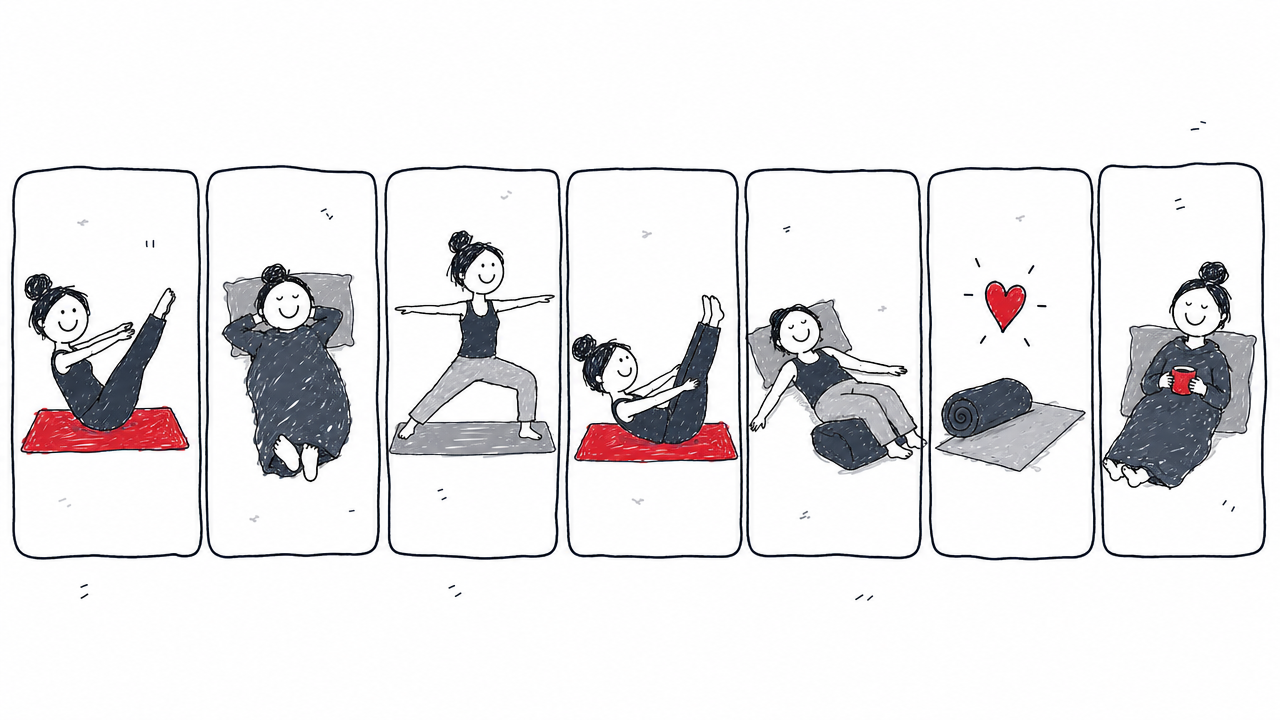
Yes, and many people thrive on the combination. Pilates provides controlled core work, postural strengthening, and movement precision. Yoga adds flexibility, balance, breathwork, and relaxation. The two complement each other rather than competing, so there's no rule saying you have to pick just one.
A practical sample weekly split for someone starting out:
- 2 Pilates sessions (mat or reformer) for core and postural work
- 2 yoga sessions (one flow-based, one restorative) for flexibility and stress relief
Adjust the ratio based on which practice serves your current priorities.
Which practice fits your goal: quick recommendations
No single winner exists, and by now you can probably see why. Here's the goal-by-goal summary:
The most reliable way to decide? Try both. Take one beginner Pilates class and one beginner or gentle yoga class, then ask yourself: Which instructor connected with you? Which class fit your schedule and budget? Which practice did you want to return to?
Because here's the truth that matters more than any comparison table: consistency matters more than the "perfect" choice. The practice you enjoy enough to show up for week after week will deliver more results than the theoretically optimal one you quit after a month.
FAQ
Is Pilates or yoga better for weight loss?
No reliable universal winner exists. Calorie burn depends on class intensity, duration, and how consistently you attend. Weight change hinges on total daily activity and nutrition across your whole routine, not one class alone. Choose the practice you'll actually stick with, and address nutrition separately.
Is Pilates or yoga better during pregnancy?
Both can be adapted, but modifications are essential. Prenatal yoga and prenatal Pilates classes exist for exactly this purpose, with trained instructors who understand the physical changes of pregnancy. Always consult your healthcare provider before starting or continuing either practice during pregnancy.
How often should a beginner practice Pilates or yoga?
Two to three sessions per week is a common and sustainable starting point. Consistency matters more than frequency: three classes per week maintained for months will outperform daily sessions abandoned after two weeks. And allow yourself rest days, especially while your body adapts to new movement patterns.
Do I need to be flexible to start yoga?
No, and this worry keeps far too many people from ever starting. Flexibility develops through regular practice; it's a result, not a prerequisite. Beginners should use props (blocks, straps, bolsters) and accept modifications rather than forcing poses. A qualified instructor can scale each posture to your current range of motion.