
How to Get Preapproved for a Mortgage: Steps, Documents, and Timeline
Learn how to get preapproved for a mortgage step by step, from gathering documents and comparing lenders to reviewing your letter and protecting your finances t

How to get preapproved for a mortgage: steps, documents, and timeline
To get preapproved for a mortgage, compare lenders, prepare your financial documents, complete a mortgage application, allow a credit check, and respond to any follow-up requests. If the review is favorable, the lender issues a preapproval letter stating an approximate loan amount and conditions. Preapproval is conditional: it does not guarantee final loan approval, as the Consumer Financial Protection Bureau (CFPB) explains. This guide covers prerequisites, a step-by-step process, required documents, timeline, and what to do if you are denied.
What mortgage preapproval is and why it matters
Mortgage preapproval is a lender's conditional willingness to lend you up to a certain amount based on a review of your finances. The preapproval letter typically states a loan amount, loan type, estimated interest rate, and an expiry date. It signals to sellers and real estate agents that your finances have been reviewed, but it is not a final approval.
A critical point: the property itself, its appraisal, the title search, and any changes in your financial situation between preapproval and closing can still affect the outcome. Preapproval means the lender has reviewed you; the property and final conditions have not yet been assessed.
The CFPB warns that lenders use "preapproval" and "prequalification" differently. Some prequalifications involve only borrower-provided information, while some preapprovals include verified documents and a credit check. Instead of relying on the label, ask each lender exactly what was reviewed.
Throughout this guide, keep three numbers in mind:
- What the lender may be willing to lend (the preapproval amount)
- What you can technically qualify for (based on underwriting guidelines)
- What you can comfortably afford (based on your full household budget)
These are rarely the same number. Only the third one protects your long-term financial health.
What you need before applying (prerequisites)
Before you contact a single lender, gather a clear picture of your credit, income, debts, and paperwork. Lenders look at several linked factors, and arriving prepared speeds up the process and reduces the risk of surprises. The two sections below cover the financial benchmarks lenders review and the specific documents you should have on hand.
Credit, income, and debt basics
Lenders commonly review your credit history and scores, gross qualifying income, employment stability, assets and reserves, down-payment funds, and existing debt. A central metric is the debt-to-income ratio (DTI):
DTI = total monthly debt payments ÷ gross monthly income × 100
No single credit-score or DTI cutoff applies to every mortgage. Fannie Mae identifies credit history, delinquent accounts, revolving credit use, DTI, reserves, loan-to-value ratio (LTV), occupancy type, property type, and variable income as risk factors its Desktop Underwriter (DU) automated underwriting system weighs together. A borrower with strong reserves and a low LTV, for example, may be treated differently than one with thin savings, even at the same credit score.
Fannie Mae also states that stable, predictable, documented, and reasonably continuable income is foundational to underwriting. Irregular or self-employment income requires more paperwork, not necessarily disqualification.
Documents you will need (checklist)
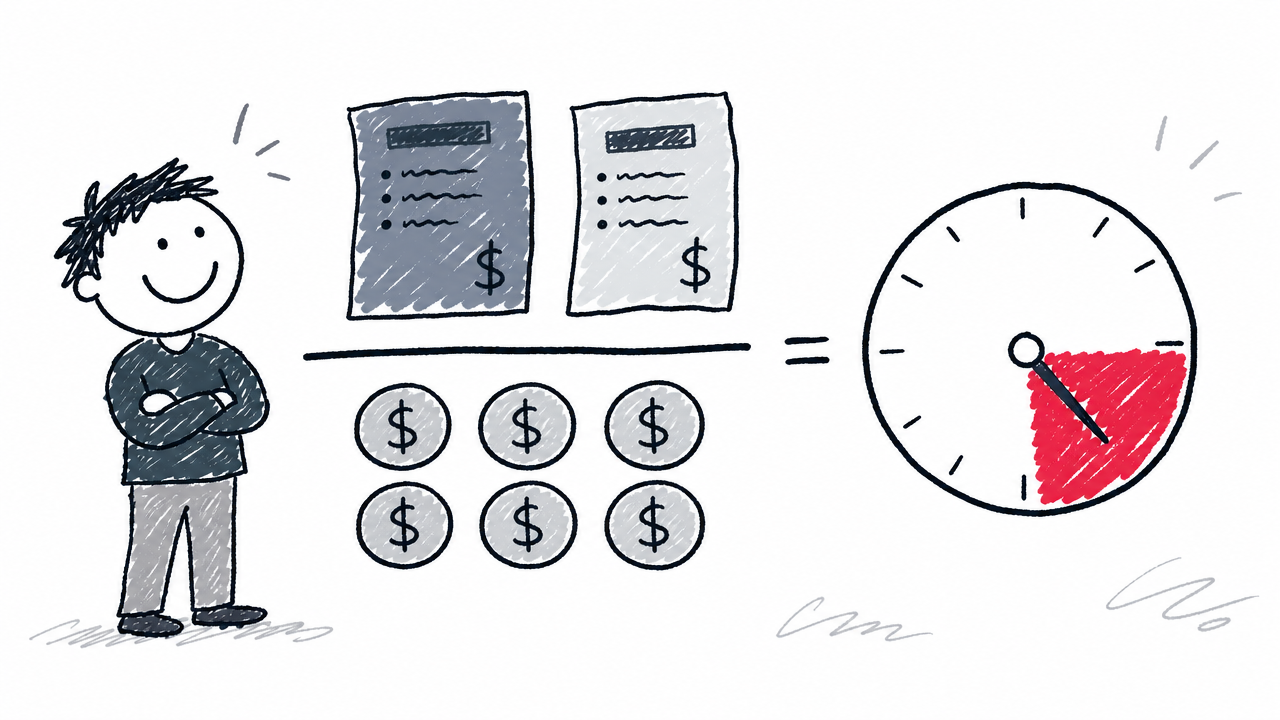
Exact requirements vary by lender and loan program. The checklist below, organized into five categories, reflects common expectations based on guidance from the CFPB, Fannie Mae employment/income standards, and Fannie Mae asset-verification guidance.
Identity and personal information
- Government-issued photo ID
- Social Security number
- Current address and address history
- Proof of any recent name change
Employment and wage income
- Pay stubs covering the most recent 30 days (Fannie Mae guidance says no earlier than 30 days before the initial loan application, with year-to-date earnings)
- W-2 forms for the most recent 1–2 years
- Employment verification or contact information for employers
- Written explanation of any employment gaps
Tax and non-wage income
- Signed federal tax returns for the most recent 2 years
- 1099 forms, if applicable
- Profit-and-loss statements for self-employment income
- Award letters or statements for Social Security, pension, disability, alimony, rental income, or other recurring sources
Assets and funds to close
- Two most recent months of bank statements (Fannie Mae's asset-verification guidance generally calls for a full two-month period; a supplemental statement may be needed if the latest is more than 45 days old)
- Investment and retirement account statements
- Records showing the source of down-payment funds
- Gift letter and evidence of the donor's funds, if gift money is used
- Records of grants or down-payment help programs
Debts and obligations
- Details of credit cards, auto loans, student loans, and personal loans
- Divorce decree, separation agreement, or child-support documents, if applicable
- Information about other properties you own
- Lease or rental income records, if applicable
Step-by-step: how to get preapproved for a mortgage
Step 1: Set a personal home-buying budget
The lender's preapproval amount is not the same as what you should spend. Before applying, estimate your complete monthly housing cost:
- Principal and interest on the mortgage
- Property taxes
- Homeowners insurance
- Mortgage insurance (private mortgage insurance for conventional loans, or FHA mortgage insurance for FHA loans)
- HOA dues, if applicable
- Maintenance and repair costs
- Existing debt payments (student loans, auto loans, credit cards)
Add your expected down payment and closing costs. HUD states that affordability depends on income, credit rating, monthly expenses, down payment, and interest rate. Only you can decide what monthly payment is truly comfortable. A lender may approve you for more than you should borrow.
Step 2: Check your credit reports for errors
Review your credit reports from all three major bureaus before any lender pulls your credit. You can do this at AnnualCreditReport.com. Checking your own report does not affect your credit score.
If you find errors:
- Dispute them with the credit-reporting company and the information provider (the creditor that reported the data).
- Keep written records of every dispute.
- Ask the lender how an active dispute may affect underwriting.
Avoid opening new credit accounts or taking on major new debt before or during the mortgage process. New accounts lower your average account age, increase inquiries, and can raise your DTI.
Step 3: Compare at least three lenders
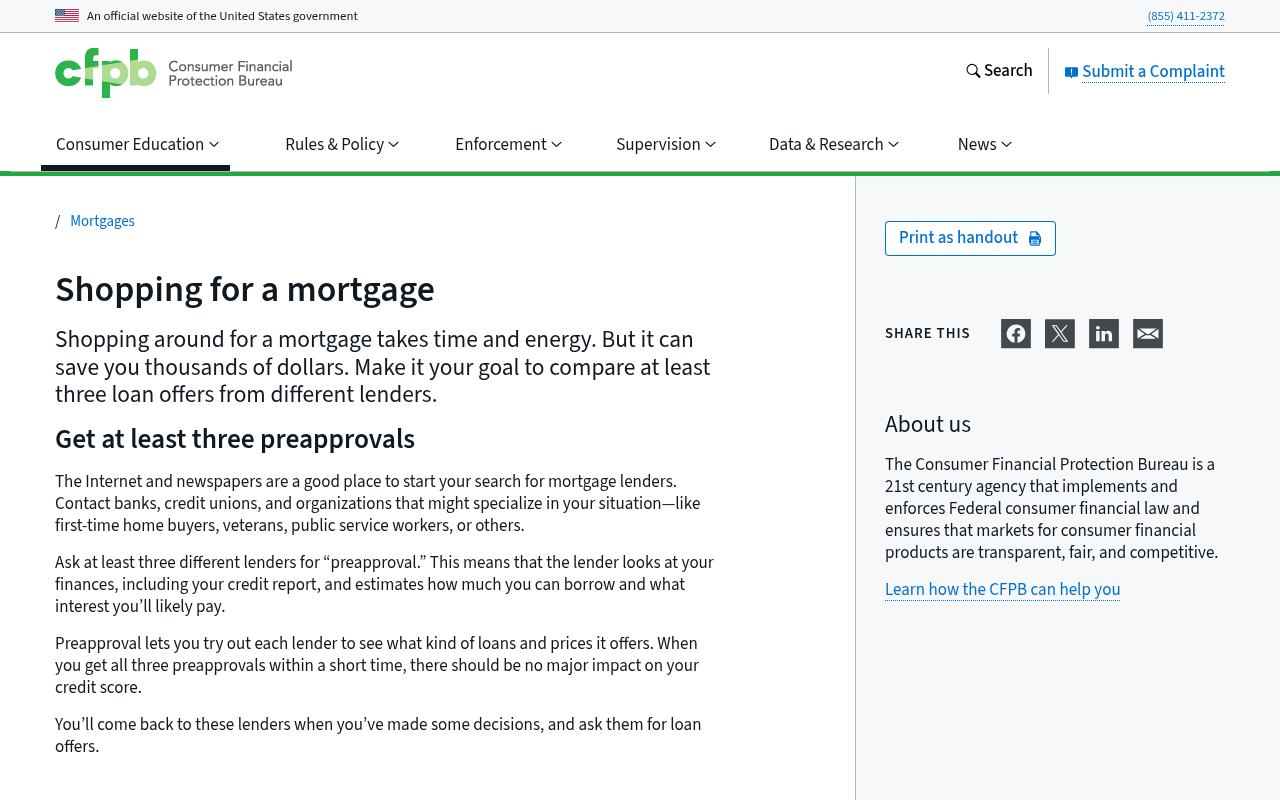
The CFPB recommends requesting preapprovals from at least three lenders. Consider a mix of banks, credit unions, mortgage companies, and lenders experienced with FHA, VA, USDA, or first-time-buyer programs.
Questions to ask each lender:
The credit-shopping window: The CFPB says mortgage credit checks within a 45-day window are recorded as a single inquiry for scoring purposes. This means you can shop aggressively without compounding the credit impact.
Lender-specific variation is real. For example, Chase advertises that its initial online process does not affect the borrower's credit score, and its preapproval typically lasts 30–60 days. Bank of America describes its preapproval as involving a hard credit inquiry, with a 90-day letter that may take up to 10 business days after requested information is provided. These are examples of variation, not universal rules.
Step 4: Complete the application and allow the credit review
You will provide your legal name, income, Social Security number, employment information, assets and liabilities, estimated price, down payment, desired loan amount, loan program, and occupancy type. This information is commonly submitted through the Uniform Residential Loan Application (Form 1003).
The lender will pull a credit report and may run your application through an automated underwriting system (AUS). Fannie Mae's Desktop Underwriter (DU) weighs equity, credit, liquid reserves, reliable recurring income, and other risk factors. For FHA loans, HUD's FHA TOTAL Scorecard provides a real-time recommendation classified as "Accept" or "Refer."
An automated "Accept" or "Approve" result is not final approval. HUD states that FHA TOTAL recommendations alone cannot be used to accept or deny an FHA-insured mortgage; loans must still be underwritten under applicable FHA policy. A DU approval is likewise conditional and subject to further verification.
Step 5: Respond promptly to lender requests
Speed and completeness matter. The CFPB says complete and accurate records speed the process, while missing documents may cause delays or rejection.
- Upload every page of multi-page statements, including blank pages.
- Use legible, unaltered documents.
- Explain large deposits or unusual transfers before the lender asks.
- Keep pay stubs and bank statements current; a statement older than 45 days may need supplementing.
- Respond quickly to any clarification requests.
- Notify the lender right away of employment changes, new debt, credit disputes, gifts, or changes in available funds.
Step 6: Review the preapproval letter carefully
Once issued, read the letter closely. It may include:
- Loan amount (the most the lender will consider)
- Loan program (conventional, FHA, VA, etc.)
- Estimated interest rate
- Price and down-payment assumptions
- Expiry date
- Outstanding conditions (documents still needed)
- Lender contact information
Key questions to ask yourself:
- Is the approved amount based on a payment that includes taxes, insurance, mortgage insurance, and HOA dues, or just principal and interest?
- Is the rate locked or merely estimated?
- Does the letter depend on selling another property or receiving a gift?
- Are any items still unverified?
- What happens when it expires, and can the lender renew or update it?
You are not committed to the lender that preapproved you. The preapproval letter establishes what you can offer; the final lender choice comes later.
Step 7: Protect your financial profile while house hunting
Lenders may re-verify your credit, income, and assets before closing. Between preapproval and closing, do not:
- Open new credit accounts or credit cards
- Make large credit-financed buys
- Change jobs without consulting the lender first
- Co-sign loans for anyone
- Make large, undocumented deposits
- Drain your savings or move money between accounts without a paper trail
Any of these actions can trigger a reassessment that delays or blocks final approval.
Step 8: Compare official Loan Estimates after an offer is accepted
Once a lender receives six key items (your name, income, Social Security number, property address, estimated property value, and desired loan amount), it must generally provide a Loan Estimate within three business days under TILA-RESPA Integrated Disclosure (TRID) rules. A Loan Estimate is not an approval or denial; it is a standardized disclosure.
Compare Loan Estimates from competing lenders, focusing on:
The CFPB provides a detailed guide to reviewing Loan Estimates side by side.

How long does mortgage preapproval take?
Expect three distinct timelines, not one:
1. Preparation time (days to weeks). Gathering documents and reviewing your credit can be quick if your records are organized, or it can take weeks if you need to dispute errors, get tax transcripts, or assemble self-employment records.
2. Lender review time (1 to 10+ business days). Some lenders issue a decision within a day; others take longer. Bank of America, as one example, states that its process may take up to 10 business days after requested information is provided. Complexity (self-employment, several income sources, large gift funds) can extend this.
3. Letter validity (30 to 90 days). The CFPB says preapproval letters typically expire in 30 to 60 days. Freddie Mac says buyers can generally expect 30 to 90 days, depending on the lender. Check the date printed on your letter.
Time your preapproval close to serious house hunting so the letter does not expire before you make an offer. Renewal usually requires updated pay stubs, bank statements, and potentially a new credit pull.
What happens if you are denied preapproval
Denial is not the end of the road. Common reasons include thin credit history, a low credit score, high DTI, incomplete income records, employment gaps, limited assets, or unresolved credit disputes.
If you are denied, the lender must provide an adverse action notice under the Equal Credit Opportunity Act (ECOA) and the Fair Credit Reporting Act (FCRA). The CFPB advises you to:
- Request the specific reason for denial.
- Get the credit score the lender used.
- Review your credit reports for errors and dispute any inaccuracies.
- Reduce debt where possible to lower your DTI.
- Strengthen your records, especially if income or assets were poorly documented.
- Contact a HUD-approved housing counseling agency at 1-800-569-4287 or through HUD's counseling page. Counselors can help with affordability planning, credit improvement, and understanding mortgage options.
Another lender may approve you if the denial was tied to that lender's specific requirements or loan program. FHA, VA, and USDA loans have different guidelines than conventional loans, and a lender experienced with those programs may reach a different conclusion.
Common mistakes that delay or derail preapproval
Submitting incomplete or outdated documents. Missing pages, expired bank statements, or unsigned tax returns force the lender to pause and request replacements.
Failing to explain large deposits. An unexplained $5,000 deposit in your bank statement triggers questions about the source of funds. Document gifts, bonuses, or asset sales before you are asked.
Opening new credit lines before or during the process. A new car loan or credit card changes your DTI and credit profile, potentially voiding your preapproval.
Confusing preapproval with final approval. Preapproval is conditional. The property, appraisal, title, and your updated financial situation still matter.
Shopping only one lender. Without quotes from several lenders, you cannot compare rates, fees, or loan programs.
Letting the letter expire before making an offer. If you wait too long, you will need to resubmit documents and possibly undergo another credit check to renew.
FAQ
What is the difference between preapproval and prequalification?
The CFPB says lenders use these terms differently. Some prequalifications rely on borrower-provided information without verification; some preapprovals involve verified documents and a credit check. Rather than trusting the label, ask each lender what financial information it actually reviewed and whether a credit report was pulled.
Does getting preapproved hurt my credit score?
Preapproval may involve a hard credit inquiry, which can have a small, temporary effect. The CFPB says mortgage-shopping inquiries within a 45-day window are recorded as a single inquiry for scoring purposes. Some lenders use a soft pull for an initial review, so ask before you agree to the check.
Can I get preapproved before I find a house?
Yes, and most experts recommend it. Preapproval helps you set a realistic price range and shows sellers that your finances have been reviewed. Time it so the letter does not expire before you make an offer; validity periods typically range from 30 to 90 days.
Do I have to use the lender that preapproved me?
No. A preapproval letter does not bind you to that lender. After your offer is accepted, the CFPB recommends comparing Loan Estimates from several lenders before committing. You may choose a different lender entirely.
Can I get preapproved with student loans or self-employment income?
Yes, but the paperwork is more detailed. Self-employed borrowers often need two years of tax returns, profit-and-loss statements, and possibly business returns. Student loans factor into your DTI calculation. Prepare thorough records and consider lenders experienced with these borrower profiles. Fannie Mae's income documentation standards outline what lenders may require.
What credit score do I need to get preapproved?
No single number applies to every borrower. Requirements vary by loan program, lender, down payment, and your full risk profile. Fannie Mae weighs credit score alongside DTI, reserves, LTV, and other factors. FHA programs may be open to borrowers with lower scores, but other compensating factors matter.
Does mortgage preapproval guarantee final approval?
No. Preapproval is conditional. Final approval depends on the property appraisal, title review, updated verification of your income, assets, and employment, and full underwriting. Changes in your financial situation between preapproval and closing can alter the outcome.
Is a preapproval letter the same as a Loan Estimate?
No. A preapproval letter is a lender's conditional signal of willingness to lend. A Loan Estimate is a standardized disclosure required by TRID rules once the lender has six key application items, including the property address. The Loan Estimate details specific costs, fees, and terms, and is not itself an approval or denial.
Should I pay off debt before applying for preapproval?
Paying down debt can lower your DTI and improve your credit use ratio, both of which strengthen your application. Avoid draining your savings to do so, though; lenders also want to see enough reserves and funds for your down payment and closing costs. Balance debt payoff against the need for liquid assets.