
Free Math Worksheets and Practice Resources for Elementary Students
Eight verified sites with free math worksheets for elementary students, plus the details busy parents and teachers actually need: format, answer keys, and logins
Free math worksheets and practice resources for elementary students
Teachers, parents, and homeschoolers can access thousands of free math worksheets for kindergarten through grade 5 without paying for a subscription. This guide rounds up eight verified resources: K5 Learning, Math-Drills, HomeschoolMath.net, Practice Math Worksheets, Math Salamanders, Math Games, Common Core Sheets, and Khan Academy. Every entry lists format, login needs, and who it fits best. The guide is sorted by grade band and topic, so jump straight to what you need and get back to your day.
Quick-reference comparison table
If you only have two minutes, this table is for you. Each column answers what teachers and parents ask first: format, answer keys, and whether you need an account.
"Not presented" means the site does not show a login wall on its worksheet pages, but no explicit "no account" policy was found. Math-Drills' claim of 70,000+ worksheets and Math Games' per-grade counts (e.g., 66 kindergarten worksheets) were checked in August 2026 and should be reverified before classroom-wide use.
Kindergarten through grade 2 resources
Counting, number sense, and number recognition
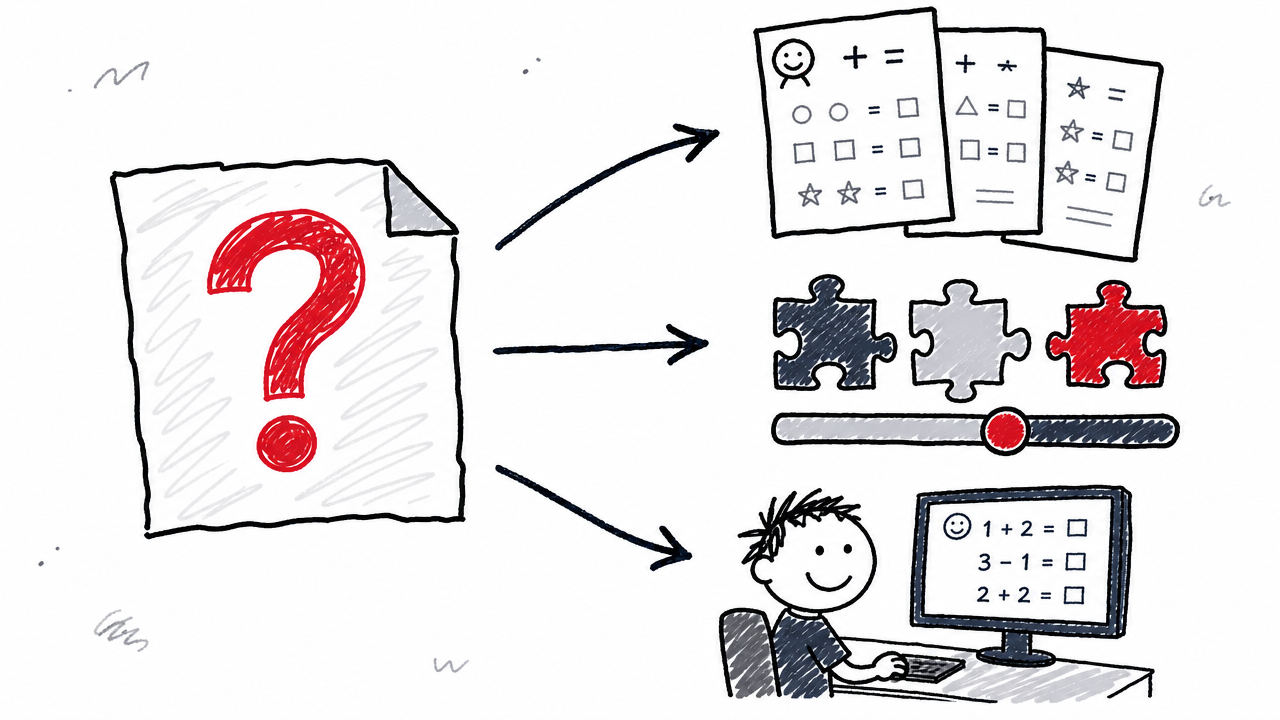
For the youngest learners, the priority is building number sense through counting sequences, number lines, number bonds, and place value. Three resources stand out here.
K5 Learning offers free printable PDF worksheets for kindergarten counting, number recognition, and number bonds. Answer keys appear on the second page. You don't need a login for the free worksheets, though a paid membership unlocks more content and ad-free browsing. Best for parents who want a ready-made homework packet. (K5 Learning)
Math Salamanders covers preschool through grade 2 with printable counting sheets, number lines, and place-value activities that lean on visual models. No login is stated on the site. The colorful layout is a hit with younger students. (Math Salamanders)
Practice Math Worksheets provides addition and subtraction worksheets within 10 and within 20, ideal for building early number sense. The site requires no sign-up to generate or download worksheets, so it's about as friction-free as it gets. (Practice Math Worksheets)
Addition and subtraction worksheets
The strongest free options for K–2 addition and subtraction drills combine large libraries with answer keys and adjustable difficulty.
Math-Drills hosts a massive library (the site claims over 70,000 worksheets) spanning basic addition facts through multi-digit subtraction with regrouping. Every worksheet includes an answer key, and sheets work on screen as well as in print. No account needed. (Math-Drills)
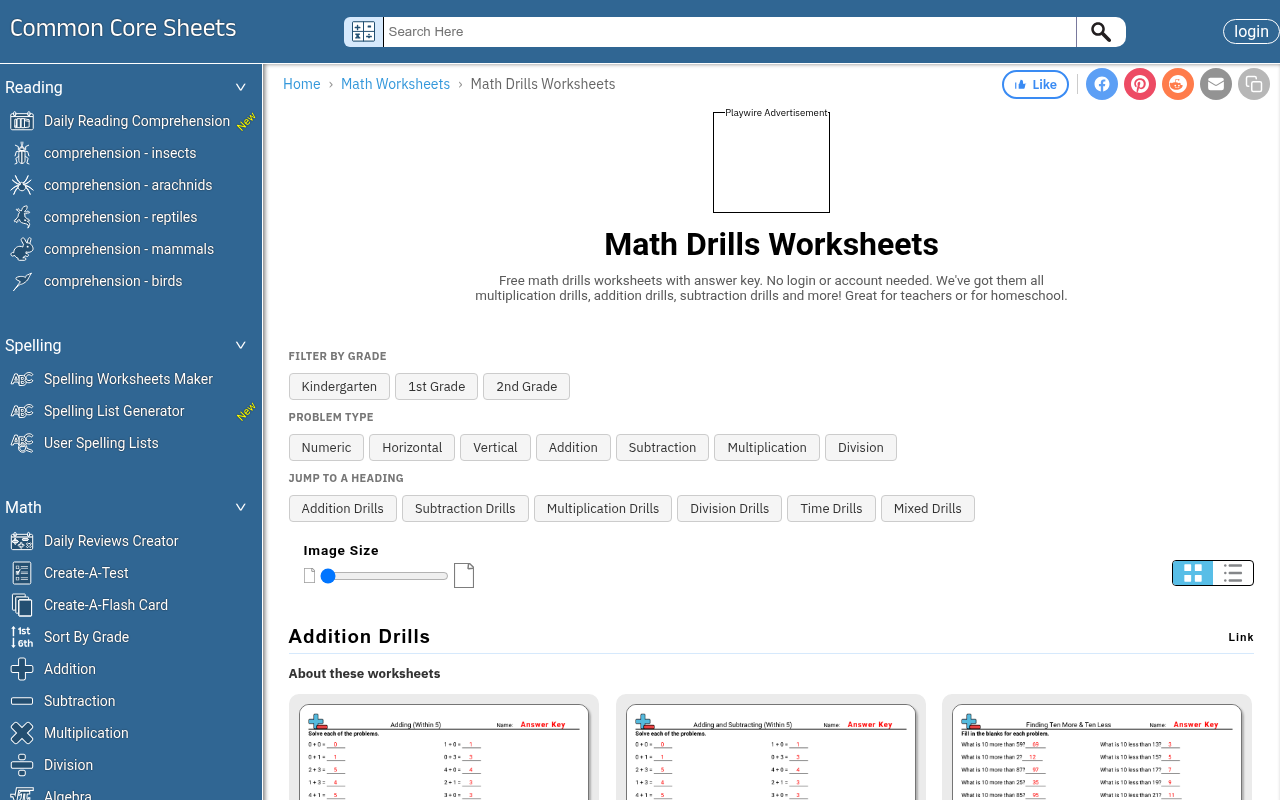
Common Core Sheets offers drill pages with 50 to 100 problems per sheet, complete with answer keys. The site states clearly that no login or account is needed. Grade filters help you find regrouping worksheets for grade 2 quickly. (Common Core Sheets)
HomeschoolMath.net lets you set the number range (for example, addends within 20, within 100, or beyond), randomize problems, and adjust font and spacing. That control makes scaffolding from basic facts to regrouping simple. The worksheets are publicly accessible. (HomeschoolMath.net)
What are the best free counting worksheets for kindergarten?
K5 Learning's kindergarten counting sets are among the most accessible: they're sorted by skill (counting to 10, to 20, skip counting), include answer keys, and download as PDFs right away (K5 Learning). Math Games lists 66 kindergarten worksheets that are Common Core–aligned per its site and can produce unlimited questions (Math Games).
If you'd rather have interactive practice than printable sheets, Khan Academy's early math course covers counting, comparing, and number recognition with on-screen exercises. It gives instant feedback that helps young learners self-correct. A free account unlocks progress tracking. (Khan Academy)
Early word problems
The Common Core State Standards expect kindergartners to solve addition and subtraction word problems within 10 using objects or drawings. So worksheets at this level should include visual models, letting children represent the problem before writing a number sentence.
Practice Math Worksheets offers word-problem generators that produce simple scenarios for K–2 learners (Practice Math Worksheets). K5 Learning provides curated word-problem sets organized by grade that pair illustrations with short story problems (K5 Learning). When you're picking early word problems, look for sheets that prompt students to draw, circle objects, or use a number line rather than jumping straight to symbolic equations.
Grades 3–5 resources
Where can I find free multiplication worksheets?
Four resources cover multiplication and division well. Common Core Sheets provides 100-problem multiplication drill sheets with answer keys and needs no login (Common Core Sheets). Math-Drills offers times tables practice, multiplication facts sorted by factor, and multi-digit multiplication with answer keys (Math-Drills).
Math Games generates grade 3–5 multiplication worksheets with unlimited questions and states Common Core alignment on its page (Math Games). HomeschoolMath.net lets you pick specific factors (e.g., multiplying by 6 and 7 only, or all facts through 12) and regenerate random problem sets as often as you need (HomeschoolMath.net).
All four sites also offer division worksheets, including division with remainders. The Common Core Math Standards introduce multiplication and division within 100 formally in grade 3.
Are there free fraction worksheets for grades 3–5?
Yes. Fraction models, comparing and ordering fractions, and introductory decimals are well covered by three resources.
K5 Learning provides printable fraction and decimal worksheets for grades 3 through 5, covering topics like comparing fractions and converting between fractions and decimals. Answer keys are on the second page. (K5 Learning)
Practice Math Worksheets offers fraction worksheets with adjustable denominators, so you can start with halves and fourths before moving to higher denominators. No sign-up needed. (Practice Math Worksheets)
Math Salamanders stands out for fraction models and visual aids: area models, fraction bars, and pie charts that help students see what a fraction means before computing. (Math Salamanders)
The Common Core State Standards introduce visual fraction models in grade 3, so worksheets that pair computation with diagrams align most closely with that expectation.
Multi-digit operations and place value
Multi-digit addition, subtraction, multiplication, and long division form the backbone of grades 3–5 arithmetic. HomeschoolMath.net is especially useful here because its number-range controls let you scaffold difficulty: start with three-digit by one-digit multiplication, then advance to four-digit by two-digit. The second-page answer key supports self-checking. (HomeschoolMath.net)
Math-Drills provides a broad library of multi-digit arithmetic sorted by operation and digit count, with every worksheet paired to an answer key. (Math-Drills)
Word problems and problem solving
Multi-step word problems are where students learn to apply arithmetic in real-world contexts. The best worksheets ask learners to identify the situation, choose the right operation, and justify the answer.
Practice Math Worksheets word-problem generators produce randomized scenarios for all four operations with adjustable number ranges (Practice Math Worksheets). K5 Learning offers curated grade 3–5 word-problem sets that grow in complexity across grade levels (K5 Learning). Khan Academy adds interactive problem-solving modules with hints and step-by-step feedback (Khan Academy).
Worth knowing: the IES What Works Clearinghouse practice guide on assisting students struggling with mathematics recommends deliberate word-problem instruction that teaches students to identify problem structures and use visual representations, not just plug numbers into operations.
Online interactive practice as a worksheet alternative
Is Khan Academy free for elementary math practice?
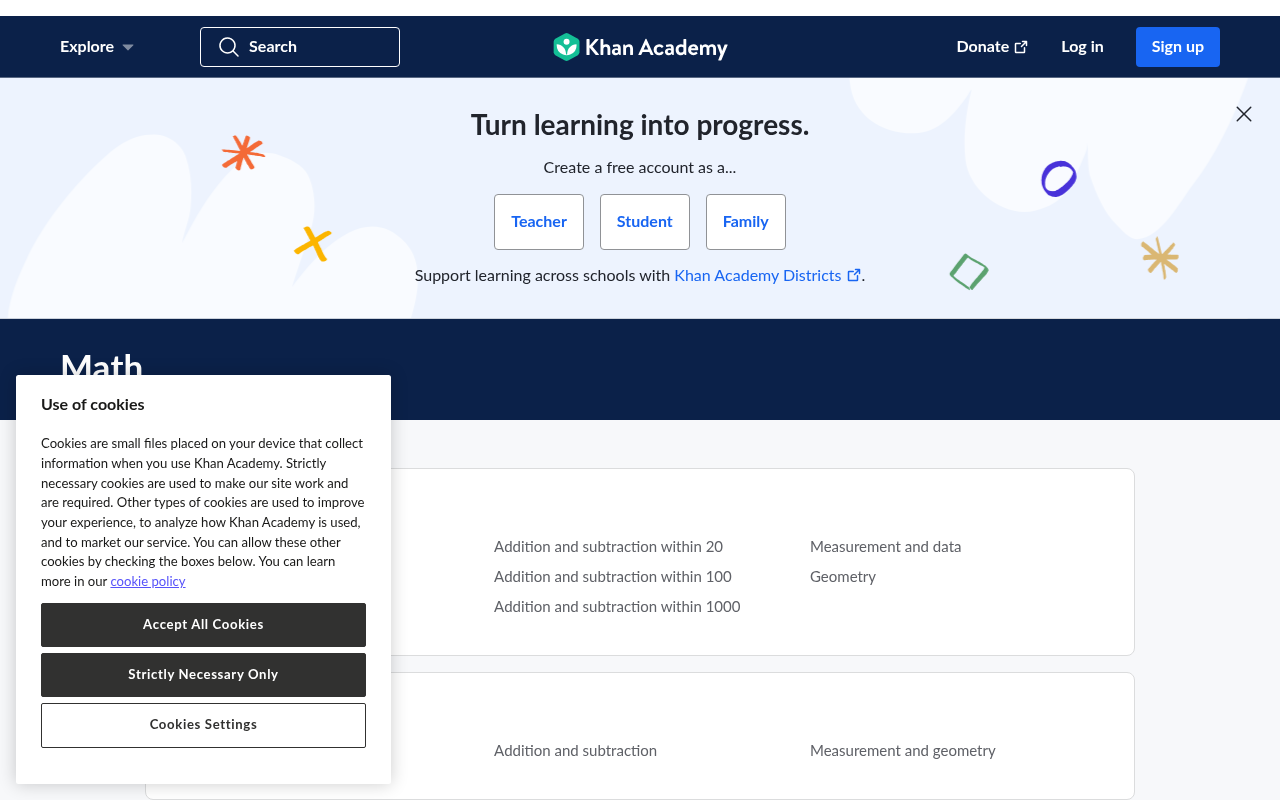
Yes, completely. Khan Academy's full learning library is free and covers early math through grade 5: counting, place value, arithmetic, fractions, decimals, measurement, and geometry. It works as an interactive practice platform rather than a printable worksheet site: students solve exercises on screen and get instant feedback. (Khan Academy)
A free account unlocks a learner dashboard, class codes for teachers, and progress tracking. Students can sign up as learners and join a teacher's class with a code. The content itself is viewable without logging in, but tracking and assignment features need an account.
Curious what the teaching style actually feels like before you hand your child a login? Watch a minute of this classic first addition lesson: patient, visual, and paced for a brand-new learner.
Video: Basic addition from the official Khan Academy channel.
Should students use printable worksheets or interactive math practice?
Honestly, both. The two formats serve different purposes and work best together. Printable worksheets build pencil-and-paper fluency, need no device or internet, and let you collect written work for error analysis. Interactive platforms like Khan Academy give instant feedback, adapt to the learner's level, and keep students engaged.
The IES WWC practice guide recommends concrete and semi-concrete models alongside practice. Timed fact-fluency activities should last about 10 minutes per session, per the IES elementary mathematics intervention guide. A simple routine that covers both needs: pair a short printed drill for fluency with an interactive session for adaptive problem-solving.
Do free math worksheets come with answer keys?
Most of the resources listed here include answer keys by default, which is a relief when you're checking work at the kitchen table. K5 Learning prints answers on the second page of every worksheet. Math-Drills pairs each problem set with a matching key. Common Core Sheets and HomeschoolMath.net also provide second-page answer keys. Math Games generates answer keys alongside its worksheets.
Practice Math Worksheets treats answer keys as optional: you choose whether to include them when building a packet. Khan Academy takes a different approach, giving instant digital feedback on each problem rather than a printable key.
Which free math worksheet sites work without a login?
Access rules vary, and knowing them ahead of time saves precious classroom minutes.
- No login or account (stated clearly): Common Core Sheets and Practice Math Worksheets both say no sign-up is needed.
- No login shown on site: Math-Drills, Math Salamanders, HomeschoolMath.net, and Math Games don't display a login wall on their worksheet pages.
- Free worksheets available, membership adds content: K5 Learning offers a large free tier, but paid membership unlocks more worksheets and ad-free access.
- Free account recommended for full features: Khan Academy content is viewable without an account, but progress tracking and class features need a free sign-up.
One practical tip: before handing out worksheets to a whole class, recheck each site's download flow. Policies can change, and pop-ups or soft gates may appear outside the main worksheet pages.
Can I customize worksheet difficulty and number range?
Yes, three of these resources offer true worksheet generators with adjustable settings. HomeschoolMath.net lets you set number range, operation, font size, spacing, and problem count, then regenerate a fresh random set with one click (HomeschoolMath.net). Practice Math Worksheets supports custom multi-page packets where you choose the operation range and problem count (Practice Math Worksheets). Math Games generates unlimited questions within a chosen grade and topic (Math Games).
By contrast, K5 Learning and Math Salamanders provide fixed, pre-made PDFs. They're handy for grab-and-go use but less flexible for a mixed-ability classroom.
Custom generators really shine for scaffolding: you can produce addition-within-50 problems for one student and addition-within-200 problems for another, all from the same tool.
How to choose and use worksheets well
Match difficulty to the learner
Pick a number range just above the student's current comfort level. If a child handles addition within 20 easily, move to addition within 50 rather than jumping to three-digit addition. The IES WWC elementary mathematics intervention guide recommends intensive whole-number work in K–5 and rational-number work in grades 4–8, always building on proven skills.
Use answer keys for checking, not guessing
Answer keys work best when students finish an entire worksheet (or a set section) before checking. Checking one problem at a time encourages copying rather than thinking. When you review errors together, look for patterns (e.g., repeated regrouping mistakes) that point to a concept gap rather than a careless slip.
Pair drills with deeper understanding
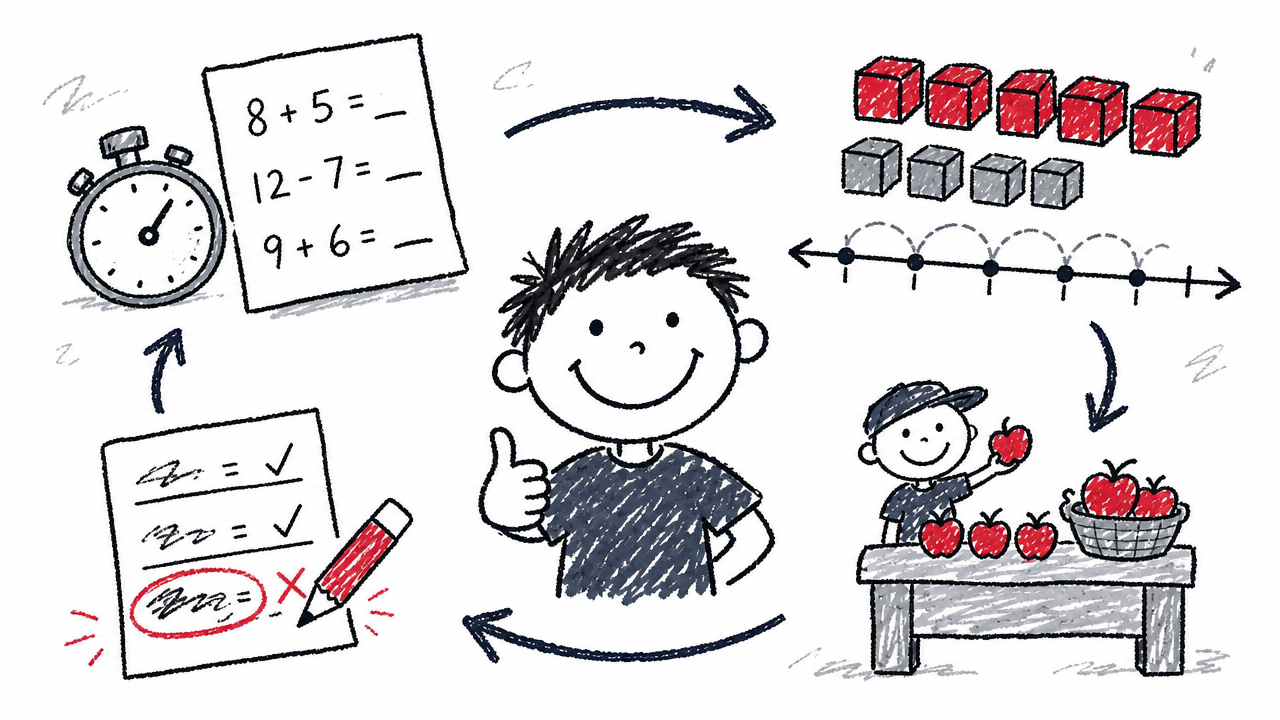
Fact-fluency drills build speed, but they don't replace understanding. The IES WWC practice guide on assisting students struggling with mathematics recommends adding concrete and semi-concrete models: base-ten blocks, fraction bars, number lines, and drawings. Word-problem instruction should teach students to identify the situation, choose an operation, and explain their reasoning.
The intervention guide's benchmark for timed fluency practice is about 10 minutes per session (IES WWC). That's intervention guidance, not a blanket daily rule, and longer sessions risk frustration and fading returns. After a short drill, shift to discussion, visual models, or application problems.
The Common Core State Standards stress both conceptual understanding and procedural skill. Worksheets are one tool in that toolkit, not the whole toolkit.
Are free worksheets aligned with the Common Core State Standards?
Only resources whose official pages claim alignment should be labeled that way. Math Games and Practice Math Worksheets both state Common Core alignment on their sites (Math Games, Practice Math Worksheets). Common Core Sheets references the standards by name (Common Core Sheets).
The other resources in this guide cover similar skills but don't make an explicit alignment claim. That doesn't mean they conflict with the standards; it just means you'll want to verify coverage yourself.
If you'd like to check grade-level expectations directly, visit the Common Core State Standards Initiative mathematics page. Looking up the specific standard (for example, 3.OA.C.7 for multiplication and division fluency within 100) and comparing it to a worksheet's content is the most reliable way to confirm alignment.
FAQ
Where can I find free math worksheets for elementary students?
Eight reliable resources cover K–5: K5 Learning, Math-Drills, HomeschoolMath.net, Practice Math Worksheets, Math Salamanders, Math Games, Common Core Sheets, and Khan Academy. Together they offer printable PDFs, custom generators, and interactive online practice spanning counting through fractions and word problems.
Do I need to create an account to download free math worksheets?
Common Core Sheets and Practice Math Worksheets need no account at all. Math-Drills, Math Salamanders, HomeschoolMath.net, and Math Games don't show a login wall. K5 Learning's free worksheets are accessible without a login, though membership adds content. Khan Academy needs a free account for progress tracking, but content is viewable without one.
Which resources are good for homeschooling?
HomeschoolMath.net is built for homeschool families and offers custom generators with adjustable difficulty. K5 Learning provides structured, grade-sorted packets. Khan Academy's free progress tracking and class-code system work well for parents managing a home curriculum. All eight resources can support homeschool use.
Can I generate unlimited worksheets with different problems each time?
HomeschoolMath.net, Practice Math Worksheets, and Math Games all offer randomized or unlimited worksheet generation. Each click of "generate" produces a fresh problem set. By contrast, K5 Learning and Math Salamanders provide fixed pre-made PDFs, so the same file always contains the same problems.
How can I choose the right worksheet difficulty for my child?
Start with the number range your child handles well, then pick a worksheet set one step above that level (e.g., addition within 50 after mastering within 20). Use the answer key to spot error patterns. If a child scores below roughly 80% accuracy, the level may be too hard. Move up only after steady success at the current level.