
Employee Onboarding Best Practices That Make New Hires Stay
Onboarding best practices that reduce early turnover by delivering clarity, capability, connection, and confidence from preboarding through the first 12 months.
Employee onboarding best practices that make new hires stay
Effective employee onboarding is a structured process that begins before Day 1 and helps a new hire build role clarity, capability, relationships, and confidence through the first several months of employment. New hires are more likely to stay when the organization delivers what it promised, makes success clear, provides the tools and training to reach it, and offers real relationships along the way. Yet Gallup reports that only 12% of U.S. employees say their organization does a good job of onboarding. The gap between what onboarding should do and what most companies deliver is where preventable turnover lives.
Why onboarding is a retention system, not an orientation event
Onboarding is the months-long process of integrating a new employee into the role, team, and organization. Orientation is just its first hour: paperwork, policies, and a building tour. SHRM defines onboarding as helping new hires learn an organization's structure, culture, vision, mission, and values, and notes that it can last up to 12 months. Conflating the two is the root cause of most early turnover.
The distinction matters because new hires make fast judgments. A BambooHR study of 1,565 full-time U.S. employees found that 70% decide whether a job is the right fit within the first month, and 29% decide within the first week. That early decision window is the reason every practice below is ordered by its impact on preventable early turnover.
Onboarding must deliver four outcomes:
- Clarity: The new hire knows what is expected and how success will be judged.
- Capability: The new hire can access the tools, training, and practice needed to perform.
- Connection: The new hire knows who to ask, how the team works, and where they belong.
- Confidence: The new hire sees progress, receives feedback, and believes the job matches what was promised.
When any of these four outcomes is missing, the hire's early experience falls short of expectations, and the risk of departure rises.
Personalize, don't standardize. Onboarding depth and pacing should adapt to role complexity, seniority, work location, and prior experience. A senior director joining from outside the industry needs more stakeholder mapping and strategic context than an entry-level hire in a well-documented role. A remote employee needs deliberate social connection that an in-office hire may get informally. One-size-fits-all checklists leave gaps for some hires and waste time for others.

Start before Day 1 with purposeful preboarding
The silence between offer acceptance and Day 1 is a retention risk. Every day a new hire hears nothing, doubt grows. Preboarding fills that gap with actions that prove the organization is ready and invested. SHRM's onboarding process guidance recommends starting after offer acceptance and completing administrative tasks before the first day so that Day 1 can focus on the role and the team.
Purposeful preboarding includes five actions: a personal manager welcome, a first-week schedule, equipment and access confirmation from IT, an introduction to the assigned buddy or mentor, and digital completion of paperwork and benefits enrollment. None of these require expensive software. They require coordination and follow-through.
Right example: The manager sends a personal message within 48 hours of offer acceptance, shares the first-week schedule, confirms the laptop ships on time, and introduces the assigned buddy by name and email before the start date.
Wrong example: HR sends a generic "see you Monday" email. The new hire hears nothing else for two weeks, begins to wonder if the role is still available, and starts passively browsing other listings.
Owner: Manager (welcome and schedule), HR (paperwork and benefits), IT (equipment and access).
Make Day 1 operationally ready and human
The first day should prove the organization is prepared for the employee. A working laptop, a scheduled manager meeting, team introductions, role context, and one manageable first task set the baseline. BambooHR's First Day Fog benchmarking report found that 52% of employees say onboarding focuses too much on administration instead of role training, and 53% identify being welcomed by the team as a driver of belonging.
Administration is necessary, but it should not consume the entire day. Spread compliance tasks across the first week when possible. Put human contact and early wins first.
Right example: The laptop works when the hire opens it. The manager welcomes the hire in person or on video within the first hour. The team does brief introductions. By end of day, the hire completes a small, real task and knows what tomorrow looks like.
Wrong example: The hire fills out forms all morning, waits 90 minutes for IT credentials, eats lunch alone, and the manager is in back-to-back meetings until 4 PM.
Owner: IT (access and equipment), Manager (welcome, role context, first task), Team (introductions).
What should a 30/60/90-day onboarding plan include?
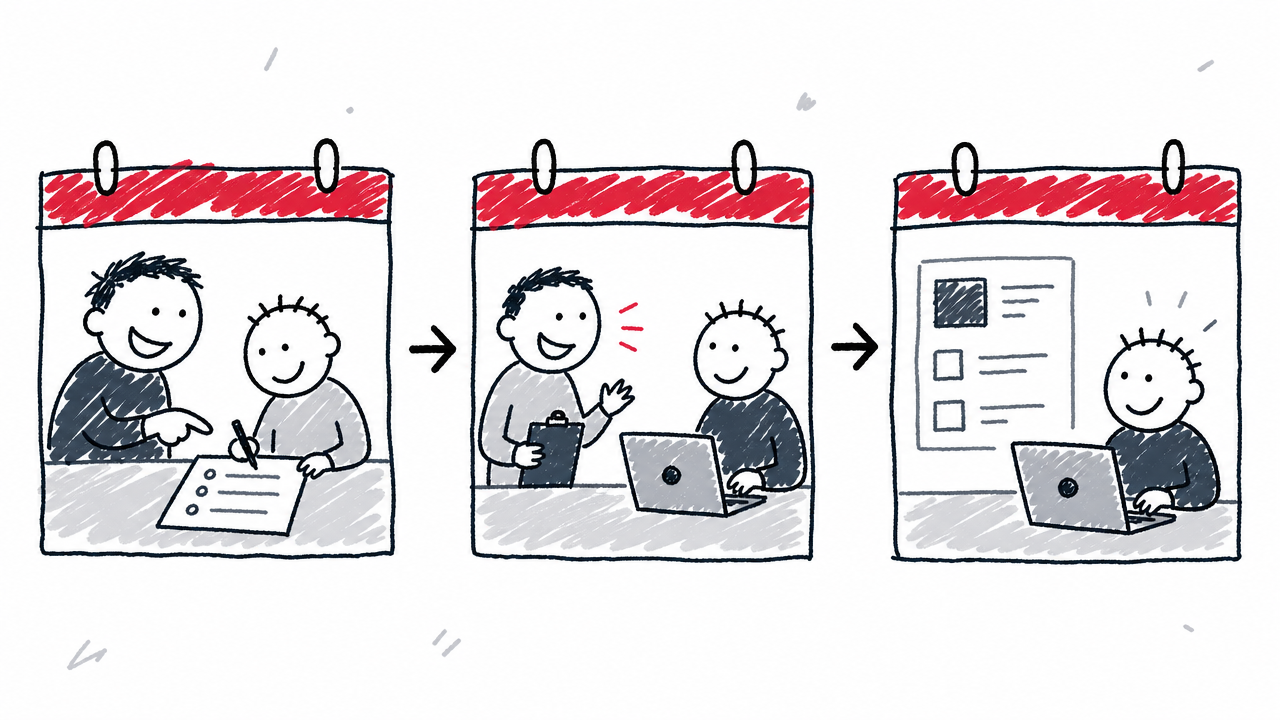
A 30/60/90-day plan is an operating agreement between the new hire and the manager, not a static document filed and forgotten. It must contain observable outcomes, named owners, scheduled check-ins, required training, and explicit permission to revise goals as both parties learn more. Knowledge at Wharton recommends checking in at 30, 60, and 90 days to track progress and resolve issues early.
First 30 days: learn, observe, build relationships
The new hire's job in this phase is to absorb, not to produce at full speed. Goals should include completing role-specific training, meeting key stakeholders, understanding team workflows, and building a working relationship with the manager and buddy. Weekly manager check-ins are essential. Give explicit permission to ask questions without penalty.
Sample questions for the Day-30 review:
- "What is still unclear about your role or priorities?"
- "Who do you still need to meet to do your job well?"
- "What support or resources are missing?"
- "Is this role matching what you expected when you accepted?"
Days 31–60: contribute with support
The hire transitions from training to supported contribution. Assign early deliverables with clear scope, provide cross-functional exposure through small projects, and begin reducing the level of direct guidance. The manager reviews progress against the original 30-day milestones and adjusts the plan.
Sample questions for the Day-60 review:
- "Where are you feeling most confident, and where do you still need help?"
- "Are the goals we set still the right ones?"
- "How is your relationship with the team and your buddy working?"
- "What would make your next 30 days more productive?"
Days 61–90: take ownership and show results
Greater autonomy becomes the expectation. The hire should show measurable progress against milestones, take ownership of defined responsibilities, and take part in a formal review at Day 90. The manager and hire together set goals for the next quarter.
Sample questions for the Day-90 review:
- "What are you most proud of so far?"
- "What has been harder than expected, and what would help?"
- "Do you have a clear picture of what success looks like over the next six months?"
- "Is there anything about the role, team, or culture that concerns you?"
Right example: The plan lists three measurable first-month priorities (e.g., "complete product certification," "shadow two client calls," "deliver first QA review"), names the manager and buddy as support contacts, and includes a Day-30 review meeting on the calendar.
Wrong example: The plan says "learn the business" and sits in a shared drive untouched until the probation review at Day 90.
Make the manager the visible owner of onboarding
Gallup reports that employees are 3.4 times as likely to feel onboarding was successful when managers take an active role. HR coordinates logistics and compliance, but the manager owns role expectations, early feedback, and team integration. When those responsibilities default to HR, the hire gets process without context.
SHRM's responsibility framework cautions that saying "onboarding is everyone's responsibility" is insufficient without actionable tasks and accountability. A clear ownership breakdown prevents gaps:
Right example: The manager holds weekly one-on-ones starting Day 1 and gives specific, actionable feedback by the end of Week 1.
Wrong example: HR owns the checklist while the manager waits until the 90-day review to discuss performance.
Build relationships through a buddy, mentor, and purposeful introductions
A buddy handles day-to-day informal support: where to find things, how meetings work, who to ask about what. A mentor provides career and organizational guidance on a longer horizon. New hires need both. BambooHR found that 93% of surveyed employees want to shadow a colleague and 87% hope to make a friend at work. These are not soft preferences; unmet social needs speed up departure.
Wharton's guidance recommends assigning projects that create cross-functional relationships, which is especially valuable for senior or external hires who must build credibility across teams quickly.
Right example: The buddy answers informal questions daily and introduces the hire to relevant colleagues across departments during the first two weeks. Stakeholder meetings are scheduled, not left to chance.
Wrong example: The hire is added to a group chat with no named contact for basic questions. No one checks whether the hire has met the people they need to work with.
How do you prevent new hires from feeling overwhelmed?
Space training over weeks, pair learning with supervised practice, and focus on role-specific content over generic modules. BambooHR's First Day Fog report found that 42% of employees say onboarding overwhelmed them with too much information. Information overload does not speed up productivity; it delays it, because the hire cannot tell what matters now from what matters later.
The fix is sequencing. Decide what the hire must know by end of Day 1, end of Week 1, and end of Month 1, and deliver content in that order. Everything else can wait.
Right example: Training is broken into daily 90-minute sessions over three weeks, each paired with a hands-on task that reinforces the lesson.
Wrong example: The hire receives a 200-page handbook and a full day of back-to-back presentations on Day 1, retains a fraction, and spends the next week trying to figure out what was important.
Teach culture through behavior, not slogans
Culture onboarding works when managers show how values appear in real decisions, norms, and feedback. A slide deck of values statements is not culture; it is marketing. Gallup's research emphasizes that learning what defines success and receiving candid feedback are recurring themes in exceptional onboarding experiences.
Right example: During the first week, the manager explains how the team makes decisions, describes a recent situation where a company value shaped a real outcome, and tells the hire what behavior looks like when the team is at its best.
Wrong example: The hire watches a pre-recorded values video narrated by the CEO, never sees those values referenced again, and pieces together the real culture over months of observation.
Give frequent feedback and adjust the plan
Feedback should be early, specific, and two-directional. The manager should ask the hire what is unclear and review early work well before Day 30. Waiting until a formal review to deliver substantive feedback means the hire has spent weeks uncertain whether they are on track, which erodes confidence and raises the chance of disengagement.
The plan itself should be a living document. If the hire's first two weeks reveal that priorities have shifted, or that training on a particular system needs more time, the plan should be revised together.
Right example: At Day 14, the manager reviews the hire's first deliverable, names one strength and one specific improvement, and asks what support is missing. They adjust the Month 1 milestones accordingly.
Wrong example: The first substantive feedback arrives at the 90-day review. The hire has been guessing for 12 weeks.
How long should onboarding last? Continue support beyond Day 90
Onboarding should not end abruptly at Day 90. Gallup describes full integration as a process that may take 12 months or longer depending on the role, and notes that organizations can lose one-third to two-thirds of new hires within the first 12 months. SHRM confirms that onboarding can last up to 12 months. The 90-day plan is a starting framework, not a finish line.
The University of Florida's six-month onboarding checklist provides a practical model of structured follow-through: continued weekly meetings, performance feedback, goal-setting, and a formal conversation before the probationary period ends.
Right example: After Day 90, the manager transitions to monthly development conversations and connects the hire to growth opportunities such as stretch projects, cross-functional teams, or professional development.
Wrong example: All structured support ends on Day 91. The hire is treated as fully ramped regardless of role complexity, and the next formal conversation is the annual review.
How do you onboard remote or hybrid employees?
Remote and hybrid hires face the same four needs (clarity, capability, connection, confidence) with fewer informal touchpoints. Deliberate design closes the gap. BambooHR's First Day Fog report found that hybrid onboarding recorded 75% satisfaction, compared with 73% for in-person and 71% for remote, suggesting that blending virtual and in-person elements can work well when done with intention.
Key adjustments for remote and hybrid onboarding:
- Ship equipment early so the hire can test everything before Day 1.
- Schedule video face time with the manager and team on the first day; do not rely on chat alone.
- Assign a buddy who is available in the same time zone or with overlapping hours.
- Over-communicate the first-week schedule so the hire knows exactly when and where to show up (in person or online).
- Create structured social moments (virtual coffee, team lunch during an on-site day) because hallway introductions will not happen organically.
- Check in more often, not less. Remote hires are less likely to raise problems unprompted.
Right example: The remote hire receives a laptop and a printed first-week schedule by courier, joins a 30-minute video welcome with the manager on Day 1, meets the buddy for a virtual coffee, and has daily 15-minute check-ins for the first week.
Wrong example: The remote hire is emailed a list of links, added to Slack, and told to "reach out if you need anything." No one follows up for five days.
How do you measure onboarding success?
Measure onboarding by outcomes, not by checklist completion. SHRM's measurement framework recommends tracking seven categories: time to productivity, 90-day and first-year retention, new-hire surveys, engagement scores, performance milestones, manager follow-through, and cohort comparison.
Build a simple measurement dashboard:
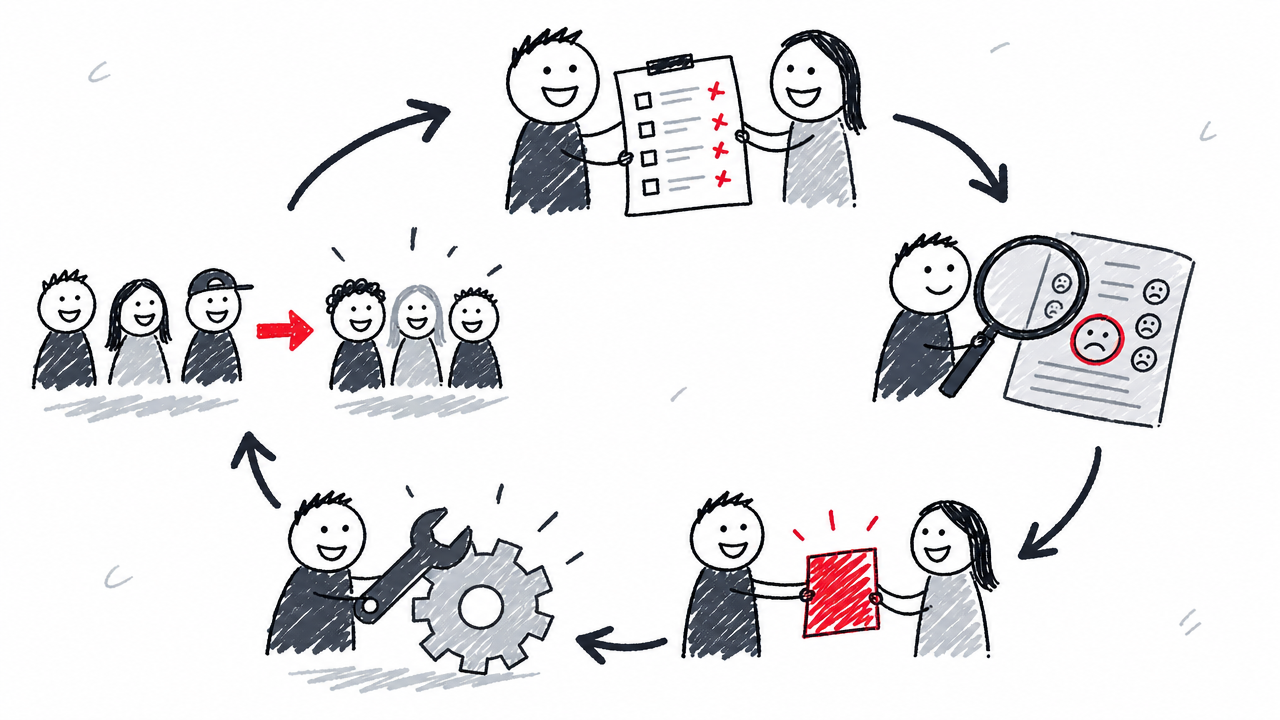
The feedback loop matters more than any single metric: collect data, identify a pattern, assign an owner, make a change, and compare the next hiring cohort.
Right example: HR compares 90-day retention, time to first deliverable, and survey sentiment across quarterly hiring cohorts to spot improvement or regression.
Wrong example: HR reports onboarding is "done" because every checklist item was marked complete.
Common onboarding mistakes to avoid
These patterns appear again and again in the research. Each one creates a specific, preventable retention risk.
Treating orientation as the entire onboarding program. The hire gets compliance but not capability or connection. Retention risk: the hire never feels integrated beyond the administrative layer.
Leaving new hires without working technology on Day 1. BambooHR's research lists technology issues among the top first-week frustrations. Retention risk: the hire reads disorganization as a signal that the company does not value their time.
Letting the manager delegate all onboarding to HR. HR can coordinate, but it cannot provide role-specific feedback or team integration. Retention risk: the hire has no relationship with the person who will judge their performance.
Dumping all information in the first two days. 42% of employees report feeling overwhelmed during onboarding. Retention risk: the hire feels incompetent before they have had a chance to learn.
Writing a 30/60/90-day plan that no one revisits. A plan that is never discussed is a plan that does not exist. Retention risk: the hire has no milestones, no feedback, and no visible progress.
Stopping structured support abruptly at Day 90. Complex roles may require six to 12 months to reach full productivity. Retention risk: the hire stalls without guidance and reads the silence as neglect.
Measuring completion rates instead of outcomes. A 100% checklist completion rate tells you nothing about whether new hires are productive, engaged, or planning to leave. Retention risk: the process looks successful on paper while early turnover continues.
Onboarding checklist: preboarding through six months
Use this compact timeline as a planning reference. Adapt the depth and pacing to the role's complexity, the hire's seniority, and the work location.
FAQ
What are the five C's of onboarding?
Compliance, clarification, confidence, connection, and culture. They represent the categories of support a new hire needs, from completing required paperwork and understanding role expectations through building organizational relationships and absorbing how decisions are made. The framework is useful for auditing gaps, though practical onboarding plans often organize around stages (preboarding, Day 1, 30/60/90 days) rather than categories alone.
Is onboarding the same as orientation?
No. Orientation is a short administrative introduction covering paperwork, policies, and benefits. Onboarding is a longer process, lasting several months to a year, that builds role clarity, capability, relationships, and confidence. SHRM explicitly separates the two and notes that onboarding can extend up to 12 months.
Who is responsible for onboarding a new employee?
HR coordinates logistics and compliance. The direct manager owns role expectations, feedback, and team integration. A buddy or mentor handles informal support. IT ensures access and equipment. Leadership provides strategic and cultural context. SHRM's responsibility framework stresses that each role needs specific, assigned tasks rather than a vague shared mandate.
How can a small business create effective onboarding without a large HR team?
Focus on the highest-impact actions: a personal manager welcome before Day 1, working tools on arrival, a written 30/60/90-day plan with clear milestones, weekly manager check-ins, and a named buddy. These require time and intention, and small teams often have an advantage because the manager and team are already close to the hire.
How often should managers meet with new hires during the first 90 days?
Weekly for the first 30 days and every two weeks through Day 90. More frequent informal check-ins improve role clarity and catch problems early. Gallup's research links active manager involvement to a 3.4x increase in the likelihood that the hire rates their onboarding as successful.
What should HR ask new hires at 30, 60, and 90 days?
At 30 days, ask: "What is still unclear?", "Who do you still need to meet?", and "Is this role matching your expectations?" At 60 days, ask: "Where do you feel confident, and where do you need more help?", "Are your goals still the right ones?", and "How is your relationship with your team and buddy?" At 90 days, ask: "What are you most proud of?", "What has been harder than expected?", and "Is there anything about the role or culture that concerns you?" These questions surface problems early enough to fix them.
How do you onboard remote or hybrid employees?
Ship equipment early, schedule video face time with the manager and team on Day 1, assign a buddy with overlapping hours, over-communicate the first-week schedule, and create structured social moments. BambooHR's First Day Fog report found that hybrid onboarding recorded 75% satisfaction, compared with 73% for in-person and 71% for remote, so blending formats can work when designed with intention. The core principle is the same: replace the informal touchpoints that remote hires miss with deliberate, scheduled alternatives.