
The Best Coffee Grinders for Home Brewing
Five burr grinders worth your money, compared on grind consistency, retention, noise, and price, so you'll find the right coffee grinder for espresso, pour-over, or drip

The best coffee grinders for home brewing
The best coffee grinder depends on what you brew most often. That's the honest answer, so instead of crowning one winner, here are five picks, each judged on the same five factors: grind consistency, burr type, retention, noise, and price.
- Best budget electric espresso grinder: Baratza Encore ESP ($199.95)
- Best all-purpose grinder: Fellow Opus 2 ($199.95)
- Best premium filter grinder: Fellow Ode Brew Grinder Gen 2 ($399.95)
- Best straightforward filter value: Baratza Encore ($149.95)
- Best budget and travel manual grinder: 1Zpresso Q Air ($69)
Every pick below uses the same comparison fields, so you can judge them side by side instead of taking marketing claims at face value.
How we chose these grinders: selection criteria
Before any grinder shows up on this list, here's how the list was built. These six criteria applied equally to every grinder, and a product earned its spot only when it performed well across the criteria that matter for its use case.
Grind consistency
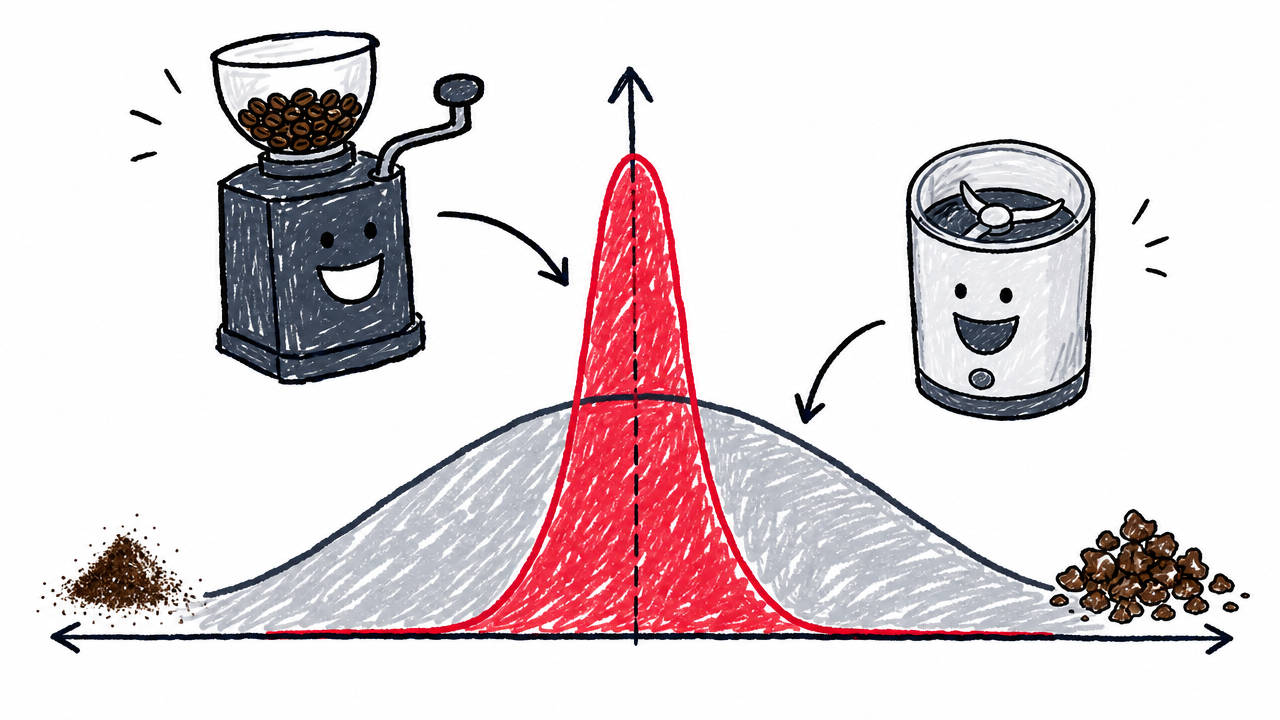
Grind consistency is the single most important factor in coffee quality. A grinder really has one job: produce particles in a narrow size range. Every grinder creates a distribution: some particles land at the target size, some come out too fine ("fines"), and some come out too large ("boulders"). The tighter that distribution, the more evenly your coffee extracts, and that's where balanced flavor and repeatable results come from. No grinder produces perfectly uniform grounds, but better grinders shrink the spread. Coffee Review has used laser-diffraction particle analysis from Horiba Instruments to measure this distribution, rather than relying on visual inspection alone.
Burr type and geometry
Conical burrs are what you'll find in most versatile home grinders. They tend to be more affordable and easier to calibrate. Flat burrs are often linked to clarity and uniformity in the cup. Neither shape is universally superior, though. What matters more is burr geometry, alignment, and motor behavior. A well-engineered conical grinder can outperform a poorly aligned flat-burr grinder, so this article doesn't award extra points for burr shape alone.
Retention and workflow
Retention is ground coffee trapped inside the burr chamber, chute, or exit path after grinding. Kaffeemacher's testing protocol distinguishes between temporary retention, permanent retention, and absolute retention. Temporary retention clears itself over later doses; permanent retention (dead space) stays until you clean. Retention matters most when you single-dose, switch beans often, or brew espresso, where a fraction of a gram shifts the shot. If you're brewing hopper-fed filter coffee with the same beans every day, retention is much less of a worry.
Noise
Measured decibel figures are only comparable when the testing distance and method match. Kaffeemacher, for example, measures noise at 20 cm from the grinder. Without a standard method, descriptions like "quieter than average" are more honest than cherry-picked numbers, so that's what you'll get here. For manual grinders, noise is irrelevant; the trade-offs are grinding effort, speed, and handle comfort instead.
Price and ownership value
All prices in this article are current US direct prices from official product pages, checked August 11, 2026. Temporary sale prices, marketplace listings, and bundle pricing are excluded. Beyond the sticker price, it's worth thinking about ownership value: replacement burrs, repairability, warranty length, and whether the grinder stays useful if your brewing habits change. A $150 grinder that lasts a decade and accepts $25 replacement burrs can beat a $300 grinder with proprietary, hard-to-source parts.
Adjustment range and precision
Espresso demands many fine micro-steps. One click that moves the grind too far can ruin a shot. America's Test Kitchen recommends at least 40 settings with ample fine steps for espresso use. Filter brewing is more forgiving: fewer settings work fine as long as you can land in the medium-fine through coarse range. Don't be dazzled by a high setting count alone, though; it doesn't guarantee usability if the steps are hard to read or operate. Stepless grinders offer infinite positions but ask for more careful dialing.
Quick comparison table
Here's the at-a-glance view. Every column maps to the selection criteria above.
Best budget electric espresso grinder: Baratza Encore ESP
The Baratza Encore ESP is the most accessible electric grinder that delivers credible espresso alongside a full filter range. At $199.95, it undercuts most entry-level espresso grinders while giving you 20 dedicated fine-grind micro-steps (settings 1–20) and a second bank of 20 settings (21–40) covering filter through cold brew.
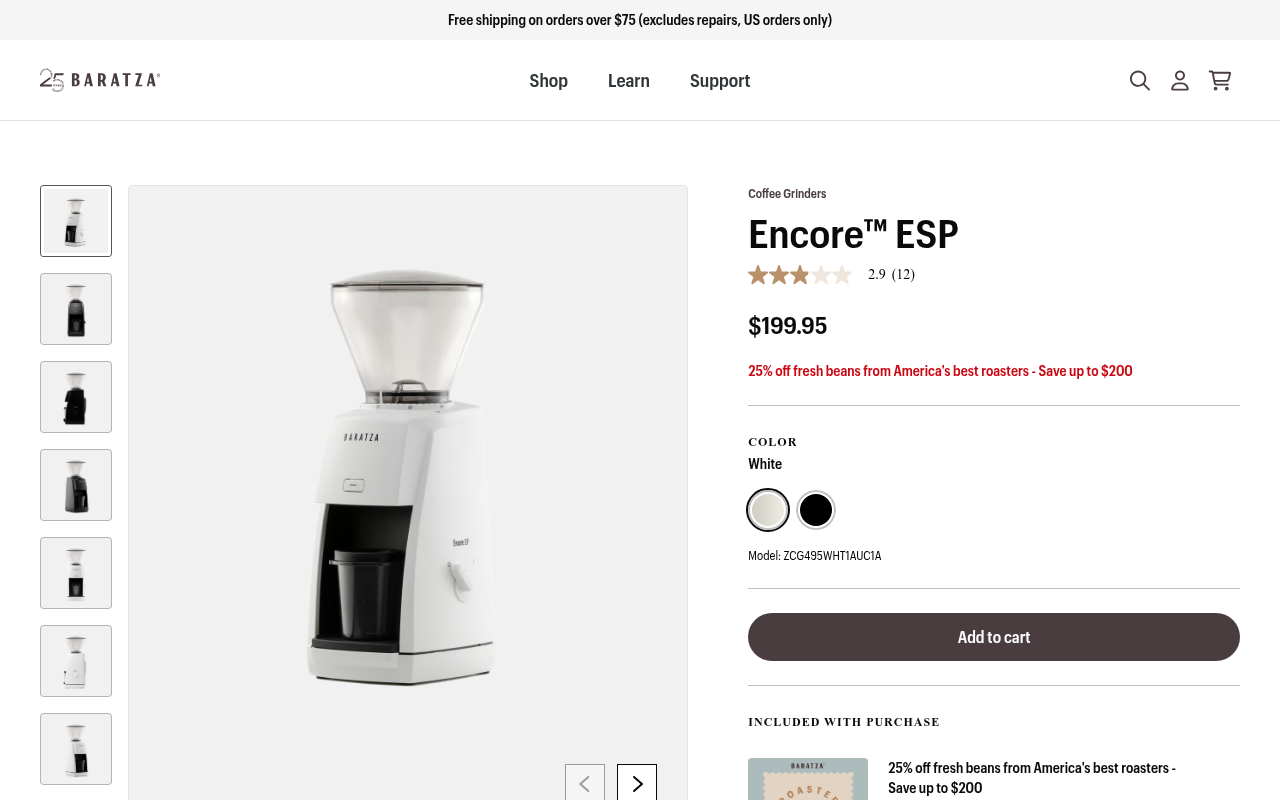
Who it's best for: If you brew mostly filter coffee but want to pull espresso at home without buying a second grinder, this is the first electric grinder I'd point you to.
Standout trait: Credible home-espresso capability at an entry-level price, which is genuinely rare. The M2 conical steel burr, quick-release burr system, and included dosing cup (fits 54 mm portafilters, with a 58 mm adapter) make espresso practical right out of the box. America's Test Kitchen named the Encore ESP the winner in its tested group after grinding 110 pounds of coffee across light, medium, and dark roasts and sifting with KRUVE sifters. Serious Eats also highlights the 40 settings and 20 fine-grind micro-steps in its retested picks.
Limitation: The hopper-fed design means more retention than dedicated single-dose espresso grinders. In CoffeeGeek's testing, an 18.5-gram espresso dose took about 13 seconds at one test point, and retention exceeded 2 grams under some conditions. Noise is noticeable. So no, this isn't a replacement for a premium espresso grinder if you daily-dial demanding light roasts. But for medium-to-dark home espresso and everything from pour-over to cold brew, the value is exceptional.
Best all-purpose grinder for mixed brewing: Fellow Opus 2
The Fellow Opus 2 handles espresso, pour-over, drip, AeroPress, French press, and cold brew in one compact body. At $199.95 it matches the Encore ESP's price while taking a different approach: a stepless side dial for infinite grind positions and a 100-gram single-dose load bin instead of a hopper.
Who it's best for: Households that switch brewing methods daily. Maybe you want a V60 in the morning and someone else pulls an espresso after dinner. The Opus 2 covers both without a second grinder taking up counter space.
Standout trait: True all-method versatility with very low retention. Bon Appétit named the Opus 2 its top pick after testing 22 grinders and reported less than 0.1 gram of retention in its own testing. The 48 mm stainless-steel conical burrs, anti-static design, automatic shutoff, and tool-free burr access make daily use and cleaning genuinely easy. The included espresso dosing cup works with 54 mm and 58 mm portafilters.
Limitation: Versatile isn't the same as specialized. If you dial in espresso shots daily, you may find that the stepless dial, for all its infinite positions, takes more care to hit your target than a grinder with discrete espresso micro-steps. For beginners, that means a steeper initial learning curve for espresso, though the payoff is a grinder that does everything else well too.
Best premium filter grinder: Fellow Ode Brew Grinder Gen 2
The Fellow Ode Brew Grinder Gen 2 is a purpose-built filter grinder with 64 mm flat, uncoated stainless-steel Gen 2 brew burrs. At $399.95 it's the priciest pick on this list, and it earns that cost with large flat burrs optimized for clarity, sweetness, and repeatability across pour-over, drip, batch brew, AeroPress, French press, and cold brew.
Who it's best for: Dedicated filter and pour-over drinkers who want premium grind quality and don't mind paying for it. If you own a V60, Kalita Wave, Origami, or Chemex and want one grinder that gets the best from all of them, this is your pick.
Standout trait: The 64 mm flat burrs are far larger than what most home grinders offer at this price. Flat burrs at this diameter tend to produce tight particle distribution, and you'll taste that as clarity in the cup. The stepped dial makes repeating a recipe effortless, which is exactly what you want once you've dialed in a favorite.
Limitation: The Ode Gen 2 can't grind for espresso, and that's by design. Fellow's official comparison page explicitly separates the Ode from espresso-capable grinders. If espresso is part of your routine, go with the Opus 2 or Encore ESP instead. The narrower brew-focused range is a feature, not a flaw.
Best straightforward filter grinder on a budget: Baratza Encore
The Baratza Encore is the workhorse that launched thousands of coffee journeys. At $149.95, it's still the simplest, most repairable electric grinder for non-espresso brewing.
Who it's best for: Beginners who want a reliable electric grinder for drip, pour-over, AeroPress, French press, and cold brew without overthinking settings or workflow. If that's you, this is the easy call.
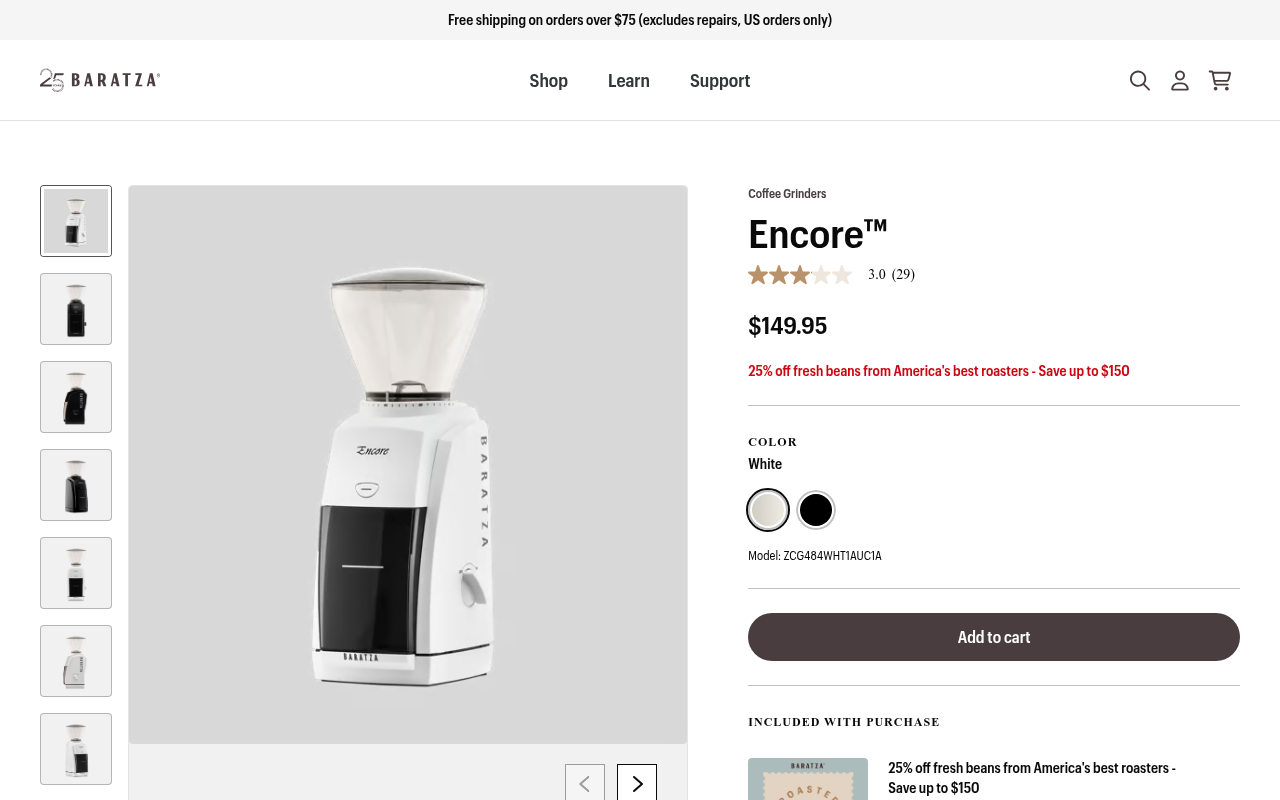
Standout trait: Baratza designs the Encore for roughly 10 years of home use. Replacement burrs and parts are easy to find, and the grinder is simple to take apart. That repairability is rare at this price, and it means the Encore can outlast grinders costing twice as much.
Limitation: The original Encore isn't built for precision espresso. Its 40 mm burrs and 40 settings cover the filter spectrum well, but they lack the fine micro-steps espresso demands. If espresso is a future goal, spend $50 more on the Encore ESP and get 20 dedicated espresso settings from day one.
Best budget and travel manual grinder: 1Zpresso Q Air
The 1Zpresso Q Air proves that a $69 manual grinder can match or beat cheap electric grinders in consistency. At roughly 370 grams with a 15–20 gram capacity and 30 clicks, it fits in a backpack, a suitcase, or a kitchen drawer.
Who it's best for: One- to two-cup brewers who want quality grinding without an electric-grinder budget, and travelers who refuse to settle for pre-ground coffee on the road. The official product page notes AeroPress plunger compatibility, which makes it a natural travel pairing.
Standout trait: The Q-series stainless-steel heptagonal burrs deliver even particle distribution for pour-over, AeroPress, drip, and French press. No motor means no noise, no power needed, and no cord. Tool-free disassembly makes cleaning simple even in a hotel room. The 1Zpresso Q-series page has more detail on burr geometry and compatible brew methods.
Limitation: Small capacity means this is a single-serve grinder. And the manual effort is real: expect 30–60 seconds of cranking per dose depending on grind size and bean density. The 30-click range targets filter brewing. You can grind fine enough for a pressurized portafilter, but the Q Air isn't ideal for repeated daily espresso dialing where micro-step precision and speed matter.
Is a burr grinder really better than a blade grinder?
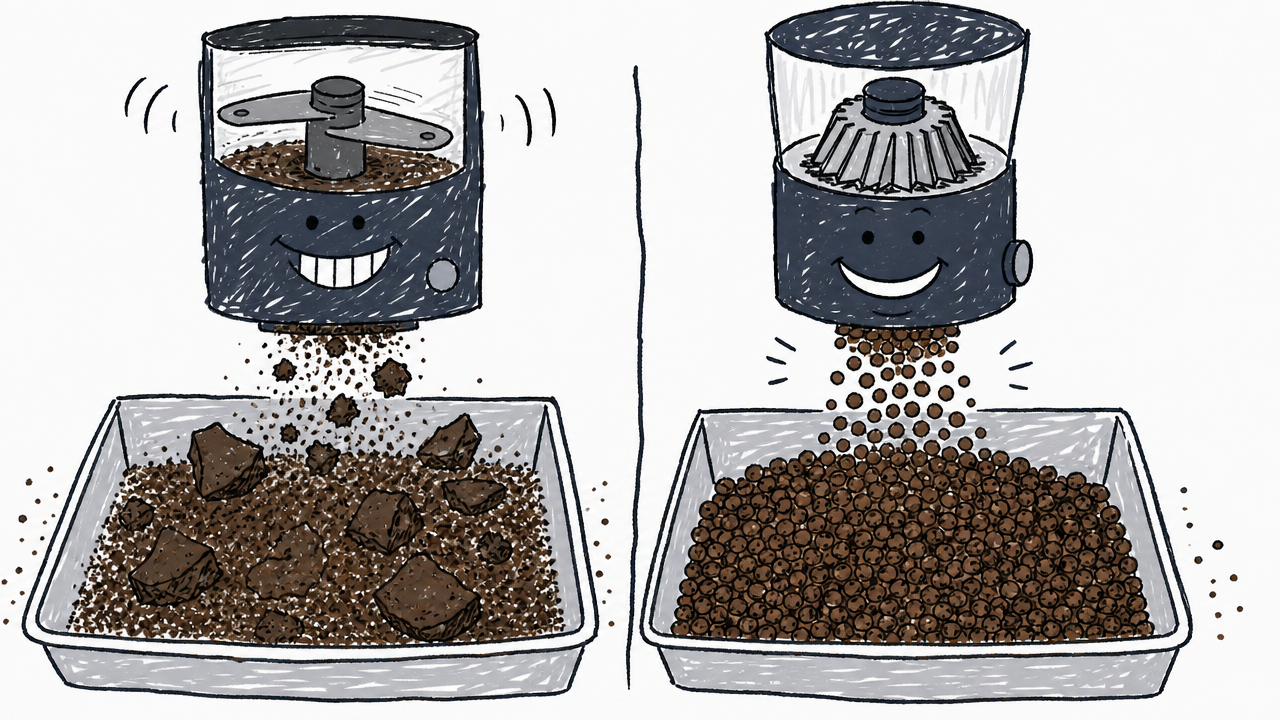
Yes, and it's not close. A burr grinder crushes beans between two abrasive surfaces set at a fixed gap, producing a fairly consistent particle size. A blade grinder spins a blade that chops beans at random, like a blender. The result is a wide, chaotic spread of sizes: dust mixed with chunks.
That spread matters because different-sized particles extract at different rates. Fine dust over-extracts (bitterness, harshness) while large chunks under-extract (sourness, thinness). A blade grinder makes consistent brewing nearly impossible. A burr grinder doesn't remove all variation, but it narrows the distribution enough to let you control extraction and repeat a good cup. If you're spending money on quality beans, a burr grinder is the single most impactful upgrade you can make.
What is the difference between flat and conical burrs?
Conical burrs use a cone-shaped inner burr inside a ring-shaped outer burr. Beans feed from the top and get crushed as they travel downward through a narrowing gap. They're common in home grinders because they run at lower speeds, produce less heat, and are often cheaper.
Flat burrs use two parallel discs facing each other. Beans enter at the center and are pushed outward by centrifugal force through progressively finer teeth. Flat burrs are often linked to tighter particle distribution and greater clarity in the cup.
Neither shape is universally better, whatever the marketing says. Burr geometry (tooth shape, cutting angle, surface finish) and alignment precision matter more than the flat-versus-conical label. A well-engineered conical grinder can outperform a cheap flat-burr grinder. Choose based on the specific grinder's performance, not burr-shape marketing.
Can one coffee grinder handle both espresso and drip?
Yes, but with trade-offs worth knowing upfront. Grinders like the Fellow Opus 2 and Baratza Encore ESP can produce both espresso-fine and drip-coarse grounds. If you pull the occasional espresso and mostly brew filter coffee, either works well.
The distinction matters for daily, precision espresso. Switching between espresso and filter on one grinder means re-dialing your grind setting and purging stale grounds each time. Stepless grinders need careful repositioning; stepped grinders may not land on the exact same spot twice. Grinders that "can do espresso" aren't the same as grinders that excel at espresso. If espresso is your primary method and you demand shot-to-shot consistency, a dedicated espresso grinder (or a grinder with extensive fine-step resolution) is the better path.
Grind size guide by brewing method
Use this table as a starting point. Exact dialing depends on your beans, water temperature, dose, and taste, so treat it as a map rather than a rulebook.
Espresso is the most demanding. A small grind change (one or two clicks on most grinders) can swing your shot from sour to bitter. Filter methods are more forgiving, but dialing in still improves your cup.
How to keep your grinder performing well
Regular cleaning extends burr life and preserves grind quality, and it takes less time than you'd think. Brush the burr chamber and chute every one to two weeks if you grind daily. Remove the burrs monthly and clear out compacted fines and coffee oils. Oily residue left uncleaned goes rancid and taints fresh grounds.
Burr replacement signals: dull, flat, or lifeless taste that persists across different beans; visibly worn or chipped burr teeth; slower grinding speed at the same setting. Most home burr sets last 500–1,000 pounds of coffee, but check your manufacturer's guidelines.
Cutting static and retention: The Ross Droplet Technique (RDT), a single drop of water on the beans before grinding, reduces static cling and keeps grounds from sticking to the chute and chamber. Single-dosing (weighing your dose and grinding only that amount) cuts down on stale grounds left in the hopper and burr path. Kaffeemacher's testing protocol notes that retention below 2 grams generally has a smaller effect when a grinder is used regularly, while larger retained amounts can meaningfully change the next dose.
FAQ
How many grind settings should a coffee grinder have?
At least 40 with ample fine micro-steps if you plan to brew espresso, per America's Test Kitchen's testing. For filter-only brewing, fewer settings work fine. Stepless grinders offer infinite positions but need more careful dialing since there are no discrete "clicks" to return to.
What is grind retention, and why does it matter?
Retention is ground coffee trapped in the burr chamber, chute, or exit path after grinding. It can go stale and mix into your next dose, hurting flavor and dose accuracy. Kaffeemacher splits retention into temporary (clears over later doses), permanent (dead space that needs cleaning), and absolute. It matters most when you're single-dosing espresso or switching beans.
Is the Baratza Encore good enough for espresso?
The original Encore is designed for filter brewing and lacks dedicated espresso micro-steps. For espresso, choose the Encore ESP, which adds 20 fine-grind settings (1–20) built for espresso.
Is the Fellow Ode suitable for espresso?
No. Fellow explicitly positions the Ode Gen 2 as a filter-only grinder. Its range doesn't reach espresso fineness. That's a deliberate design choice, not a shortcoming to work around.
Is a manual coffee grinder worth buying?
Yes, for one- to two-cup sessions, travel, or tight budgets. The trade-off is manual effort and slower speed, not grind quality. A well-made manual grinder like the 1Zpresso Q Air can match or beat cheap electric grinders in particle-size consistency, with no motor noise and no power needed.
All prices were verified from official product pages, checked August 11, 2026. Grinder prices and stock can change; recheck the linked pages for current pricing and availability before ordering.